




Introduction to the Artist
George Clausen (1852–1944) was one of the leading representatives of British painting in the late nineteenth and early twentieth centuries. Nature, rural life, and the ordinary yet poetic moments of everyday existence formed the foundation of his art. Influenced by the sensitivity to light and color of French Impressionism, he also conveyed English rural life through a realistic and emotional perspective. Clausen placed light at the center of his paintings, particularly when depicting workers, peasants, and children; the rhythm of sunlight and shadow often becomes an even more dominant narrator than the human figure itself.
This work belongs within Impressionism and English Naturalism. In late nineteenth-century England, the role of nature in everyday life and the poetic representation of the countryside became central concerns within this artistic approach.
Panofsky’s Three-Level Analysis
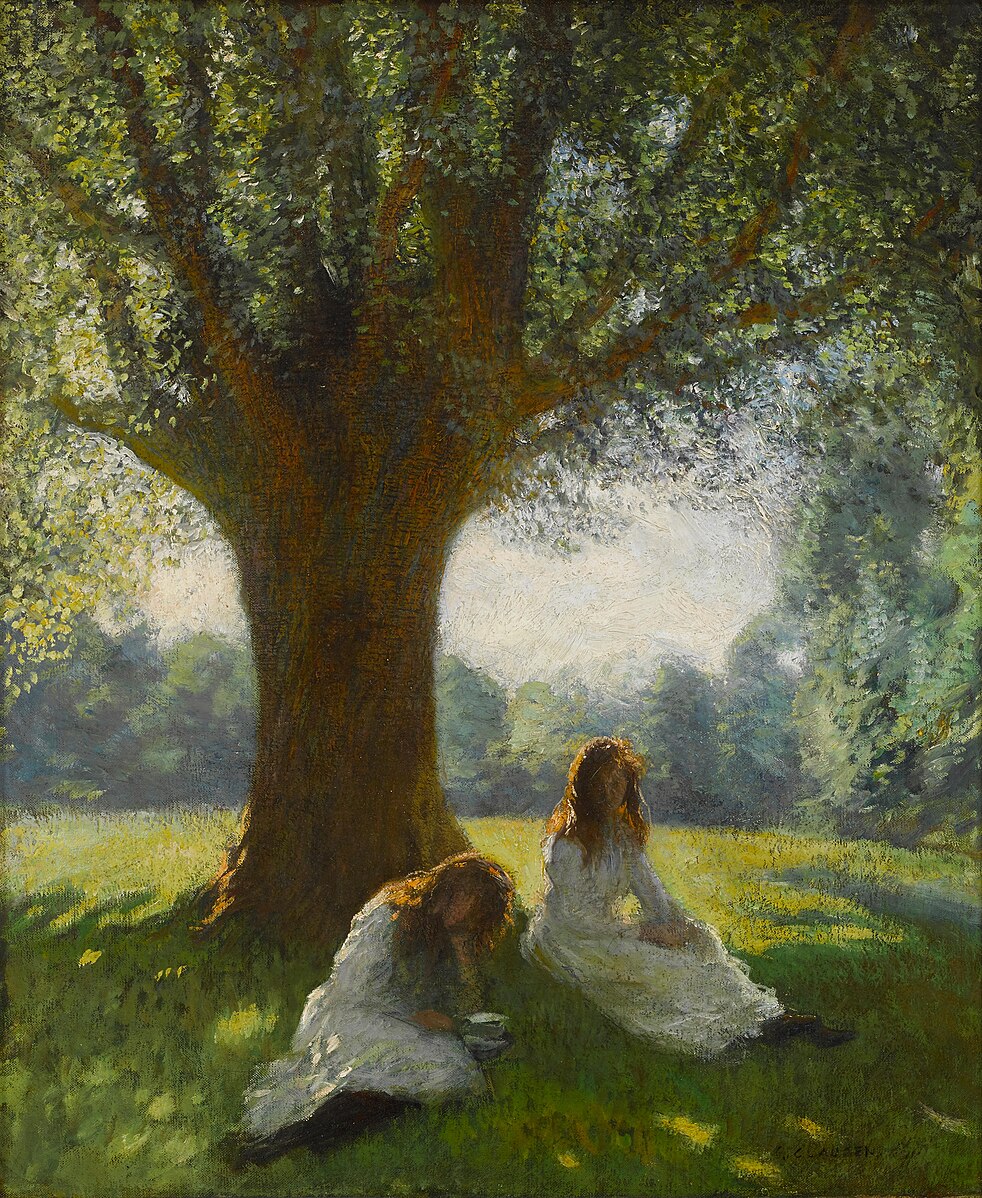
George Clausen’s The Spreading Tree brings the silence of two young girls together with pastoral tranquility beneath the shade of a great tree, using light and shadow to construct harmony between human beings and nature.
Source: Wikimedia Commons.
Pre-iconographic Level
Two young girls sit beneath the shade of a large tree with spreading branches. One leans against the trunk, while the other bends slightly forward and holds an object, possibly a container. Their long white dresses reflect the sunlight. In the background are a wooded area and an open sky. Light filters through the leaves of the tree and casts shadows onto the ground.
Iconographic Level
The scene presents a simple moment from everyday rural life: two young girls resting in the shade of a tree during the heat of summer. Yet the composition transforms this ordinary moment into an atmosphere of pastoral calm and serenity. The tree’s shade is not merely a shelter but also a space of silence. The white dresses evoke purity and innocence, while the shade gives the figures a more inward and contemplative presence.
Iconological Level
Clausen’s painting becomes a romantic and emotional expression of harmony between humanity and nature. The shade of the tree functions as a timeless zone of protection and silence. The young girls represent innocence and vulnerability preserved within nature’s embrace. The scene may also be read as a nostalgia for a pastoral life disappearing within a modernizing world, or as a memory of carefree childhood. The strong trunk and spreading branches symbolize permanence and protection, while the figures suggest transience and fragility. The painting therefore joins the continuity of nature and the temporality of human life within a quiet harmony.
Representation – Gaze – Void
Representation: The female figures are represented as passive, silent, and inwardly focused. Their bodies are shown in states of rest and contemplation. Nature, however, is positioned almost as an active subject; the trunk and branches dominate the painting and become its principal presence. The human figures are nearly absorbed into nature itself.
Gaze: Neither figure looks at the viewer. One bends forward, while the other turns aside. This absence of direct gaze does not invite the viewer fully into the scene but instead keeps us outside it. We become witnesses to the silence. The closed direction of the figures’ gazes creates the feeling that the viewer cannot completely enter the shaded space they occupy.
Void: The enormous tree trunk occupies the center of the painting, with the figures positioned beneath it. The open areas around them and the sky give the composition a sense of breadth. Yet because the figures remain in shade, the painting fills its open space with silence. Here, void belongs not to movement but to stillness and inward withdrawal.
Type – Style – Symbol
Type: Pastoral scenes appear frequently in Clausen’s art. This type presents nature not merely as the setting of everyday life but also as an emotional space.
Style: Impressionist brushwork is especially perceptible in the foliage and effects of light. The figures are carefully observed but not excessively idealized; their natural quality is preserved. The play of light and shadow becomes the principal dramatic element of the painting.
Symbol: The tree signifies permanence, protection, and the continuity of nature. Shade suggests silence, peace, and inward refuge. The white dresses evoke purity, innocence, and vulnerability. The meadow grasses suggest the transience of pastoral life and the vitality of the summer season.
Conclusion
George Clausen’s The Spreading Tree transforms an ordinary scene from a summer day into a timeless pastoral allegory. The silence and passivity of the figures are set against the strength of the tree trunk. The work thereby becomes an image of harmony constructed between the continuity of nature and the transience of human life.
While depicting everyday life, Clausen also creates a visual memory of the pastoral tranquility that was beginning to disappear within a modernizing world.
