









Sleep, Innocence, and the Fine Boundary of the Erotic
Introduction to the Artist and Context
Balthasar Klossowski de Rola, known as Balthus (1908–2001), was one of the most controversial and influential painters of the twentieth century. His art combines the classical figurative tradition with a modern language and is particularly known for scenes featuring young female figures. Balthus reinterpreted the compositional discipline of academic Realism through a modernist sensibility.
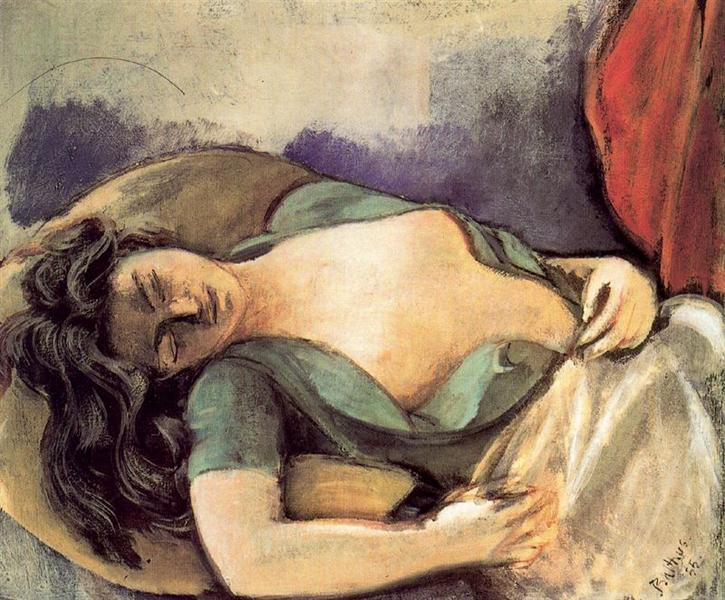
Study for the Dream I is a preparatory work made by the artist in 1935 for the well-known painting The Dream I. This study functions as a preliminary exploration testing the composition, arrangement of the figure, and emotional tone of the principal work.
Description of the Work
The composition shows a young woman sleeping while leaning against a soft pillow. She is lightly covered and wears a green short-sleeved garment, with part of her chest exposed. Her face is peaceful in sleep, her lips closed, and her hair falls in waves over her shoulder. The fingers of her right hand lightly grasp the covering. In the background, a neutral field dominated by soft pastel tones appears, while a reddish piece of fabric is visible along the right edge.
Composition and Use of Color
Central Balance:
The figure is positioned along a diagonal axis. The inclined posture of the head and torso conveys the looseness of sleep.
Color Palette:
The complementary contrast between the green garment and the red fabric establishes the warm-cool balance of the scene. The pastel tones of the background make the figure’s flesh more prominent.
Light:
Soft, diffused light defines the figure without sharp shadows. This gives the scene a timeless sense of calm.
Three-Level Analysis through Panofsky’s Method
a) Pre-iconographical Level
A young woman lies on a bed or divan, asleep and partially covered.
b) Iconographical Level
The sleeping figure has frequently been used in Western art as a representation of both innocence and the unconscious. The partially exposed chest creates an erotic association. The state of sleep establishes a tension between vulnerability and inaccessibility.
c) Iconological Level
What Balthus investigates here is the gap between the viewer’s gaze and the figure’s awareness. The figure is unaware of the viewer’s presence; this creates an experience of looking that is both intimate and observant. The themes of sleep, dream, and eroticism merge with the modernist period’s interest in the unconscious.
Representation – Gaze – Void
Representation
The figure is represented both as a sleeping young woman and as the materialized form of the painter’s metaphor of the “dream.”
Gaze
Because the figure keeps her eyes closed, there is no direct exchange of gaze with the viewer; this grants the viewer a one-sided privilege of “seeing.” This asymmetry of gaze is a recurring source of tension in Balthus’s work.
Void
The neutral and restrained background allows the figure to become the sole focus of attention. This void recalls the abstract, stageless atmosphere of a dream.
Art Movement and Technique
The work can be considered within modern figurative Expressionism. Balthus keeps the contours clearly defined while applying color transitions with a watercolor-like softness. Although this study does not contain the density of detail found in an oil painting, it already conveys the emotional effect of the main composition.
Cultural and Intellectual Reading
The 1930s were a period in which the influence of psychoanalysis on art reached a high point. Images of sleep and dream were regarded as gateways to the unconscious.
In this work, Balthus brings together the aesthetics of the female body and the inward state of dreaming. The figure’s vulnerability may appear both attractive and calming to the viewer; this is a dual feeling frequently encountered in the artist’s work.


