









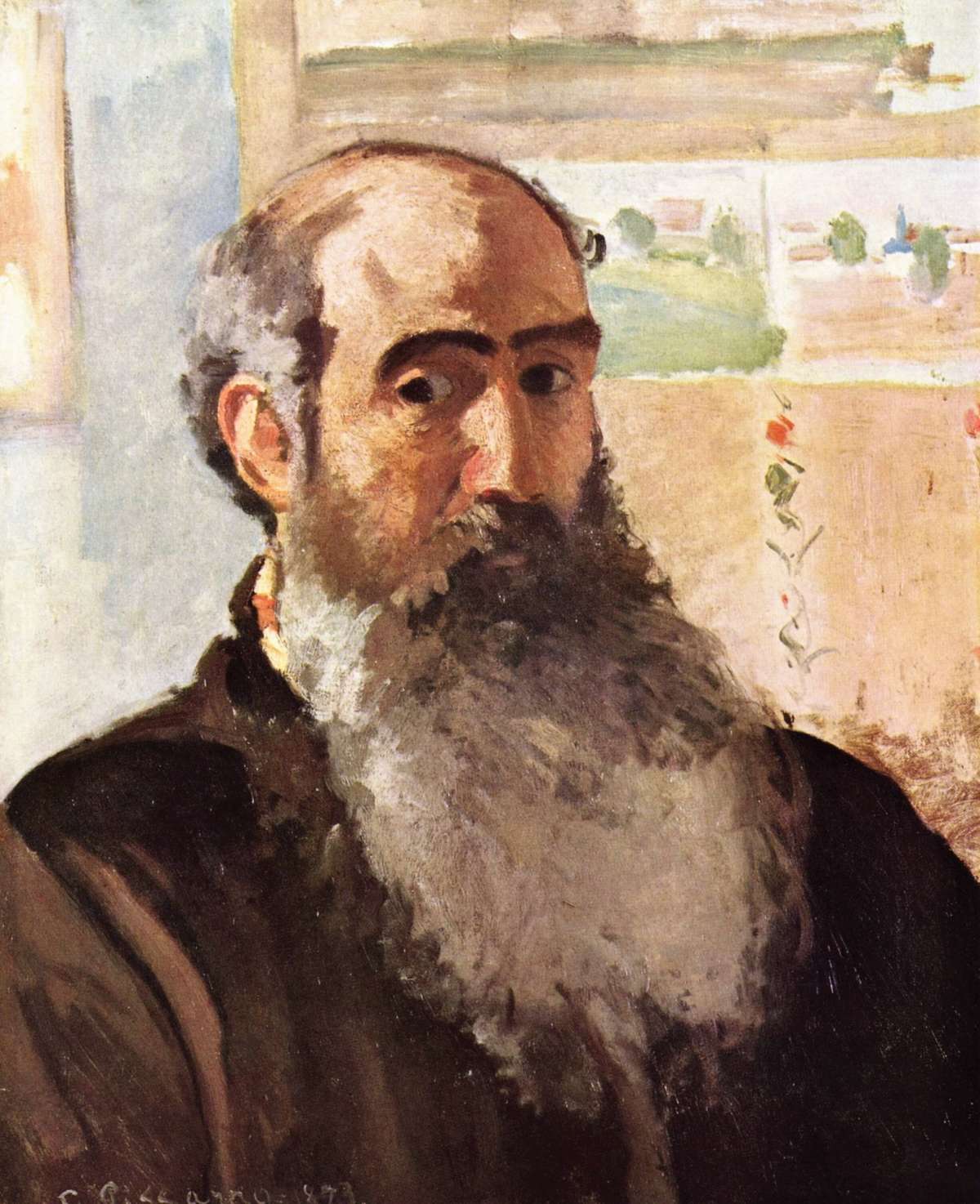
Born in 1830 on the Caribbean island of St. Thomas, Jacob Abraham Camille Pissarro was a unique figure not only because of his geographical origins but also because of his art, intellectual approach, and position within art history. Pissarro’s Jewish background, colonial past, and early exposure to cultural diversity formed the background to the humanistic, egalitarian, and observational approach to art that he would later develop. Although he was one of the founding figures of Impressionism, he never achieved the same level of popular recognition as Monet or Renoir. Yet Pissarro was not merely a painter; he was also a theorist, teacher, and philosopher of art who thought, debated, and developed ideas together with other artists.
Afro-Caribbean Neighbors and the Traces of His Early Years
Pissarro spent his childhood in the multicultural and multiracial environment of St. Thomas. Unlike many other European children, he attended school alongside Afro-Caribbean students and thus grew up outside rigid social divisions. This experience helped shape the anti-racist, socially conscious, and class-sensitive outlook that he would carry throughout his life. The same power of observation would later underlie his attention to peasants, workers, and the ordinary details of everyday life in his paintings.
At the age of twelve, Pissarro was sent to France, where he began his artistic education. In 1847, he returned to work with his family, but five years later he defied his father and left for Venezuela. This departure was more than a geographical change; it became a symbol of his belief in his own artistic journey and his search for freedom.
Rural Life and an Art Integrated with Nature
Pissarro’s approach to painting was never ostentatious or exaggerated. His concern was not to embellish nature but to understand and observe it, and to recreate it by capturing the transient effects of light. What distinguished him from Monet in this respect was his more systematic observation, quieter atmosphere, and more modest mode of expression. His paintings do not present dramatic scenes but rather peasants walking along paths, farmers plowing fields, and mist spreading across valleys.
In many of his works, people do not look toward the viewer but continue with their tasks. This gives his paintings a sense of witnessing, together with the inward calm of a passing moment. Allegory in Pissarro’s art is found less in direct symbolic representation than within the poetry created by light and atmosphere.
The Intellectual Foundations of Impressionism: Observation, Light, and Labor
In his early years, Pissarro was influenced by artists such as Jean-Baptiste-Camille Corot, Gustave Courbet, and Charles-François Daubigny. He naturally absorbed the lyricism of the Barbizon School’s treatment of nature, but soon moved beyond it toward the more unstable and transient character of light and atmosphere. Rendering the effects of light as they changed with the hour and weather was not merely a goal for him; it became an aesthetic ethic.
For Pissarro, light was not simply something that illuminated objects but a spiritual element determining the character of an entire composition. This understanding brought him close to the Impressionists. By the late 1860s, he had developed close relationships with painters such as Monet, Renoir, and Sisley. Although older than many of them, he communicated with them as an equal and became one of the intellectual centers of the group.
Pissarro and Impressionism’s Quiet Rebellion
Pissarro participated in the famous Salon des Refusés in 1863. From 1864 until 1870, however, his works were also accepted by the official Salon. This demonstrates that his art maintained a dialogue both with the Academy and with the movements that challenged it.
When the Franco-Prussian War broke out in 1870, Pissarro sought refuge in London. There he reunited with Monet and absorbed the misty effects of English atmospheric light. During this period, he also met the art dealer Paul Durand-Ruel, who would later become one of the principal supporters of the Impressionist artists.
Technical Experiments: The Turn to Pointillism and the Return
During the 1880s, Pissarro became interested in the new technique known as Neo-Impressionism or Pointillism, working alongside younger artists. His engagement with Seurat and Signac was particularly important during this period. Compositions constructed from small, separate points of color produced vivid optical mixtures when viewed from a certain distance. Pissarro referred to this method as “scientific Impressionism.”
Yet the technique conflicted with the inner rhythm of his practice, which was grounded in direct observation. After a period of experimentation, he returned to his more characteristic Impressionist approach. This episode remains important as evidence of his artistic courage and willingness to experiment.
Teacher, Master, Friend
Pissarro was not only a painter but also an influential teacher. Paul Cézanne and Paul Gauguin were deeply affected by his world of painting and thought. Cézanne’s move away from a muted palette toward brighter tones, and Gauguin’s inward journey toward understanding nature, both developed under Pissarro’s guidance.
Cézanne described him as: “Humble and colossal Pissarro, he was a father to me.” In an era when artistic ego was often dominant, Pissarro consistently defended a collective idea of art and continued to participate in group exhibitions despite financial difficulties.
Major Works
- “Hoarfrost” – The silence of nature in the morning hours and frost dissolving into light.
- “Boulevard Montmartre, Spring” – The crowds and movement of Paris approached through an Impressionist gaze.
- “The Harvest” – A tranquil yet labor-filled image of agricultural workers.
- “The Côte des Bœufs at L’Hermitage” – A pastoral panorama in Pontoise combining nature and human labor.
- “Woman Hanging Laundry” – A work that brings women’s domestic labor into visibility.
Across these works, rural and urban life come together through Pissarro’s observant, humanistic, and light-sensitive palette.
Pissarro’s Aesthetic and Ethical Legacy
Pissarro never pursued what happened to be fashionable. His art consists of paintings shaped by observation, free from ostentation, and grounded in an ethical core. Allegory remains quiet in his work, embedded within atmospheric compositions where nature, humanity, and light intertwine. Through Pissarro, Impressionism became not only a technical revolution but also a philosophical position.
Despite problems with his eyesight in the final years of his life, he continued to work productively. Shortly before his death, he wrote: “I have little time left. But I must continue to paint as long as I can see nature, in order to finish my life honorably.”
Camille Pissarro, who died on November 13, 1903, at the age of seventy-three, entered art history as the conscience, intuitive intelligence, and quiet leader of Impressionism.


