









Introduction to the Artist
Raphael is one of the most balanced and harmonious painters of the High Renaissance. In his art, figures are constructed not only through anatomical accuracy, but also through measure, serenity, soft transitions, and compositional clarity. Combining the influence of Leonardo’s sfumato, the calm order inherited from Perugino, and the Florentine understanding of the figure within his own language, Raphael establishes a powerful balance between ideal beauty and spiritual serenity, particularly in his scenes of Mary and the infant Christ.
Introduction to the Work and Composition
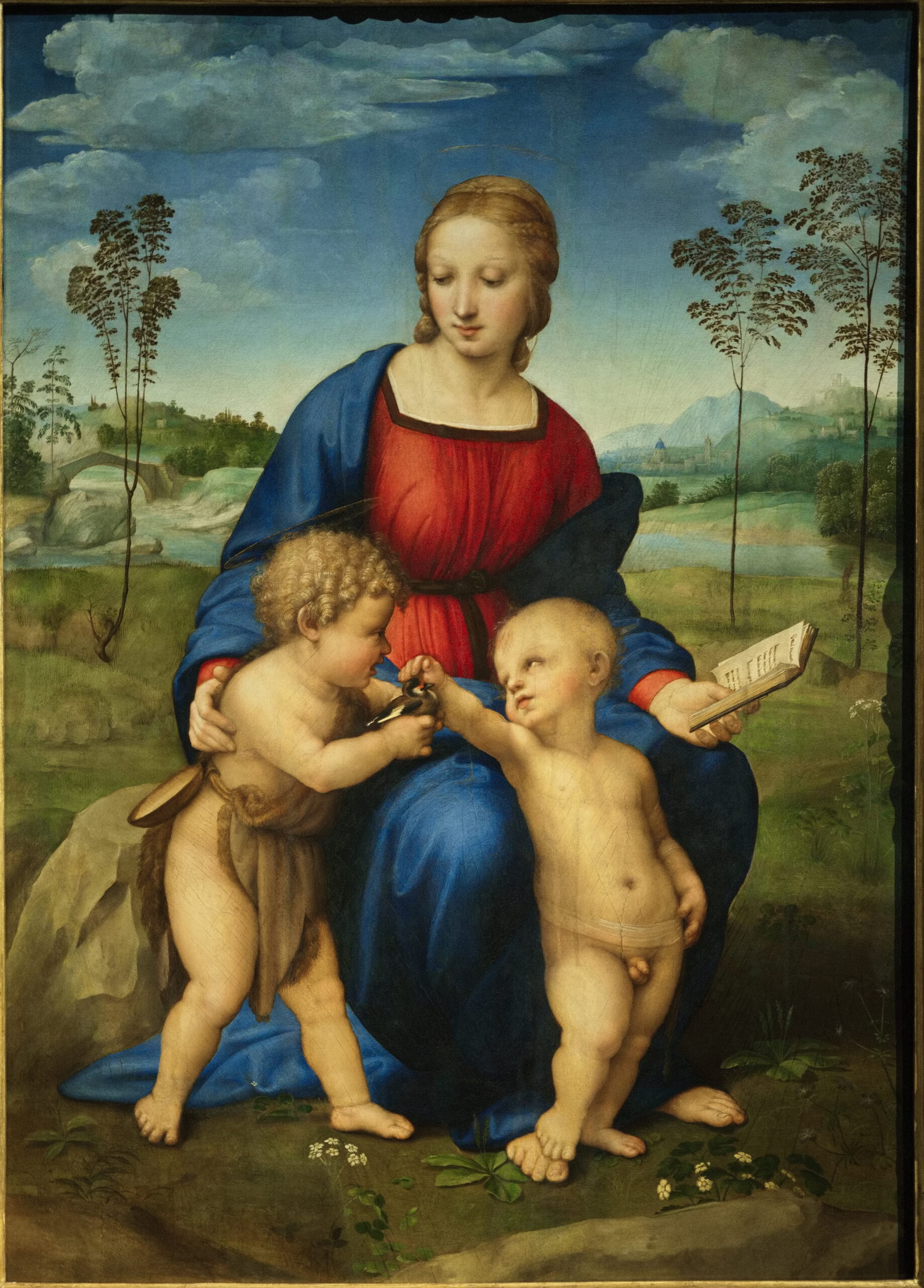
Madonna del Cardellino shows Mary and two children seated within an open natural landscape. Mary occupies the centre of the composition; through her red dress and blue mantle, she forms both its visual and iconographical axis. Her head is slightly inclined, and she directs calm attention toward the two children. She holds an open book in her right hand, while her left arm protectively embraces the young John.
On the left, the young John stands in a brown garment resembling animal skin. On the right, the infant Christ stands nude. A small goldfinch is held between the two children. John offers the bird to Christ, while Christ turns toward it attentively. This small movement is the emotional centre of the scene. Trees, a river, hills, distant mountains, and a cloudy sky appear in the background. Nature surrounds the figures without dispersing them. Everything serves the central relationship between the three figures.
Three-Level Analysis through Panofsky’s Method
Pre-iconographical
The painting shows a seated woman, two children beside her, an open book, a small bird, and a broad natural landscape. The woman is dressed in red and blue. One of the children is nude, while the other wears a brown, skin-like garment. The figures are placed beneath soft light within a balanced and serene arrangement.
Iconographical
The woman is Mary; the nude child represents Christ, while the child dressed in animal skin represents John the Baptist. In Christian iconography, the goldfinch is associated with the suffering Christ will experience in the future. The bird’s red markings traditionally evoke the Passion. The open book indicates Mary’s connection with wisdom, prayer, and sacred scripture.
Iconological
At a deeper level, the work is constructed upon the silent tension between maternal tenderness and knowledge of destiny. On the surface, there is an innocent game between children; yet this game already carries the narrative of future sacrifice. Mary’s calmness is not merely peacefulness, but a state of inward acceptance that knows destiny yet cannot prevent it. Raphael makes sacred drama visible not through theatrical suffering, but through serene beauty and measured sorrow.
Representation – Gaze – Void
Representation
The sacred family scene is represented as a moment of everyday intimacy. Mary is seated not upon an elevated throne, but within nature. The children appear not merely as divine symbols, but as living children within bodily closeness. This naturalness does not diminish the sanctity of the scene; on the contrary, it makes the sacred visible through human contact.
Gaze
The arrangement of gazes creates a closed circle among the three figures. Mary looks downward toward the children’s movement. John offers the bird to Christ, while Christ turns toward both the bird and John. The viewer observes this inward relationship from outside; the scene does not call to us directly, but silently places us in the position of witness. The gaze is therefore balanced between an object of devotion and familial intimacy.
Void
The broad landscape behind the figures provides the scene with an open space in which to breathe. The river, hills, and sky establish a calm world around the sacred group. Yet the true void lies in the temporal interval between the children’s game and the future Passion. The present moment is peaceful, but the symbol silently places future suffering within this tranquillity.
Style – Type – Symbol
Style
The work is characterised by soft modelling, balanced fields of colour, and a triangular composition. Mary’s red dress and blue mantle create a powerful yet harmonious colour contrast at the centre. The faces of the figures are formed not through harsh lines, but through soft tonal transitions. The background provides depth without allowing its details to disturb the priority of the figures. The rhythm of the composition is established through a calm triangular structure descending from Mary’s head toward the children.
Type
The fundamental type of the work is the “Madonna and Child” scene; however, John the Baptist is added to the infant Christ. The composition therefore becomes not merely a portrait of mother and child, but a three-figure sacred encounter that anticipates Christ’s future mission.
Symbol
The goldfinch evokes Christ’s future Passion and sacrifice. The book carries the ideas of sacred knowledge and destiny. Mary’s blue mantle can be associated with spiritual purity and protection, while her red garment can be connected with love and bodily suffering. John’s animal-skin garment anticipates his future identity as a prophet and his life in the wilderness.
Explicit Identification of the Art Movement
Madonna del Cardellino carries the characteristic qualities of High Renaissance painting. The ideal balance of the figures, the harmony between humanity and nature, the geometric organisation of the composition, and the presentation of the spiritual subject through measured beauty are fundamental features of this movement. Raphael constructs the sacred scene through harmony, clarity, and serenity without resorting to dramatic excess.
Conclusion
Raphael’s Madonna del Cardellino carries a great theological meaning within a small scene of childhood. Mary’s calm posture, the gentle movement of the children, and the open order of nature create a peaceful world at first glance. Yet the goldfinch places future suffering within this tranquillity. The painting therefore makes visible the silent balance between innocence and destiny, play and sacrifice, maternal tenderness and sacred fate. Raphael’s achievement lies in carrying this weighty meaning within a light, clear, and measured beauty.


