





Géricault and The Raft of the Medusa
The Raft of the Medusa depicts a real event that occurred after the French ship Méduse sank in 1816. A group of survivors struggled to remain alive upon a raft for thirteen days. Hunger, thirst, and despair drove some of the victims even to cannibalism. Géricault’s painting:
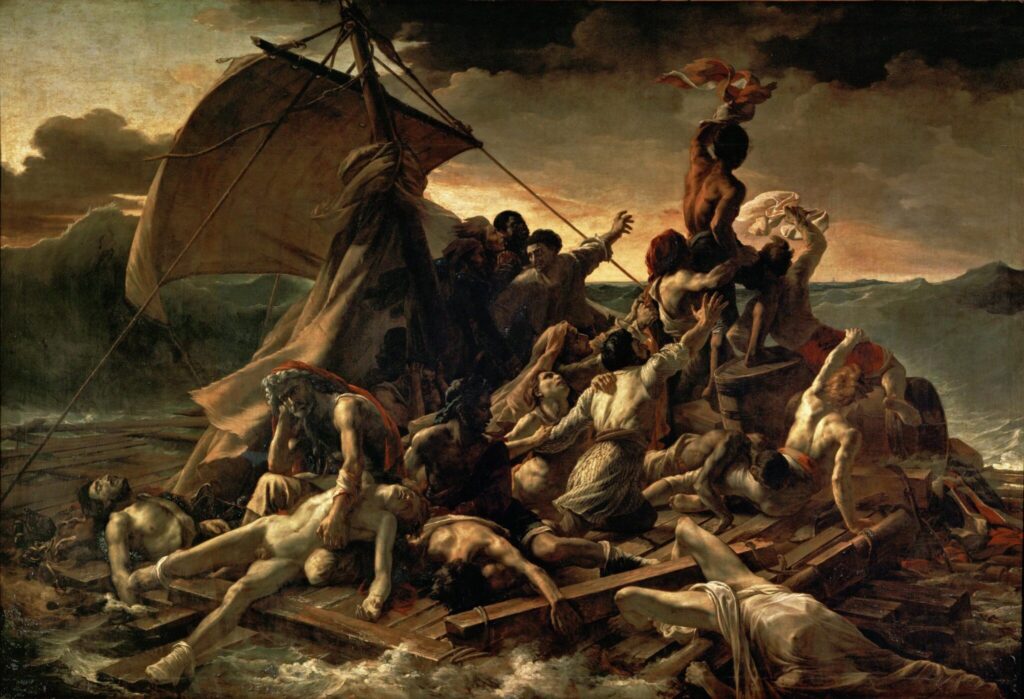
- Depicts the moment immediately before rescue,
- Arranges all the figures within a chaotic yet rhythmic order,
- Presents a ship visible upon the horizon in the background as a light of hope,
- Uses the figures’ body language to express tragedy, waiting, and hope simultaneously.
The painting is not merely a documentary representation of an event but also an expression of the Romantic period’s understanding of individual and collective catastrophe.
Titanic (1997) and the Staging of Social Tragedy

James Cameron’s Titanic is a contemporary example of transforming a historical disaster into a dramatic narrative. Throughout the film, the collective and individual effects of the maritime disaster are presented. Certain scenes in Titanic bear striking similarities to The Raft of the Medusa:
- People floating in the sea after the ship sinks,
- Crowded bodies attempting to remain above water,
- Rose and Jack struggling to survive upon a piece of wood,
- Hope and death existing within the same frame,
- The lights of the approaching rescue boat in the sky.
In terms of both composition and emotional content, these scenes contain clear references to Géricault’s painting.
Similarities in Visual Composition

- Both works position the figures upon a horizontal plane.
- At the centre of the composition lies the point where rescue and disaster intersect.
- The postures of the bodies vary between struggle, surrender, and expectation.
- The horizon is charged with hope but remains uncertain.
Thematic Parallels
Maritime disaster: Maritime accidents based upon real events and their tragic consequences.
Survival: The struggle carried out on physical, psychological, and social levels.
Social class: In Titanic, the destinies of the upper and lower classes differ, while The Raft of the Medusa is also structured through military hierarchy and injustice.
The postponement of rescue: In both works, rescue is not immediate but delayed and dramatised.
Powerful Scene Construction
The scene in Titanic depicting Jack’s death and Rose’s survival upon the piece of wood forms a direct connection with the figure standing upright at the furthest point of the raft in Géricault’s painting and looking towards the sign of rescue:
- Jack appears as though he were one of the lost figures upon the raft.
- Rose survives physically while also carrying psychological trauma.
- The scene bears witness to both an individual and a collective loss.
