




Introduction to the Artist
Gustav Klimt (1862–1918), a founding figure of the Vienna Secession, was the most influential painter of the “Golden Phase,” bringing the shimmering surfaces of Byzantine mosaics together with modern eroticism through the use of gold leaf. He relates the figure to pattern rather than sculptural volume, transforming the body into an event upon the surface through the flow of colour and motif. He treats the female image as a primary field where desire, dream, and the unconscious intersect.
Introduction to the Work and Composition Analysis
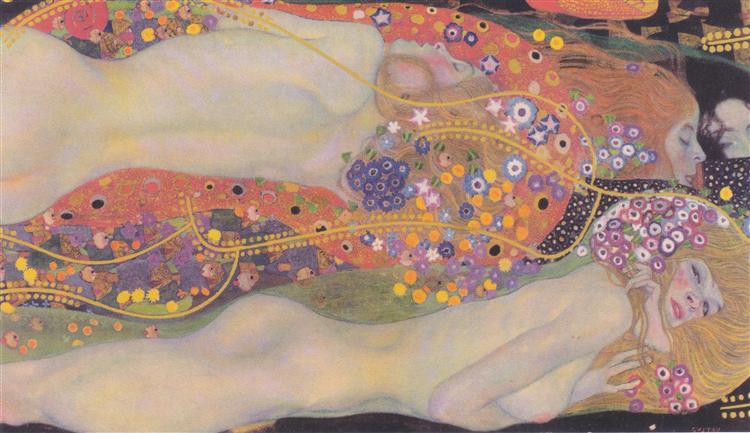
The canvas flows like a horizontal frieze. Three women move through the water in curving forms: the uppermost figure turns her back toward us, her pearlescent skin merging with the water; the central figure drifts toward the right with closed eyes, surrounded by a covering decorated with flowers and golden scales; at the far right, a blonde nude woman holding flowers turns toward us. A tension is established between the pale luminosity of the skin and the brilliance of the surrounding red-orange-gold ornament. Strands of hair and golden bands create a serpentine S-curve; surface replaces depth, and flow replaces perspective. Rather than acquiring realistic volume, the water becomes pattern through floral discs, star-like points, and splinter-like golden lines.
Three-Level Analysis through Panofsky’s Method
Pre-iconographical Level
Three women swimming in water; one with her back turned, another with closed eyes moving toward the right within a flower-covered field, and a third nude woman looking toward us. Floral and star-like discs, serpent-like curves, and fish-like details are scattered among them.
Iconographical Level
The title “Water Snakes” identifies the women with aquatic beings in an Art Nouveau interpretation of the nymph tradition. The arrangement of three figures establishes a scale of states: concealment/inwardness in the figure with her back turned, dream-like absorption in the figure with closed eyes, and recognition/address in the figure looking toward us. Hair and ribbons touching one another in the water carry a Dionysian sense of entanglement; rather than narrating a “story,” the figures diffuse a sense of duration.
Iconological Level
The work addresses the duality of the modern gaze: the seductive power of surface and the vulnerability of the body. The field of gold and ornament functions both as the brilliance of the bourgeois showcase and as the glittering mask of an economy of desire; the partial “absorption” of the figures by pattern suggests the dissolution of the subject’s boundaries within water. Klimt constructs water as an architecture of the unconscious and woman as the spirit of that architecture; nudity produces not exhibition, but the effect of a weightless inward immersion.
Representation – Gaze – Void
Representation
The body becomes visible not through sculptural modelling, but through the encounter between skin and pattern. The three figures do not reduce the female image to a single role; “hidden,” “inward-looking,” and “addressing” states coexist within the same flow. Flowers and golden points do not mark the skin, but speak with it as an equivalent visual language.
Gaze
As the eye is carried from left to right along the frieze, it passes through three modes of gaze: the unseen figure with her back turned, the inward figure with closed eyes, and the outward figure looking toward us. There is no sharp focal point; gaze moves from body to pattern and from pattern back to body. This back-and-forth movement keeps alive the question, “What am I seeing: flesh or surface?” and transforms the viewer from a passive voyeur into a wandering reader.
Void
The horizontal arrangement that eliminates depth leaves narrow intervals of water around the figures; within the flood of ornament, these intervals function as breathing spaces. The pale glow of pearlescent skin shines within this void and calls the bodies back out of the pattern; through this effect, the face of the rightmost figure looking toward us comes forward.
Style – Type – Symbol
Style
The work embodies the decorative aesthetics of the Vienna Secession: the effect of gold leaf, a supple rhythmic line, and the contrast between the cool pearlescence of skin and the warm red-orange-gold fields surrounding it. Layered surface replaces perspective; water becomes a mosaic-like weave.
Type
The work presents a modern interpretation of the mythological-allegorical “nymph/aquatic being” type and should be understood within Klimt’s horizontal ornamental frieze compositions.
Symbol
Water signifies the flow of the unconscious; serpent-like hair and ribbons suggest the circulating path of desire; floral and star-like discs refer both to aquatic vegetation and feminine fertility. The scattering of gold becomes the social showcase of desire, while the pearlescent skin suggests a fragile inner world beneath that spectacle. The sequence of three figures forms a line of inner transformation in which what is closed gradually opens toward recognition.
Explicit Identification of the Art Movement
The work belongs to Klimt’s Golden Phase within Art Nouveau / the Vienna Secession. It dissolves the distinction between figure and ground within the decorative surface, bringing the radiance of Byzantine mosaics and modern eroticism together upon the same plane.
Conclusion
Water Snakes II stages desire less as an event than as a current. Klimt transforms water into a psychological element and gold into a surface through which the gaze enchants itself. The progression of the three women—from back to face, from sleep to gaze—offers the viewer a silent route: the hidden, the inwardly withdrawn, and finally the figure who addresses us. Nudity here is not display, but an inward immersion woven through the enchantment of the surface; this is why the painting still appears contemporary—it slows the gaze rather than accelerating it and transforms what is seen into duration.
