









Motherhood, Interior Space, and Silent Contact Through an Impressionist Gaze
Berthe Morisot’s 1872 painting Le Berceau (The Cradle) occupies an exceptionally distinctive position in the history of Impressionist painting, both formally and thematically. The work can also be regarded as one of the symbols of women artists’ efforts to overcome the representational limitations imposed upon them within the patriarchal art world of the nineteenth century. It presents not merely a mother-and-child scene, but also a map of meaning constructed through the female gaze, everyday life, and inward sensitivity.
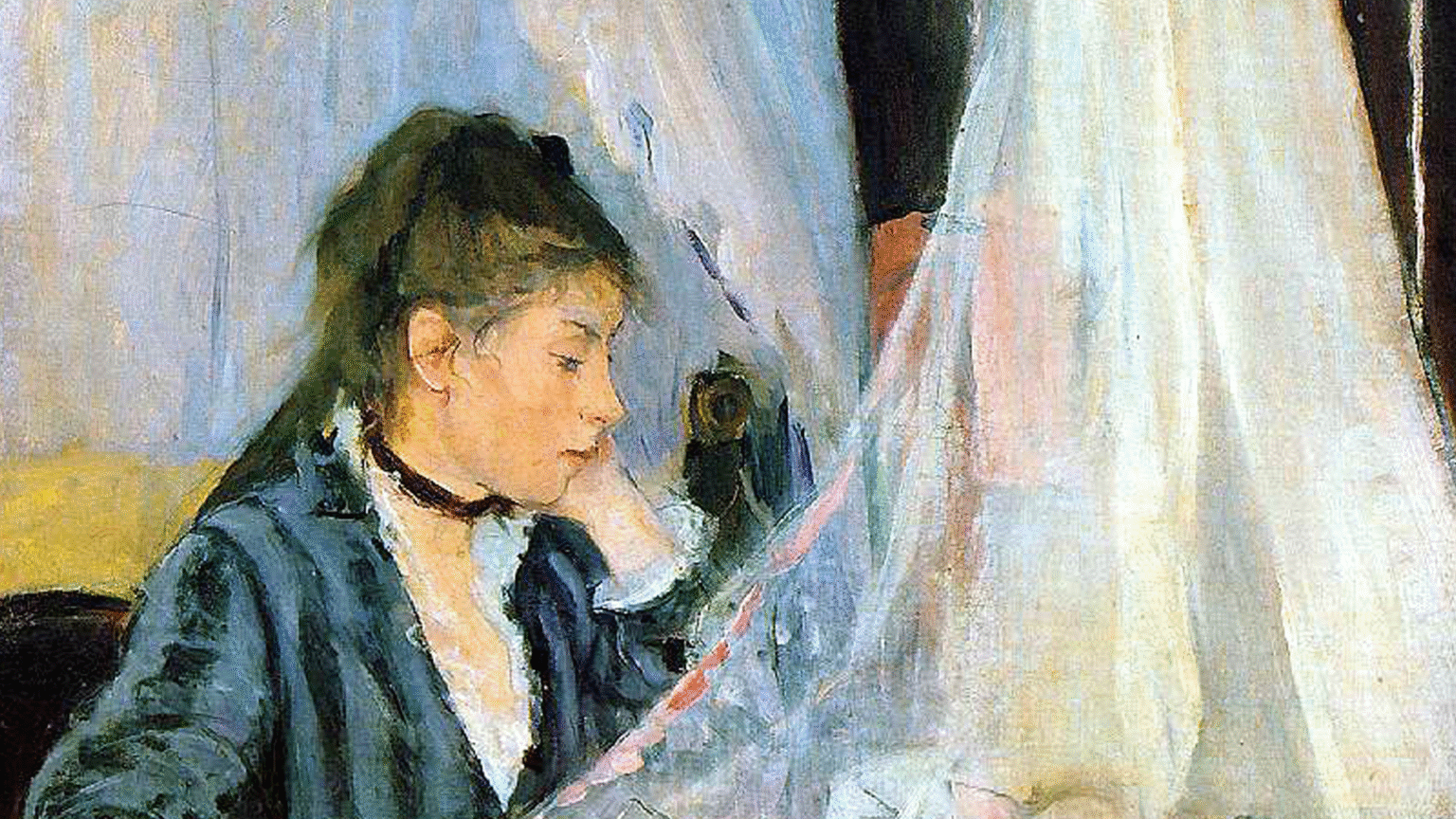
The scene in the painting is simple, yet it carries considerable emotional depth. A baby lies inside a cradle while a woman — probably the mother — watches in silence. Resting against her arm, her gaze is directed attentively toward the cradle and establishes no direct contact with the viewer. In this respect, the painting also transforms the direction and focus of the gaze: the figure is no longer someone being observed by the viewer, but an observer absorbed in another point of attention. This condition of withdrawal or redirected attention shows that Morisot avoids representing the female subject as passive. The figure exists within her own sensory integrity.
The use of light and color clearly displays the characteristic features of Impressionism. The delicacy of the gauze curtains, the soft transitions of light, the visible brushstrokes, and the near absence of firm linear definition all make the scene appear like a visual memory. Morisot’s palette is gentle, close to pastel tones, with a texture that does not strain the eye yet still demands attention. Colors and forms move through soft transitions rather than sharp divisions, emphasizing the naturalness of the scene.
Yet Le Berceau is not merely a scene of motherhood. It articulates an aesthetics of intimacy, tranquility, and care. The woman’s attention toward the child appears not as a demonstrative gesture but as an intense form of existential attachment. From this perspective, the painting can be read as an internal representation of female experience. The home and the roles associated with it are reinterpreted by Morisot not only as a social position but also as an affective space of existence.
Considering that Morisot exhibited alongside male Impressionists and struggled for recognition within the artistic sphere, Le Berceau can also be understood as a form of inward resistance. Within the limited range of subjects historically imposed upon women artists, Morisot presents her own experience through an original pictorial language. This transforms the painting from a simple mother-and-child representation into a scene of existence and a field of conceptual intensity.
Impressionism is generally defined through outdoor painting, nature, changing light, and observation. Morisot, however, offers an inward extension of this external naturalism. Light here does not illuminate nature but appears at the point where inner life intersects with time. The gauze curtains of the cradle carry more than visual delicacy; they also function as images of emotion, protection, and fragility.
In this context, Le Berceau is a work that pushes against, and even expands, the boundaries of Impressionism. It presents a scene in which the woman is both subject and creator. The gaze directed toward the baby is not merely an expression of affection but also an act of thinking, of remaining with another being. This draws the painting beyond aesthetic representation and into the field of existence.
Throughout much of art history, female figures have been represented as posed images staged for the male gaze. Morisot reverses this structure. Rather than inviting us simply to witness a woman’s everyday life, she opens a way of looking from within that woman’s world. Motherhood here appears not merely as a biological condition but as an ontological form of sensitivity.
Ultimately, Le Berceau is not only an important example of Impressionism but also a unique work in which a woman artist combines the aesthetics of the interior with the variability of the external world, renders intimacy visible, and gives meaning to silence. Morisot’s painting demonstrates how fully Impressionism could engage emotional and intellectual possibilities through both form and content. It is an image in which inward lyricism, the female gaze, and motherhood are transformed into visual thought.


