









Introduction to the Artist
Claude Monet (1840–1926) left a decisive mark on modern art history as one of the founding figures of Impressionism. Developing in France during the second half of the nineteenth century, Impressionism sought to observe nature directly, capture the changing effects of light, and break with the rigid compositional conventions of academic painting. Monet worked extensively en plein air, aiming to transfer the fleeting nature of visual perception directly onto the canvas.
By the mid-1860s, Monet was still a young painter, but he had begun to attract increasing attention within Parisian artistic circles. His travels along the Normandy coast during this period laid the foundations for the intensity he would later achieve in paintings of the sea and sky. Sainte-Adresse was a holiday location connected with Monet’s family, and he painted the area repeatedly. Beach at Sainte-Adresse belongs to this early period and already contains strong indications of his movement toward an Impressionist language.
Introduction to the Work and Composition
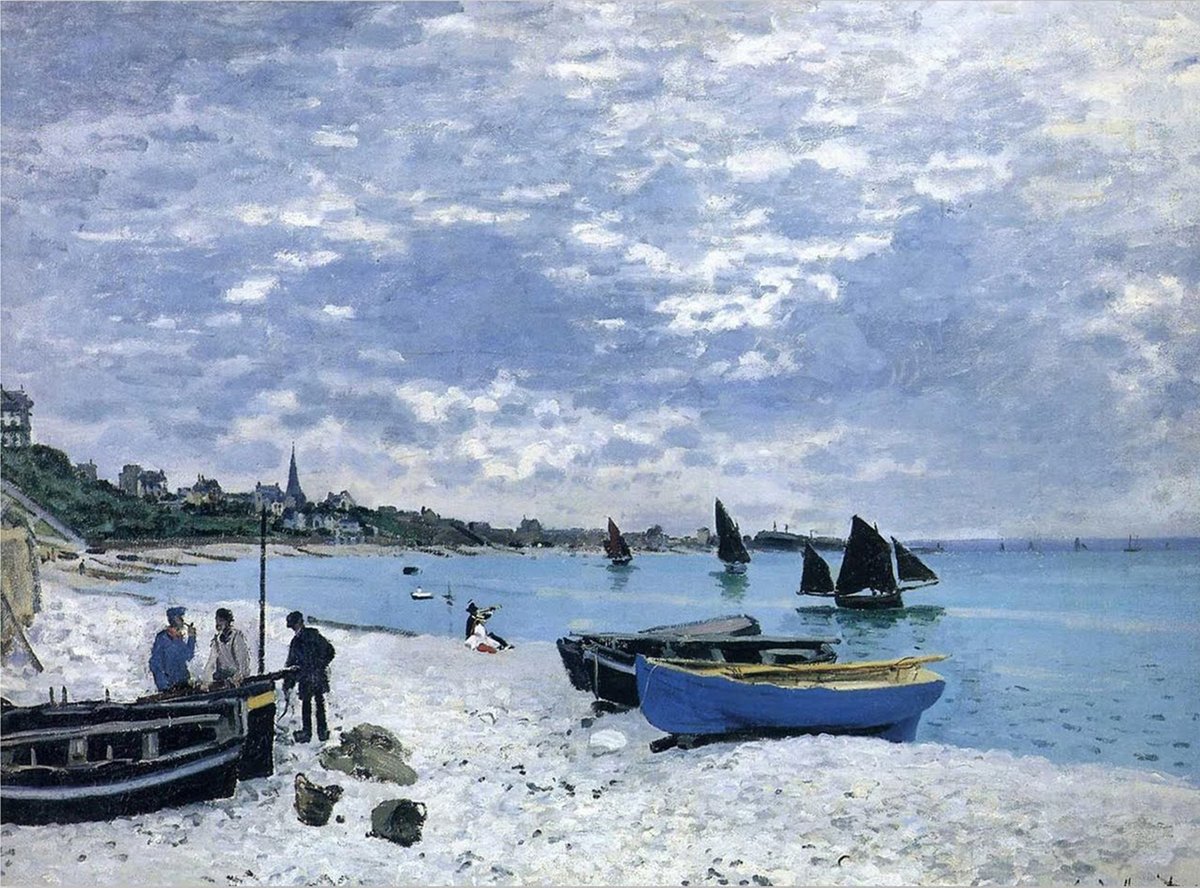
Beach at Sainte-Adresse depicts figures and boats gathered along the shore beneath an expansive sky. In the foreground, several fishermen and groups of people converse, while boats pulled onto the beach appear on the right. Farther back, sailing vessels move gently across the water. Dark sails advancing toward the horizon establish a visual rhythm with the cloudy atmosphere above.
One of the most striking features of the painting is the broad area occupied by the sky. Monet gives the sky almost as much importance as the sea and land. The movement of clouds, fractured light, and shaded areas introduce both depth and motion. The colors appear to have been observed directly from nature: blue sky, reflections on the sea, and pale beach stones continually shift under changing light.
Panofsky’s Three-Level Analysis
Pre-iconographic Level
At the level of direct observation, the painting presents a coastal landscape. People converse on the beach, boats rest on the shore, and several sailing vessels move out to sea. The sky is cloudy, though brighter openings can be sensed toward the horizon.
Claude Monet – Beach at Sainte-Adresse, 1867
Source: Wikimedia Commons.
Iconographic Level
The scene offers a fragment of everyday life in nineteenth-century France. Fishermen, boats, and people walking along the shore reflect both the socioeconomic structure of the Normandy coast and the emerging experience of modern leisure. For Monet’s contemporaries, such scenes could signify both the economic activity and cultural vitality of coastal towns.
Iconological Level
At a deeper level, the work expresses a transformation in modern visual consciousness. Monet abandons the grand mythological and religious narratives of academic history painting and places an ordinary beach at the center of artistic attention. This signals the growing legitimacy of nature and everyday life as subjects of modern art. The centrality of light and atmosphere points toward the transient and momentary character of human experience.
Representation – Gaze – Void
Representation: The figures on the beach are stripped of strong individual identity and appear almost as generalized types of people by the shore. This mode of representation emphasizes anonymity and the universal qualities of everyday life.
Gaze: None of the figures looks toward the viewer; each remains absorbed in their own activity. The viewer is positioned outside the scene as an observer. This reinforces an Impressionist attitude in which observation takes precedence over reciprocal gaze.
Void: The expansive sky forms the principal void of the composition. This open space determines the rhythm of the painting while diminishing the relative importance of the human figures and emphasizing the scale of nature.
Style – Type – Symbol
Style: Monet’s brushwork rejects the polished surface of academic painting. Rapid, lively, and at times loose strokes convey the vibration of light across sky and sea. This treatment anticipates one of the defining stylistic innovations of Impressionism.
Type: The figures on the beach function less as portraits than as social types: fisherman, seaside visitor, conversational group. These types reflect new forms of leisure and everyday modern life.
Symbol: Although the painting does not depend on a strongly symbolic narrative, the union of sky and sea can suggest the continuity of nature and the transience of human life. The dark sailing boats may also be read as images of movement toward an uncertain distance.
Conclusion
Claude Monet’s Beach at Sainte-Adresse is an important example of the artist’s early movement toward an Impressionist language centered on direct observation of nature and modern everyday life. Read through Panofsky’s method, the work reveals more than a simple coastal view: it reflects a new relationship between the modern individual, time, and space. The broad sky, dispersed gazes, and anonymous figures establish a tension between the transience of human experience and the continuity of nature.
The painting is both an early indication of Monet’s later investigations into light and atmosphere and a strong expression of Impressionism’s radical decision to place ordinary life at the center of artistic representation.


