




Introduction to the Artist
Edgar Degas (1834–1917) is regarded as one of the most important representatives of French Impressionism, although he preferred to describe himself as a realist observer rather than an Impressionist. He recorded the everyday life of Paris, studios, backstage environments, business life, and social scenes with careful observation. Degas incorporated the compositional logic of photography into painting and changed the direction of modern art through the natural way he captured movement and everyday moments.
In 1872, Degas travelled to the United States because of family connections and visited the cotton trading office of his relatives in New Orleans. The Cotton Office in New Orleans is his only major work centered on America and one of his most striking compositions devoted to the world of business.
Introduction to the Work and Composition
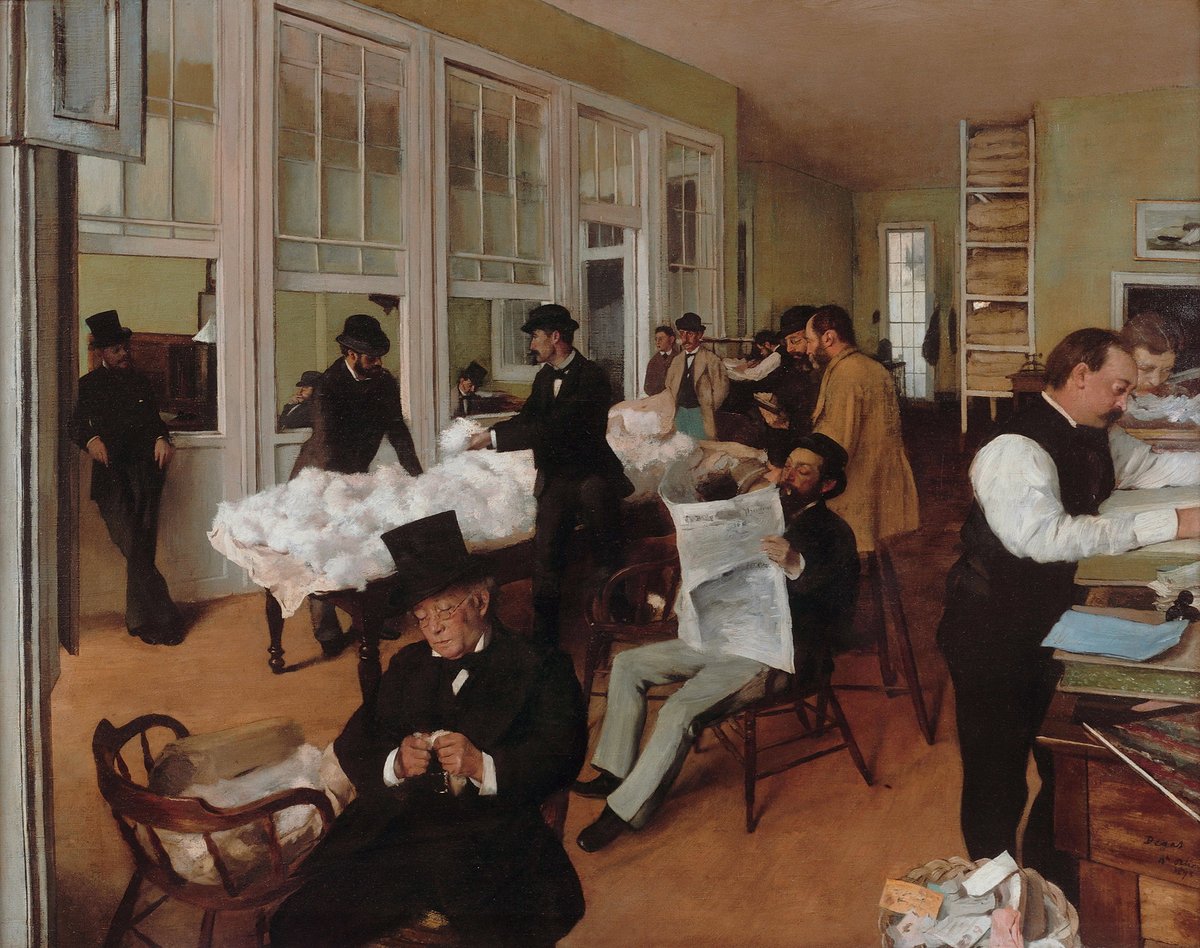
The painting depicts men involved in the cotton trade inside an office. At the center of the composition, several figures examine samples of cotton spread across a large table. In the foreground, an elderly man dressed in black carefully inspects cotton in his hands, while a nearby figure reads a newspaper. On the right, another employee is absorbed in account books. In the background, men engaged in different tasks reflect the everyday functioning of the office.
The large windows and depth of the interior give the scene natural light and spatial volume. Rather than idealizing each figure individually, Degas emphasizes the movement, work distribution, and organization within the office. In this sense, the painting functions both as a collection of portraits and as a sociological record of nineteenth-century commercial life.
Panofsky’s Three-Level Analysis
Edgar Degas’s The Cotton Office in New Orleans reflects modern office life and the economic world of cotton trading through a realist gaze, becoming one of the early major representations of business activity in modern painting.
Source: Wikimedia Commons.
a) Pre-iconographic Level
Male figures are shown working inside an office and engaged in different tasks. Some examine cotton, some read newspapers, and others work with accounts. Additional employees, documents, and cotton samples or bales appear in the background.
b) Iconographic Level
The scene represents a cotton trading office in New Orleans. Cotton stands at the center of the Southern economy of the period and remains one of the most important agricultural commodities in the post-slavery era. The office itself functions as a node within broader networks of commercial exchange.
c) Iconological Level
Through this painting, Degas presents not only a family-related scene but also the economic and social order of the nineteenth century. Cotton becomes a sign of modern capitalism and of the historical systems tied to its production and circulation. The men’s work, newspaper reading, and attention to ledgers indicate the order, calculation, and rationalization of modern business life. The painting therefore becomes not only an aesthetic record but also a visual document of new forms of work in an industrializing society.
Representation – Gaze – Void
Representation: Cotton, documents, and ledgers represent the economic structure of the period. The figures embody divisions of labor: the older man suggests experience, the employee working with accounts represents calculation and rationality, and the newspaper reader represents the circulation of information.
Gaze: No figure looks directly at the viewer; their gazes are directed toward their work or toward objects. This positions the viewer as an observer outside the scene. The office appears as though it has been seen without disturbing its everyday operation.
Void: The deep perspective emphasizes the breadth of the office. Windows and open areas in the background allow the space to breathe and let the viewer’s eye move across the scene. The intervals between figures reinforce the sense of division of labor and individual concentration.
Style – Type – Symbol
Style: Degas retains an Impressionist sensitivity to light, but here the brushwork is relatively calm and controlled. The palette is natural, and the circulation of light through the interior is conveyed through close observation. The composition is organized with the immediacy of a photographic moment.
Type: The figures embody different types within modern business life: the experienced merchant, the calculating employee, the reader following current information, the organizer of work. Together they form a collective type of the actors of modern commercial capitalism.
Symbol: Cotton signifies trade and the global economy. The newspaper represents information, news, and communication. The account book signifies rationality, record-keeping, and the organization of modern business.
Explicit Identification of the Art Movement
The work can be seen as a synthesis of Impressionism and realist observation. Degas retains the Impressionist interest in modern life and sensitivity to light while moving toward Realism through the controlled structure of the composition.
Conclusion
Edgar Degas’s The Cotton Office in New Orleans is more than an office scene; it is a visual record of nineteenth-century commercial life. It presents the economic importance of cotton, the division of labor, and the organization of the modern office through a realist gaze. By placing members of his own family within a broader economic structure, Degas moves beyond individual portraiture.
The Cotton Office in New Orleans stands out as one of the early and powerful representations of business life in modern art.
