




“The Ontology of Art and the Philosophy of Meaning Series” – Part 3 –
In the history of mythology, Mesopotamian thought is not only one of the oldest systems of belief; it is also one of the civilizations that established the first major ontological systems of being, power, and order. Sumerian, Akkadian, Babylonian, and Assyrian cultures constructed mythology not merely as a pantheon of gods, but as the ontological source of cosmic order and social power. Mesopotamian mythology is one of the earliest great intellectual laboratories through which humanity sought to understand its relationship with the universe.
The Ontological Beginning of Mesopotamia: Waters and Chaos
At the center of Mesopotamian creation myths lies the concept of the primordial waters. According to the Babylonian creation epic Enuma Elish, in the beginning there were:
- Apsu (Fresh Water)
- Tiamat (Salt Water)
These two primordial beings represent the origin of all gods and of the order of existence. The images of water here directly symbolize the field of potential being, the limitless source, and that which has not yet been differentiated. The metaphor of water as chaos forms the ontological foundation of Mesopotamian mythology.
The Construction of Cosmic Order: Enuma Elish and the Hierarchy of the Gods
New gods are born from Apsu and Tiamat. Yet the primordial order remains under constant threat. Disturbed by the activity of the younger gods, Apsu seeks to destroy them. In response, Ea (Enki) kills Apsu. Tiamat then creates forces of chaos—monsters, dragons, and giant serpents—in revenge.
The god who brings this chaotic struggle to an end is Marduk. By killing Tiamat, Marduk creates the cosmos from the body of chaos:
- The sky is formed from Tiamat’s divided body.
- The earth, mountains, rivers, seas, and stars are formed from Tiamat’s limbs.
- Humanity is created to serve the gods.
With Marduk’s victory, ontological order is established. This event, in which chaos is overcome and cosmic boundaries are defined, legitimizes the divine source of order and power within Mesopotamian thought.
The Ontological Principles of the Divine Order
Within the Mesopotamian pantheon, each god possesses a particular cosmic function and mode of being:
- An (Anu) → Sky and transcendence
- Enlil → Atmosphere, power, and law-giving order
- Enki (Ea) → Wisdom, water, and the life-giving flow
- Marduk → The king-god who defeats chaos and establishes order
- Ishtar (Inanna) → The dialectic of love, war, and fertility
- Nergal → The underworld and death
- Shamash (Utu) → The sun and the cosmic principle of justice
This ontological arrangement establishes not only the order of nature but also the metaphysical legitimacy of society and power.
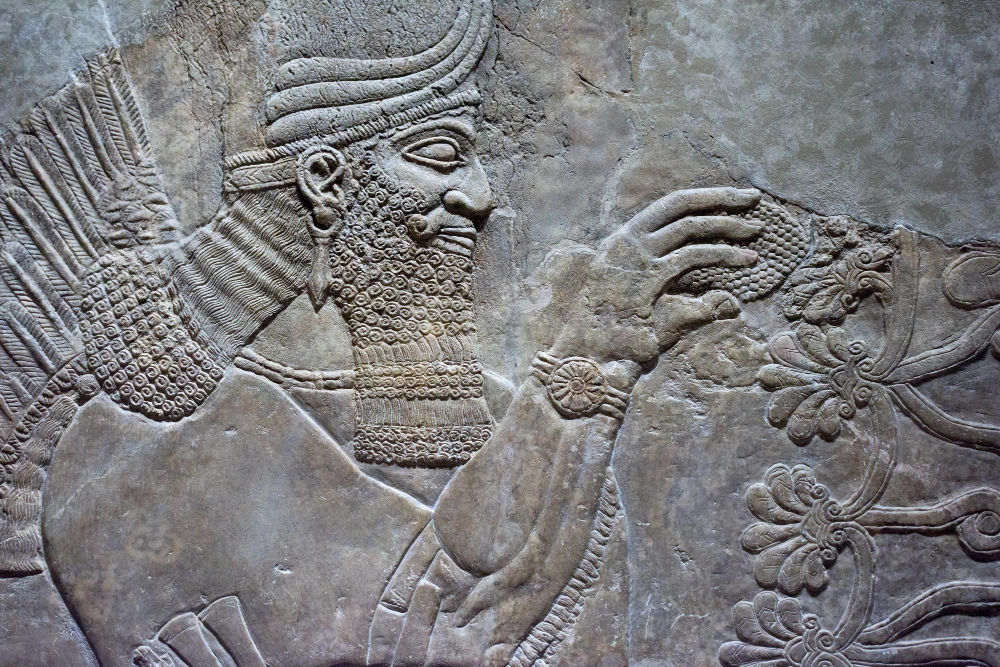
Ancient Babylonian and Assyrian sculpture from Mesopotamia.
The Ontology of the King: The Human–Divine Relationship
In Mesopotamian mythology, humanity is created as the servant of the gods. Yet the figure of the king (lugal) becomes an ontological intermediary between gods and human beings. The king:
- Represents the gods and acts as the ordering power on earth.
- Maintains balance against the continuing worldly threat of cosmic chaos.
- Sustains cosmic order through ritual, law, and justice.
The king is therefore not merely a political figure but a metaphysical mediator who preserves the order of being.
The Continuous Threat of Chaos and the Ontology of Ritual
In Mesopotamian mythology, the cosmos must constantly be established anew because chaos may return at any moment. Ritual is therefore not merely a religious obligation but a performative act through which ontological order is continually re-established.
- The Akitu (New Year) festival re-enacts the creation myth each year.
- Sacrifices balance chaotic energies.
- Divination keeps the continuity of order under observation.
Ritual here is the re-establishment of being through time.
Fate and Destiny in Mesopotamia: Tablets and Ontological Determination
The concept of fate (šimtu) holds great importance in Mesopotamian thought. The gods possess tablets of destiny that determine the fate of beings. This system:
- Represents the determined limits of existence.
- Provides the cosmic guarantee of power and order.
- Protects the ontological field from absolute contingency.
Fate here is not a fixed destiny but an ontological map of the order of being.
The Ontological Symbolic Language of Mesopotamian Mythology
Each symbol carries a density of meaning within the order of existence:
- Water (Apsu–Tiamat) → Chaotic primordial potential
- Serpent and Dragon (Tiamat’s monsters) → Chaotic dissolution and destruction
- Marduk’s Staff → Will and the power to establish law
- Sun (Shamash) → Justice and truth
- Mountain (Ziggurats) → Point of connection between celestial and earthly realms
These images are not merely narrative elements; they are ontological signs carrying the laws through which existence operates.
The Philosophical Depth of Mesopotamian Mythology
Mesopotamian mythology also contains early forms of philosophical thought:
- The opposition between being and non-being
- The conflict between chaos and cosmos
- The cyclical nature of time and the certainty of fate
- The metaphysical legitimacy of power
This system establishes a profound ontological foundation that would inspire the concepts of arkhē and logos in Greek thought, and the duality of void and being in Eastern metaphysical traditions.
The Persistence of Mesopotamian Mythology
Today, Mesopotamian mythology continues to survive across different layers:
- The Torah and sacred texts → Babylonian influence on creation narratives
- Psychoanalysis → Images of the unconscious and chaos
- Political theory → Primordial codes of the relationship between power and law
- Art and literature → Archetypal recurrence of the Tiamat–Marduk conflict
This continuity demonstrates that Mesopotamian mythology is not merely historical but one of the earliest prototypes of the ways in which human beings construct meaning in relation to existence.
The Ontological Core of Mesopotamia
Mesopotamian mythology is one of the first great ontological systems concerned with how being is established, how chaos is controlled, and how power is legitimized. Here, the gods are not merely divine figures but personified regulators of the laws of existence.
Chaos establishes the dynamic structure of being through its constant threat of return, while the king preserves this order on behalf of the gods. Mesopotamian mythology thus constructs one of the earliest great metaphysical maps of human existence.
