




Character Introduction
Tiamat is one of the oldest and most powerful figures of Mesopotamian mythology. The Enūma Eliš (the Babylonian Creation Epic) is shaped around a narrative centered on her. Tiamat is the personification of the salt waters, the feminine source of cosmic chaos. From her union with Apsu, the god of fresh waters, emerges the force from which heaven, earth, and the gods are born. For this reason, Tiamat occupies a contradictory position as both the mother who gives birth and the enemy of order.
Initially appearing as a fertile mother goddess, Tiamat becomes a vengeful force after Apsu is killed by the younger gods. To spread chaos across the world once again, she gives birth to terrifying creatures: dragons, monstrous serpents, scorpions, wild boars, and storm-producing beings. Eventually Marduk emerges from the younger generation of gods and fights Tiamat. He kills her with a great net and storm weapon, then divides her body in two: one half becomes the sky and the other the earth.
Tiamat thus becomes both the source of chaos and the “primordial body” from which the universe is created. This dual nature—the mother who gives birth but is herself destroyed—makes her unique within the history of mythology.
Cosmogony and the Details of the Myth
In the Enūma Eliš, the universe initially exists within two waters: the fresh waters of Apsu and the salt waters of Tiamat. Their union leads to the birth of the first gods: Lahmu, Lahamu, Anshar, Kishar, and later Ea and others. As the new gods multiply, however, noise, movement, and disorder enter the world. Apsu believes his peace has been disturbed and plans to destroy them. The god Ea kills Apsu through magic.
Apsu’s death enrages Tiamat. She transforms from a maternal figure into a warrior monster. She creates a vast army against the younger gods, appoints Kingu, her lover, as commander, and gives him the Tablet of Destinies. This tablet carries the power to determine universal order.
The younger gods, however, do not dare confront Tiamat. Eventually Marduk steps forward. He agrees to fight her on the condition that he becomes king of the gods. Marduk spreads his nets, uses his storm weapons, and fills Tiamat’s mouth with winds. After killing her, he divides her body in two: one half becomes the sky and the other the earth. The universe is thereby created. Humanity is then made from the blood of Kingu.
Tiamat’s defeat symbolizes the birth of order from chaos in Mesopotamian mythology. Yet at the origin of this order lies the fragmented body of a woman—the first feminine power.
Panofsky’s Three-Level Analysis
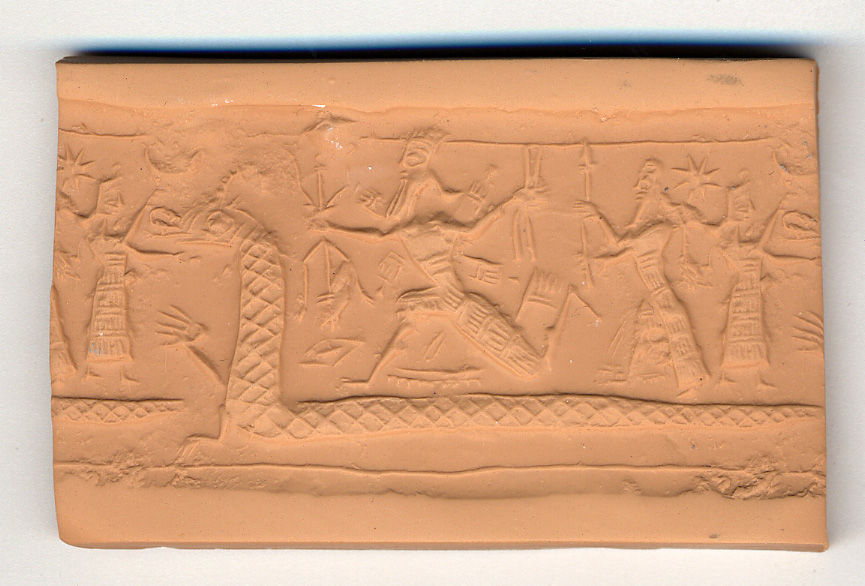
A Neo-Assyrian cylinder seal from the eighth century BCE, identified by various sources as a possible representation of the killing of Tiamat in the Enūma Eliš.
Source: Turkish Wikipedia.
Pre-iconographic Level
Tiamat appears in texts as a dragon, sea monster, or primordial feminine power; she is generally imagined as a gigantic figure fighting against Marduk.
Iconographic Level
– Salt waters: The source of boundlessness and chaos.
– Dragon / sea-monster form: Destructive supernatural power.
– Her creatures: The multiplying and contagious nature of chaos.
– The division of her body: The establishment of cosmic order.
– Tablet of Destinies: The laws of the universe and the symbol of power.
Iconological Level
Tiamat represents one of the earliest formulations of humanity’s opposition between chaos and order. She is both the mother goddess who gives birth and the destructive monster. At the iconological level, the myth of Tiamat symbolizes the idea that every order is founded upon an act of violence. The universe emerges from the dismembered body of a feminine power: this is both the victory of order and the unforgettable trace of sacrificed female power.
Representation – Gaze – Void
Representation: Tiamat is represented as both mother and monster. This dual representation gathers the productive and destructive aspects of nature within the same body.
Gaze: Tiamat’s gaze is not directed toward human beings; as a cosmic force, she challenges the gods. This gaze is not individual but universal.
Void: A striking void in Tiamat’s narrative concerns her personal emotions. She is defined neither through individual desires nor through human-like stories; she exists primarily through her function: the source of chaos and the raw material of order. This void suggests that she is less an individual deity than an archetypal principle of the universe.
Style – Type – Symbol
Style: Direct representations of Tiamat are rare in Mesopotamian art. Yet dragon and chaos-monster motifs—especially in Assyrian reliefs and seals—carry traces of her figure. In modern art and literature, Tiamat has been recreated in the form of multi-headed dragons.
Type: Tiamat is the first archetype of the “dragon / mother of chaos” type. Typhon and Echidna in Greek mythology, Leviathan in Christianity, Jörmungandr in Norse mythology, and Vritra in Indian mythology are variations of this type. All symbolize the defeat of natural chaos by order.
Symbol: Salt water, dragon form, the army of monsters, the dismembered body, the creation of heaven and earth, and the Tablet of Destinies are Tiamat’s most powerful symbols.
Comparisons across Mythologies
Tiamat’s story is not unique to Mesopotamia. Similar myths of the “chaos monster” appear in other cultures:
- Greek mythology: Zeus defeats Typhon.
- Norse mythology: Thor confronts Jörmungandr in the final battle.
- Hebrew tradition: God binds Leviathan.
- Indian mythology: Indra kills Vritra.
These similarities demonstrate that the struggle against chaos is a universal theme for humanity. In each culture, a hero or god defeats chaos and establishes order.
Explicit Mythological Context
Tiamat is the feminine goddess of salt water and chaos in Mesopotamian cosmogonies. The gods are born from her union with Apsu. After Apsu is killed, she becomes enraged, gives birth to monsters, and wages war against the younger gods. The god Marduk kills her, and her body becomes the universe.
Conclusion
Tiamat is one of the greatest archetypes of Mesopotamian mythology and of humanity’s collective unconscious. She is both the mother who gives birth and the destructive dragon. Her body lies at the origin of the universe; order is born from the fragmentation of chaos.
Tiamat continues to live in the modern world. She appears in literature, philosophy, and popular culture as the dragon of chaos. Yet the same message remains at the core of each interpretation: no order is established without paying the price of chaos.
