









Introduction to the Artist
William Merritt Chase (1849–1916) was one of the founding figures in American painting who combined European training with a local sensibility. He brought together the dark–light discipline and broad economy of brushwork he acquired in Munich with Whistler’s idea of color harmony; in studio interiors, portraits, and park scenes, he left space broad and concentrated detail only where necessary. In Chase, light is not a dramatic spotlight but the breath of paint: it allows the weight of fabric, the matte warmth of wood, and the translucency of skin to speak within the same palette. He was also an influential teacher and played a decisive role in establishing modern taste and decoratively conscious painting in New York.
Introduction to the Work and Composition
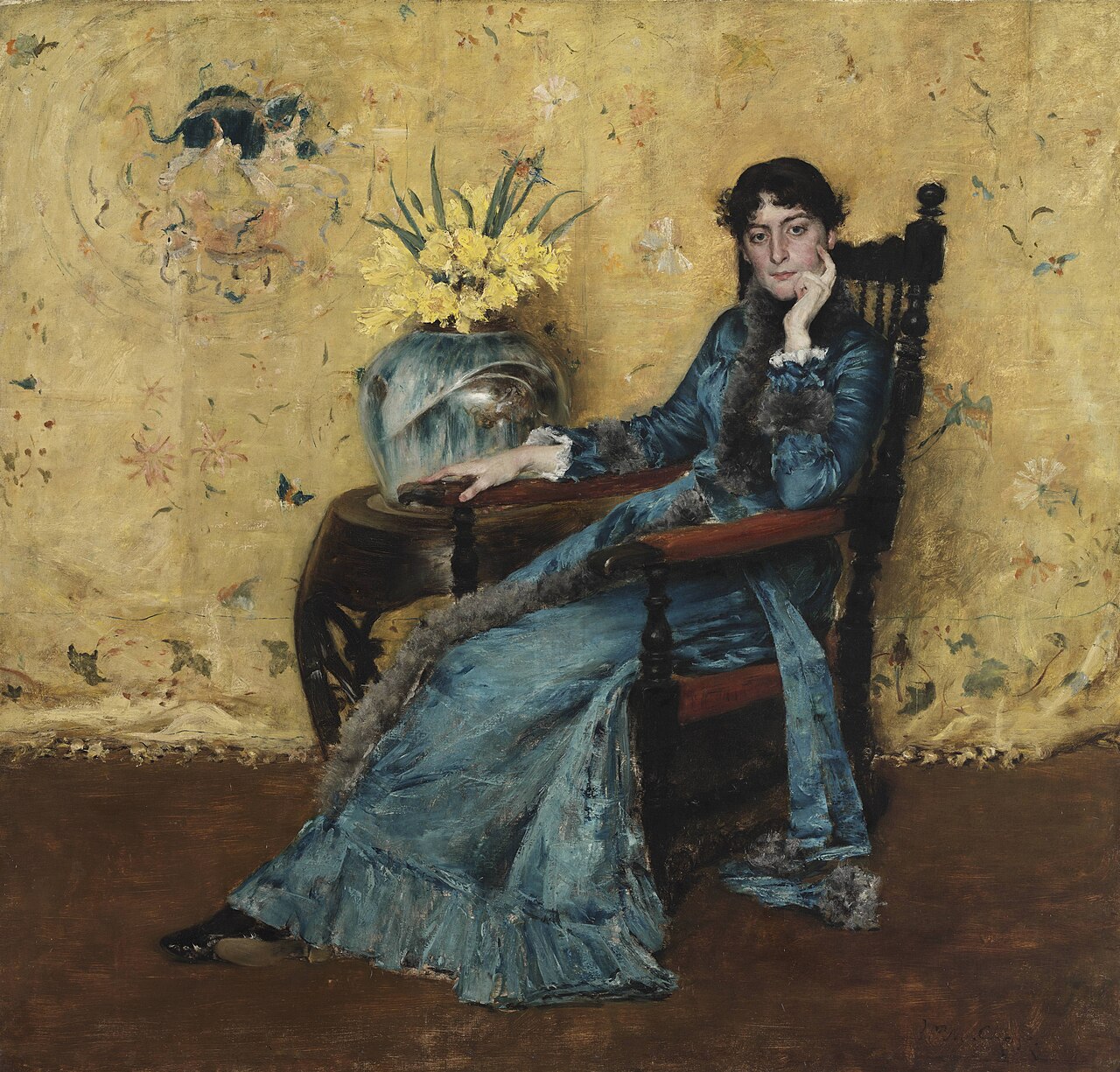
The model sits half-turned in a dark wooden armchair with high arms. Her left hand rests against her face—a small gesture opening toward thought—while her right hand lies loosely on the armrest. She wears a long dress in shades of blue trimmed with fur; the heavy folds of the fabric carry both the verticality of the figure and the relaxed inclination of the seated pose. The background is a warm, yellowish wall surface scattered with delicate Japanese-inspired motifs; on a round side table to the right, bright yellow daffodils bloom in a blue-green vase. The floor is brown, and the pointed tip of a black shoe anchors the calm lower edge of the composition.
The composition is structured through a two-field balance between the figure and the patterned background. The contrast between the blue dress and yellow wall creates a chromatic accord; the curve of the vase echoes the rhythm of the dress’s skirts. The lighter tones of the face and hands first draw the eye toward the pose, then toward the gaze itself. The patterned background is detailed but remains outside the primary focus; paint is scraped in places, thinly applied elsewhere, and left thick in others—the surface seems to breathe at different tempos.
A blue stillness before a yellow patterned wall: the hand supports the cheek, while the daffodils whisper freshness.
The chair is heavy, the gaze light; the portrait pauses within a quiet moment of thought.
Source: Wikimedia Commons.
Panofsky’s Three-Level Analysis
Pre-iconographic level: An armchair; a patterned yellow wall; a vase and daffodils on a side table; a young woman in a blue dress; a half-profile pose with her head resting on her hand. The color structure is based on a blue–yellow opposition; the brown floor and black shoe stabilize the lower edge.
Iconographic level: The portrait carries not only likeness but also posture and state of mind. The daffodils suggest freshness and vitality, while the patterned wall points to the cultivated decoration of the interior. The seated pose is relaxed but not disordered; the weight of the chair and the weight of the dress meet along the same line. The decorative background recalls the Aesthetic Movement’s principle of “beauty for beauty’s sake”; the model appears as a subject inhabiting this decorative world.
Iconological level: Chase constructs the “narrative of personality” in modern portraiture through color harmony. The coolness of blue and the warm diffusion of yellow turn the model’s balance of reason and feeling into representation: the thought is pensive but clear. The patterned background places the individual within a social–aesthetic environment; this environment suggests a productive culture of studio or home. The portrait leaves open a space for the public visibility of the urban woman after the Victorian period—a combination of authority and elegance: the hand supports the face, yet the figure remains in command of the scene.
Representation – Gaze – Void
Representation: Skin and fabric are painted at different speeds: the folds of the dress are thick and frictional; the face and hands are almost misty; thin applications on the wall create a sense of patina. The dark arms of the chair frame the model’s wrists linearly and carry the seriousness of the pose.
Gaze: The model does not look directly at the viewer; her gaze drifts slightly outward and upward. This displacement folds the viewer’s curiosity inward and creates the sensation of having encountered someone in the act of thinking.
Void: The wall is not crowded with objects; although patterned, it remains broad and uninterrupted. This expansive empty surface provides a field across which the psychology of the portrait can spread; the vase and flowers animate this void as a single accent.
Style – Type – Symbol
Style: The dark–light discipline of the Munich School merges with Whistler-like decorative simplicity. The brush is broad on the chair and clothing, delicate on the face, and creates a textural music across the background.
Type: A seated portrait in a modern interior—focused not on narrative but on state of being and the taste of the surrounding environment.
Symbol: The yellow patterned wall is not merely a background; it is a warm field across which thought spreads. The blue dress calms the figure without cooling her, suggesting composed intelligence and self-command. The daffodils are a small but concentrated sign of fresh awakening, perhaps of creative energy; the curve of the glass vase turns the movement of the inner world into a visual echo. The heavy arms of the chair resemble an authority that permits presence; rather than restricting the model’s wrist, they form a line that supports the pose.
Explicit Identification of the Art Movement
The work combines the decorative consciousness of the Aesthetic Movement with the surface-and-light sensitivity of American Impressionism. Japonisme is felt in the broad, ornamental arrangement of the background; yet the painting uses decoration not as an end in itself but as an environment. Chase transforms portraiture from a declaration of social identity into a space of character built through harmony of color and texture.
Conclusion
Portrait of Miss Dora Wheeler depicts not merely a person’s appearance but her state of being and the environment surrounding her. The accord between blue and yellow places the figure within the scene; the daffodils evoke clarity of mind as a small point of vitality. The weight of the chair is balanced by the lightness of the gaze; the broad wall surface becomes a quiet sea of thought. Chase constructs portraiture here as an agreement between personality and color within a decorative field—the viewer is left to perceive the calm rhythm of that agreement and hear its breath.


