




Introduction to the Artist
André Derain was one of the important figures positioned at the moments of rupture within early twentieth-century French painting. During his first period, he came to prominence through the bright and forceful chromatic language of Fauvism. He later turned toward the structural sensibility that emerged after Cézanne and toward a heavier, more massive construction of the figure.
Derain’s painting is therefore significant not only for its chromatic intensity, but also for the way it hardens the body and landscape. Nature is rarely merely a background in his figural works; it operates like part of the same material world as the body.
Introduction to the Work and Composition
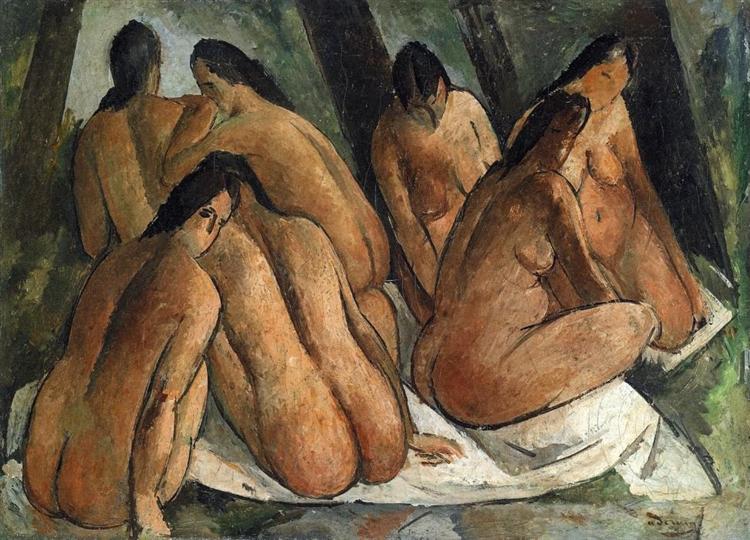
Bathers consists of six nude female figures positioned close together. A crouching figure appears near the ground in the left foreground, another large body close to the centre turns its back toward the viewer, two figures occupy the background, and two more women stand close together on the right.
Rather than opening separately, the bodies gather into a cluster. The composition creates the effect of a community of bodies rather than a narrative scene.
The figures assemble upon a piece of white fabric, while dark tree trunks and a green-brown natural environment rise behind them. The painting’s principal power lies in the merging of bodies and surroundings.
No figure is entirely independent. All exist within the same heavy, earthy, and enclosed atmosphere.
Three-Level Analysis through Panofsky’s Method
Pre-iconographical Level
The painting shows seven nude female figures gathered outdoors within a wooded area. Some crouch, some sit, and others turn away or lower their heads.
The palette is organised around earth tones, flesh colours, green, and dark brown.
Iconographical Level
The scene belongs to the tradition of the “bathers” in Western painting. It presents not merely nude women, but the established motif of female bathers positioned within nature.
Derain does not treat this subject through pastoral grace. Instead, the figures become an almost primitive and sculptural community of bodies.
Although water is not clearly visible, the scene can be understood as a figurative continuation of the bathing tradition.
Iconological Level
The work demonstrates that modern painting can no longer construct the body solely through ideal beauty and mythological lightness.
The women are not graceful, Venus-like figures. They are bodies brought closer to earth, trees, and matter.
The painting therefore considers the human body not as an object of beauty separated from nature, but as a presence as heavy and massive as nature itself.
Representation – Gaze – Void
Representation
The bodies are not represented within an erotic or narrative framework.
Rather than beautifying the figures, Derain gives them mass. Shoulders, backs, hips, and legs carry sensations of volume and weight instead of the softness of flesh.
The scene of women bathing consequently ceases to be a moment of pastoral pleasure and becomes an image in which bodies intensify within nature.
Gaze
Most of the figures do not look directly toward the viewer. Heads are lowered, faces turned away, or expressions closed.
The painting therefore offers no individuals who return our gaze. The viewer does not establish a psychological relationship with these bodies, but encounters their collective presence.
Gaze operates not through individual faces, but through the way the bodily blocks are positioned in relation to one another.
Void
Void is limited within the composition. The figures remain close to one another and to their surroundings, while the tree trunks intensify this compression.
The pale area of ground provides a brief space of breath, yet the general effect remains enclosed.
Void does not produce openness, but functions as a narrow interval that strengthens the dominance of bodily mass.
Style – Type – Symbol
Style
Derain’s language in this work moves away from Fauvist brilliance toward a heavier and more structural direction.
The colours are subdued, yet this does not weaken the painting. On the contrary, it makes the bodies more sculptural and material.
Line and patches of colour work together. The figures harden without dissolving.
Type
The women are not individual portraits, but collective figures belonging to the type of the “bather.”
This type, however, lacks the grace of the classical Academic nude. The bodies approach a rougher, denser, and more primal conception of the human figure.
Symbol
The tree trunks function not merely as natural elements, but as vertical counterparts to the bodies.
The white fabric creates a temporary field separating the figures from the ground. The principal meaning, however, emerges not through individual objects, but through the shared weight of bodies appearing to return toward earth and nature.
Explicit Identification of the Art Movement
The work is best evaluated as modern figurative painting: a bathing scene carrying a post-Cézanne structural sensibility and approaching Cubism.
Describing it as Cubist is not incorrect, yet the painting does not present fully developed Cubist analysis. Instead, it reveals an early hardening through which the body is transformed into mass and structural blocks.
Conclusion
Bathers is one of Derain’s important works in which the nude figure is removed from the classical order of beauty and carried into a heavier, more material, and more primal field.
The female body is not merely a visible form, but a presence experienced with the same density as nature.
The painting’s power lies precisely here: rather than making the nude lighter, it gives the body weight and transforms it into one of the fundamental problems of modern painting.
