









Introduction to the Artist
Charles Courtney Curran (1861–1942) was an American painter known especially for works in which female figures are depicted within nature. After studying at the Académie Julian in Paris, he returned to the United States and worked in art colonies around the Hudson River. In Curran’s paintings, the harmony between woman and nature frequently comes to the foreground; his figures are often shown in sunlight, surrounded by a sense of lightness and freedom.
Curran combined American Impressionism with Academic Realism and is also associated with representations of the relationship between woman and modernity. The Top of the World is one of his best-known works.
Introduction to the Work and Composition
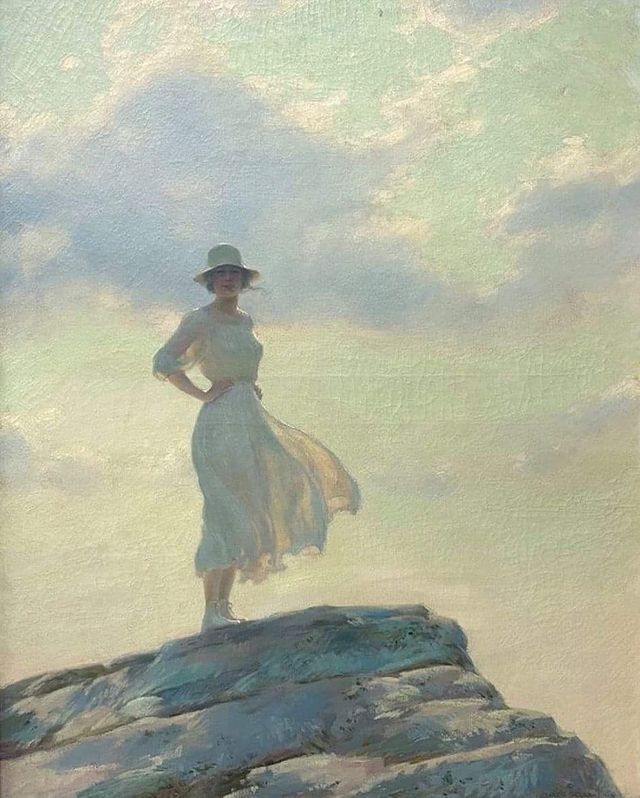
At the center of the painting, a woman stands on a rocky summit. She wears a light, flowing white dress that moves with the wind. A broad-brimmed hat rests on her head. With her hands placed on her hips, she stands with confidence.
The background is dominated by an expansive sky. Sunlight filters through the clouds, creating a luminous atmosphere around the figure. The woman seems almost to merge with the sky. The perspective is given from below rather than from above, making the figure appear elevated and difficult to reach.
The composition visualizes the freedom, strength, and integration with nature of a woman standing alone at the summit.
Charles Courtney Curran’s The Top of the World presents the woman standing at the summit as an allegory of modern freedom and individuality.
Source: Wikipedia.
Panofsky’s Three-Level Analysis
a) Pre-iconographic Level
A woman in a white dress and hat stands on a rocky summit. Behind her stretches a broad sky filled with clouds.
b) Iconographic Level
The female figure represents the free individual of the modern world. The whiteness of the dress suggests innocence, while the hat symbolizes the modernity of the contemporary woman. Her position at the summit visualizes the metaphor of “being on top of the world.”
c) Iconological Level
The work can be read in relation to early twentieth-century discussions of women’s freedom. Curran depicts the woman not as a passive object but as a subject commanding her place within nature. This reflects the changing position of women in modern American society. The figure is both innocent and powerful; she remains in harmony with nature while also appearing to master the elevated landscape around her.
Representation – Gaze – Void
Representation: The female figure represents the modern free individual, particularly the increasingly independent woman. Nature carries both difficulty and sublimity, while the figure’s presence transforms the summit into a space of self-possession.
Gaze: The woman does not look directly at the viewer; her gaze is directed toward the horizon. This suggests that her attention belongs to her own field of freedom rather than to the spectator. The viewer looks toward her with admiration but cannot intervene in her self-possessed position.
Void: The sky occupies a large part of the painting. This open field centralizes the figure and intensifies the sense of freedom. Standing alone at the summit, the woman becomes a symbol not of loneliness but of individuality.
Style – Type – Symbol
Style: Curran combines Academic Realism with an Impressionist understanding of light. The brushwork is soft, while the colors are clear and luminous.
Type: The woman represents the “modern woman” type: independent, strong, and in harmony with nature.
Symbol: The summit signifies freedom, achievement, and the condition of the modern individual. The white dress suggests purity, freedom, and lightness. The sky represents infinity and sublime elevation. The hat signifies modernity and an urban identity carried into nature.
Explicit Identification of the Art Movement
The work can be evaluated as a synthesis of American Academic Realism and Impressionist influence. Curran’s treatment of light and atmosphere is Impressionist, while the carefully rendered figure reflects academic discipline.
Conclusion
Charles Courtney Curran’s The Top of the World is not merely a landscape painting but also an allegory of the freedom and individuality of the modern woman. The female figure standing at the summit becomes a symbol of strength, confidence, and modernity joined with nature.
By allowing the white dress to move with the wind, Curran visually merges the figure with the sky. The woman is therefore represented not simply as part of nature but as a subject who has reached its summit.
The Top of the World becomes one of the most elegant images of female freedom in modern painting.


