




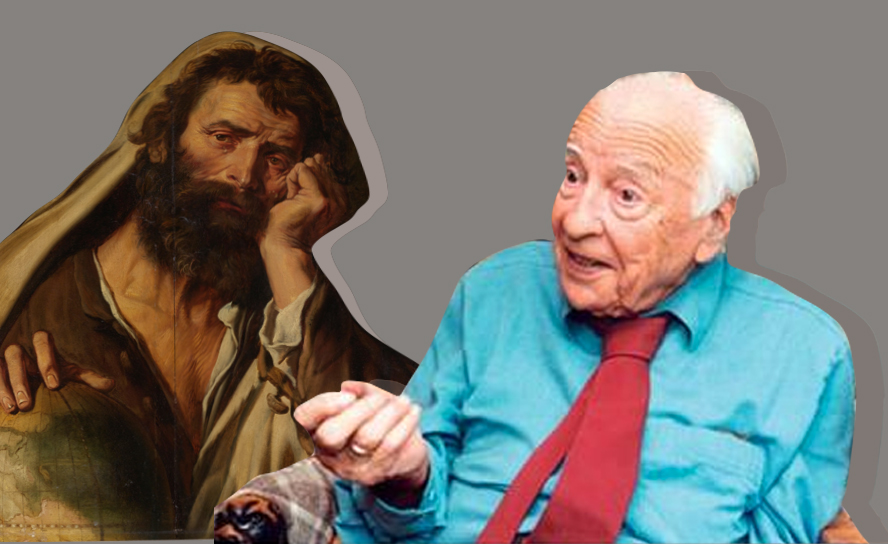
Hans-Georg Gadamer’s interpretation of Heraclitus begins with one of the fundamental problems of ancient Greek philosophy: how the relationship between being and becoming is to be understood. Heraclitus’ philosophy has often been identified with the idea that everything changes, while his famous image of the river has been interpreted as the principal expression of this doctrine. For Gadamer, however, the philosophical depth of Heraclitus lies not merely in demonstrating the continuity of change, but in attempting to understand how things that change and appear opposed to one another can belong to the same whole. The river, war and peace, hunger and satiety, sleeping and waking, life and death, and the kindling and extinguishing of fire are not independent examples. They offer different ways of understanding unity within multiplicity and order within change.
The difficulty of understanding Heraclitus is intensified by the fact that his work has not survived as a complete text. What remains consists of fragments preserved in the writings of Plato, Aristotle, and later ancient authors. Each fragment has been transmitted within the intellectual purposes of the work in which it was quoted. Rather than treating Heraclitus’ statements as isolated aphorisms, Gadamer investigates how they are connected through a common philosophical problem. From this perspective, the obscurity of Heraclitus arises not simply from an incomprehensible style, but from the way his thought compels us to consider apparently opposed realities together, beyond our habitual conceptual distinctions.
The Obscure Style of Heraclitus and the Historical Transmission of the Fragments
Heraclitus was known in antiquity as “Heraclitus the Obscure.” This designation was not merely a consequence of his difficult language. The density of his statements, the unexpected relationships he established between words, and his ability to bring opposing meanings together within a single expression make his writings especially demanding to interpret. Gadamer nevertheless rejects the assumption that this style proves that Heraclitus composed a collection of independent aphorisms. He argues that Heraclitus must have developed an intellectually coherent text rather than merely assembling a succession of brief sayings.
One of the important grounds for this interpretation is Aristotle’s quotation of the opening sentence of Heraclitus’ work. The first fragment introduces the failure of human beings to understand the logos. Its opening can be rendered in English as follows: “Of this logos, which exists forever, human beings remain without understanding, both before they have heard it and after hearing it for the first time.” Aristotle, however, draws attention to a grammatical ambiguity concerning the placement of “forever.” Does the word describe the logos as eternally existing, or does it indicate that human beings are perpetually unable to understand it? Both interpretations are grammatically possible and can alter the philosophical emphasis of the statement.
Gadamer connects this ambiguity with the reading practices of antiquity. In the ancient Greek world, texts were not written according to modern conventions of punctuation, and written language frequently acquired its meaning through oral reading. Pauses, emphasis, and the rhythm of a sentence played an important role in conveying meaning. The historical account of Augustine’s surprise at the ability of Ambrose, Bishop of Milan, to read silently illustrates the difference between ancient and modern habits of reading. For Gadamer, the opening sentence of Heraclitus reveals the importance of the relationship between the interpretation of written language and the hearing of living speech.
The principal difficulty in interpreting the fragments, however, lies in the circumstances of their transmission by later thinkers. When an author quoted Heraclitus, the quotation was often intended to support the author’s own position or to criticize another argument. The context in which a fragment has survived may therefore differ considerably from the original context of Heraclitus’ thought. Gadamer consequently emphasizes a fundamental principle of interpretation: to understand a quotation, one must first ask why it was quoted and within what intellectual context it appeared. Merely arranging the fragments in succession risks separating them from the historical and philosophical relationships that originally gave them meaning.
The problem introduced in the first fragment is therefore more than a linguistic difficulty. The failure of human beings to understand the logos, even when it is presented to them, shows that philosophical knowledge cannot be reduced to the accumulation of statements one has heard. The problem raised at the beginning of Heraclitus’ work opens onto the central concern of his philosophy: human beings experience the events of the world, yet struggle to comprehend the order within which those events belong.
Logos: Understanding That All Things Are One
At the center of Heraclitus’ philosophy stands the concept of logos, whose meaning cannot be exhausted by the English equivalents “word” or “reason.” Logos brings together a broad range of meanings, including discourse, explanation, account, proportion, and intelligible order. In Gadamer’s interpretation, its importance lies in the relationship between the intelligible structure of the world and the language through which that structure is expressed. Human beings live within this order, yet do not always understand it. Their difficulty arises not because reality conceals itself completely, but because they often regard the events they encounter as separate and independent realities.
Fragment 50 provides one of the clearest expressions of this thought: “Listening not to me but to the Logos, it is wise to acknowledge that all things are one.” Here the personal authority of the philosopher recedes into the background. Heraclitus does not ask his listeners to accept his statements merely because he has spoken them; he directs their attention toward the reality expressed through his words. Wisdom is not attached to the personality of the speaker but to the understanding of the common order that the speaker attempts to articulate.
The assertion that “all things are one” establishes a fundamental distinction in Heraclitus’ philosophy. Unity, however, does not mean that differences disappear or that multiplicity is merely an illusion. The problem concerns how different things belong together and how apparently opposing conditions acquire their meaning within a single reality. Night and day, war and peace, hunger and satiety can be distinguished from one another, but this distinction does not establish their complete independence.
In Gadamer’s reading, logos should therefore not be understood as a motionless principle placed in opposition to change. It concerns the intelligibility of the order constituted by changing events. Through different examples, the fragments of Heraclitus repeatedly return to the same philosophical question: Is it possible to understand things that separate from one another not merely through their differences, but through the unity that relates them? This question distinguishes Heraclitus’ philosophy of becoming from a simple doctrine of perpetual change.
The River Paradox: Continuity Within Change
The image of the river is among the best-known expressions of the relationship between becoming and unity in Heraclitus’ philosophy. Fragment 12 states: “Upon those who step into the same rivers, ever different waters flow.” The statement turns on the fact that a river remains recognizable as the same river even though its waters are continually changing. The water changes at every moment, yet this change does not eliminate the river’s recognizable identity.
Gadamer regards the later tendency to understand Heraclitus exclusively as the philosopher of flux as an incomplete interpretation. If the river image is used merely to demonstrate that everything changes, the central philosophical problem is overlooked. The river that remains the same despite its changing waters reveals that change and continuity cannot be entirely separated. A river is not a motionless object existing independently of the waters that flow through it; flowing belongs to its mode of existence. At the same time, the continuity of this flow makes it possible for the river to constitute a recognizable whole.
In this example, change and identity are not simply two mutually exclusive conditions. The river’s identity does not depend on the permanence of its particular waters. On the contrary, its existence as a river is inseparable from their continuing movement. The difficulty of Heraclitus’ thought consists in understanding this relationship without imagining either a permanence entirely independent of change or a change entirely deprived of continuity.
The river image therefore raises a fundamental question about attempts to explain being exclusively through immutability. Does the continuity of something require all its elements to remain unchanged, or can a stable relationship among changing elements also make continuity possible? For Gadamer, Heraclitus’ understanding of logos and unity opens the way toward this second possibility.
The Unity of Opposites: War, Peace, Hunger, and Satiety
Gadamer gives particular importance to the relationship between war and peace when explaining Heraclitus’ understanding of the unity of opposites. When war begins, everyday life, collective purposes, and social relationships undergo profound transformations. Forms of conduct that appear ordinary in peacetime acquire different meanings, while shared danger reorganizes relations among human beings. Yet the opposition between war and peace does not mean that they are entirely unrelated within the broader reality of human existence.
Drawing upon the experiences of his generation during the two world wars, Gadamer recalls that shared danger could produce powerful forms of solidarity. Under wartime conditions, people sometimes assisted one another, accepted common responsibilities, and developed strong bonds of mutual obligation. At the same time, failures of solidarity and instances in which individuals neglected their responsibilities toward others were also evident. These observations do not imply that war possesses a positive value. The point is that war and peace cannot be understood as completely disconnected conditions of human life.
The danger of war and the task of preserving peace belong to the same historical existence. Peace is not merely the absence of war; it is a structure of relationships that must be maintained and protected. War becomes intelligible through the destruction or disruption of such relationships. Opposites are therefore understood in relation to one another. The unity Gadamer discovers in Heraclitus does not abolish the opposition between them, but concerns their interdependence within human life.
The example of hunger and satiety demonstrates a similar relationship. Food has a different meaning for someone who is hungry than for someone who is already satisfied. Hunger increases the attraction of food, while satiety can diminish it. Hunger and satiety are therefore not simply two mutually exclusive bodily states; they are related aspects of the same vital process, each helping to determine the meaning of the other. In Gadamer’s interpretation, Heraclitus does not merely define opposites conceptually but shows how they belong together within ordinary experience.
The thought attributed to Heraclitus by Plato, according to which what separates within itself also comes together with itself, is important in this context. Gadamer regards Plato’s direct acquaintance with Heraclitus’ work as a significant historical resource for interpretation. Nevertheless, Plato’s account is not independent of his own philosophical concerns. The example of the barley drink, whose ingredients separate when it is not stirred, also illustrates the importance of movement. Stirring prevents the elements from settling apart and keeps them together. Unity is maintained here not by eliminating movement, but through its continuation.
These examples demonstrate that Heraclitus does not treat opposites merely as logical contradictions. Opposing conditions are connected within vital, natural, and historical processes. The unity of Heraclitus is not an abstract identity situated outside these processes.
Sleep, Wakefulness, and Death: Unity at the Boundary of Life
Heraclitus’ reflection on opposites becomes a more profound problem when it reaches the relationship between life and death. Gadamer turns here to one of the most familiar experiences of human existence: sleep. Every day, human beings pass between wakefulness and sleep, yet the ordinary character of this transition does not mean that it has been fully understood philosophically. A sleeping person remains alive, but the relationship established between waking consciousness and the world is transformed. Upon awakening, the person once again finds themselves in relation to the world.
Fragment 26 connects this experience with death through the imagery of night and light. In Gadamer’s interpretation, the central thought of the fragment may be expressed as follows: “A person kindles a light for himself in the night, when his eyes are extinguished; while alive, he touches the dead in sleep, and while awake, he touches the sleeping.” The idea of kindling a light at night acquires several meanings when connected with the extinguishing of the eyes. The closing of the eyes may signify sleep, while their irreversible extinguishing suggests death. The same image thus creates a linguistic and philosophical proximity between bodily sleep and the end of life.
Gadamer emphasizes that sleep and death should not be identified completely. Sleep is a reversible experience: a person falls asleep and awakens again. Death, by contrast, marks the final boundary beyond which this return no longer takes place. The resemblance between sleep and death does not make them the same event. The philosophical force of the fragment lies in demonstrating how conditions that appear clearly separated can nevertheless carry closely related meanings within human existence.
The thought that a sleeping person touches death suggests that life itself contains an experience resembling absence. When a person sleeps, existence continues, but the relationship established by waking consciousness is suspended or transformed. Awakening restores this relationship. Life therefore cannot be understood solely as an uninterrupted state of wakefulness. The differences between sleep, waking, and death make the question of what it means to live more complex.
Gadamer also relates this problem to Heidegger’s understanding of human finitude. In Heidegger’s conception of being-toward-death, the human being knows that life will end but cannot grasp that end as a completed personal experience. Death is not merely an event that will occur at some future moment; it is a fundamental possibility through which the finite character of existence is disclosed. For Gadamer, Heraclitus’ statements concerning life, sleep, and death are powerful ancient expressions of this problem of finitude. Heidegger’s existential concepts, however, should not be presented as doctrines directly formulated by Heraclitus, but as later philosophical possibilities opened by the interpretation of his fragments.
Mortals and Immortals: The Reciprocal Relationship Between Life and Death
Heraclitus’ understanding of life and death acquires another dimension in his paradoxical statements concerning mortals and immortals. Fragment 62 states: “Immortals are mortal, mortals immortal; each lives the death of the other and dies the life of the other.” This formulation reverses the traditional distinction between human beings and gods, compelling us to reconsider it. Human beings are mortal, while the gods are conceived as immortal. In Heraclitus’ statement, however, these two conditions are not preserved as entirely independent categories; the meanings of life and death are reconsidered through their reciprocal relationship.
Gadamer emphasizes that the fragment should not be explained directly through later Christian doctrines of immortality and resurrection. The opposition between divine immortality and human mortality in the ancient Greek world must be understood within its own religious and philosophical context. Heraclitus’ paradox does not necessarily constitute a completed doctrine of life after death. It may also be understood as a reflection on the reciprocal meanings of mortality and immortality.
At this point, Gadamer introduces another interpretive possibility. The influence of those who have died upon the lives of the living does not necessarily disappear with the end of their biological existence. The thoughts, actions, works, and historical legacies of previous generations may continue to shape the world of later generations. The life of someone who has died can remain effective in the memory and cultural experience of those who survive. This possibility suggests that the relationship between life and death cannot be considered exclusively in terms of the termination of bodily existence.
Gadamer does not, however, claim that this interpretation establishes the one definitive meaning of Heraclitus’ words. The fragmentary character of their transmission requires different interpretive possibilities to be considered carefully. What matters here is that Heraclitus does not leave mortality and immortality as two entirely independent realities. Life and death retain their opposition while being brought together within the same existential problem.
Ever-Living Fire: Cosmic Order and Measure
Heraclitus’ conception of fire forms the cosmological dimension of the relationship between becoming and unity. Within the tradition of ancient natural philosophy, just as Thales associated the fundamental principle with water and Anaximenes with air, Heraclitus has often been interpreted as regarding fire as the primary substance of the universe. Gadamer, however, considers it insufficient to read the fragments concerning fire merely as a doctrine explaining the material from which the universe originated. For him, the fundamental question concerns how changing natural events constitute a common order.
Fragment 30 provides the central expression of this thought:
“This world-order, the same for all, was made neither by any god nor by any human being, but it always was, is, and shall be: an ever-living fire, kindling in measures and going out in measures.”
The statement declares that the cosmic order was not brought into existence by either gods or human beings. The world is understood not as the outcome of a particular act of creation, but as an order that has always existed. Yet this continuity does not imply a motionless reality. Cosmic order is associated with an ever-living fire that continually kindles and goes out.
In Gadamer’s interpretation, fire is significant because it is not a static substance. As fire burns, it moves continuously, changes its form, and maintains its existence through this activity. The continuity of a flame is achieved not through the cessation of change, but through the ongoing process of combustion. Fire is therefore particularly suited to expressing, as the river image does, how change and continuity can belong to the same reality.
Heraclitus’ fire, however, is not movement without measure. The concept of measure (metron), emphasized twice in the fragment, indicates that kindling and extinguishing occur according to a determinate order. The movement of fire is not presented as accidental disorder. Change follows certain measures, and these measures are fundamental to the intelligibility of the cosmic order.
For Gadamer, the important point is that fire is associated with both life and cosmic order. Kindling and extinguishing are opposing processes, yet they occur within the same whole. Continuity is not found in the abolition of contrary movements, but in their occurrence according to determinate measures. Heraclitus’ doctrine of fire thus acquires a meaning broader than an explanation of the universe’s original substance. Fire becomes one of the central examples through which the relationship between the continuity of becoming and the order of the world can be understood.
The Transformations of Fire: Cosmogony or the Rhythm of Nature?
One of the most distinctive and debatable aspects of Gadamer’s interpretation of Heraclitus concerns the transformations of fire described in Fragment 31. The opening of the fragment states: “The transformations of fire: first sea; of sea, half earth and half hot wind.” The difficulty of the passage is also evident in the different ways the term rendered here as “hot wind” has been interpreted, including translations involving storm or lightning. In traditional cosmological interpretations, the statement has been understood as describing the material transformation of fire into water and subsequently into other natural elements.
Gadamer does not consider this interpretation necessary. In his view, speaking of the transformations of fire may refer not to the material conversion of fire into water or earth, but to the changes brought about in nature by the sun and its heat. His interpretation proceeds from the experience of natural phenomena. Changes in the relationship between sea and land, the emergence of dry ground as waters recede, the formation of hot winds, and seasonal variations may all be understood as natural processes connected with solar heat. Fire would then signify not primarily an original substance from which other materials are physically produced, but a force involved in the transformations occurring throughout nature.
The continuation of the fragment, in which the sea is related once again to its earlier condition through determinate measures, is among the elements Gadamer employs to support this reading. The occurrence of natural processes according to particular proportions and rhythms can be connected with the measured kindling and extinguishing described in Fragment 30. The two fragments can thus be read not as separate accounts of an original substance and subsequent transformation, but as reflections upon the measured order of nature.
Gadamer further suggests that the Greek term expressing turning or transformation may be related to the language used for the turning points in the annual course of the sun. The summer and winter solstices mark significant boundaries in the seasonal changes of nature. Variations in temperature connected with the movement of the sun affect the relationships between sea, land, and air. The expression “transformations of fire” may therefore be understood as referring to the seasonal rhythms of the natural world.
It is essential, however, to distinguish Heraclitus’ fragment from Gadamer’s interpretation. Cosmological readings that understand the passage as describing the material transformations of fire remain possible. Gadamer’s account is an interpretive proposal developed in opposition to this tradition. His purpose is to understand the natural events described by Heraclitus through their experiential significance rather than explaining them immediately through the concepts of later theories of matter. From this perspective, the transformations of fire can be read not as a cosmogony describing how the universe was produced from an original material, but as a reflection on the order of nature through change and continuity.
Soul, Consciousness, and Intelligent Fire
In Gadamer’s interpretation, Heraclitus’ thought concerning fire extends beyond cosmic events. Its relationship with living beings and human consciousness also constitutes an important philosophical problem. The association between life and warmth in ancient Greek thought made it possible to consider fire in relation to the conditions of living existence. The warmth of the living body, breathing, and bodily movement were among the experiences through which life could be conceived as more than a merely material arrangement.
Heraclitus’ understanding of the soul (psyche) becomes significant in this context. The soul is considered not simply as an independent element located within the body, but in relation to life itself and the human capacity to engage with the world. One of the questions that particularly interests Gadamer is the nature of waking consciousness. While a sleeping person continues to live bodily, the relationship between waking consciousness and the world is altered. Upon awakening, the person again finds themselves open to the world. Wakefulness, in this sense, is not merely a bodily condition but a mode of experience through which human beings encounter what exists around them.
Gadamer also considers the notion of “intelligent fire” found in the interpretive tradition concerning Heraclitus. This expression, however, should not be taken as the name of a complete theory of consciousness directly preserved from Heraclitus himself. It belongs to a later tradition in which fire was associated with reason, life, and thought. For Gadamer, the important point is that cosmic order and the human capacity for thinking need not be regarded as entirely separate realities. The movements of nature and the rhythms of living existence take place within the same world.
This problem can also be related to modern scientific research into human consciousness. Electrical activity in the nervous system and physical changes in the brain can be measured. Gadamer, however, does not conclude that such measurements fully explain what a person understands while thinking or what consciousness means for the person who experiences it. The scientific investigation of bodily processes and the experience of a meaningful world do not belong to precisely the same level of explanation. Heraclitus’ reflections on wakefulness, sleep, life, and death therefore remain important not merely as elements of an ancient doctrine of nature, but as early expressions of philosophical questions concerning the understanding of human consciousness.
The Influence of Heraclitus on Hegel, Nietzsche, and Heidegger
The importance of Heraclitus in the subsequent history of philosophy becomes particularly evident in German thought. Gadamer relates the interest shown by Hegel, Nietzsche, and Heidegger to the philosophical power of fragments that can be interpreted anew in different historical periods. This does not mean, however, that these philosophers drew identical conclusions from Heraclitus. Each discovered different possibilities within the ancient fragments in relation to the problems of their own philosophy.
According to Gadamer’s account, Hegel felt such an affinity with Heraclitus that he maintained there was no proposition in Heraclitus that he could not have incorporated into his own philosophical logic. The basis of this affinity lies in the problem of opposition and unity. In Hegelian dialectics, the movement of thought is understood through the relationships between opposed determinations. Heraclitus’ statements suggesting that what separates within itself also comes together with itself offered Hegel powerful ancient examples of this relationship. Nevertheless, the fragments of Heraclitus should not be regarded as an already completed anticipation of Hegel’s philosophical system. Their proximity concerns the reconsideration of a common philosophical problem under different historical conditions.
Nietzsche’s interest in Heraclitus is connected particularly with the philosophical significance of becoming and change. Gadamer, however, maintains a critical distance from the tendency, reinforced under Nietzsche’s influence, to interpret Heraclitus as a thinker who composed independent aphorisms. The brevity and density of Heraclitus’ expressions do not prove that his work originally consisted of disconnected statements. The fragments must instead be reconsidered within a shared philosophical problem.
In Heidegger’s interpretations of Heraclitus, the questions of being, logos, and the human relationship with the world come to the foreground. The finitude of human existence, the relationship between life and death, and the difficulty of explaining consciousness are reconsidered through the fragments of Heraclitus. For Gadamer, the underlying reason for Heraclitus’ enduring influence on subsequent philosophy lies in the problem of unity within multiplicity. How different things constitute a whole, how changing realities belong to the same order, and how human beings can understand their own consciousness are questions that extend beyond the boundaries of ancient philosophy and remain fundamental throughout the history of thought.
Conclusion
Gadamer’s interpretation of Heraclitus seeks to understand how change and continuity belong to the same order rather than placing becoming in opposition to being. The common meaning of logos, the flow of the river, the unity of opposites, the relationship between life and death, and the measured movement of fire are complementary dimensions of this thought. Yet the fragments of Heraclitus cannot be removed from their historical contexts and transformed into the fixed propositions of a completed philosophical system. In Gadamer’s hermeneutical approach, the essential task is to understand the problems expressed by these statements within their historical circumstances and to clarify the possibilities of thought they continue to offer. What preserve

1 Comment
Pingback: Hans-Georg Gadamer – Hegel, the French Revolution, and Freedom