




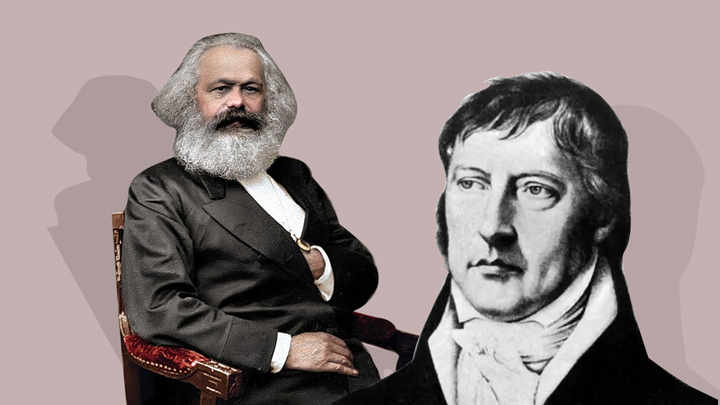
Idealism and materialism appear to be one of the oldest and most persistent oppositions in the history of philosophy. On one side stands idealism, which takes thought, consciousness, or the Idea as fundamental; on the other, materialism, which takes matter and a reality independent of thought as fundamental. This opposition is useful at an introductory level, but it quickly becomes inadequate when applied to major philosophical systems. To oppose Hegel as an “idealist who replaces reality with thought” and Marx as a “materialist who replaces thought with matter” does less to reveal the fundamental difference between the two thinkers than to eliminate the common field of problems they share.
The real difficulty is that idealism and materialism are not simply two opposing answers to a single question. At least three distinct problems become entangled here: What is the fundamental structure of reality? How can we know reality? Through what form of thought can we grasp the movement of reality? The first question is ontological, the second epistemological, and the third methodological. A philosopher does not have to proceed in the same direction on all three levels. A materialist ontology may rely on a mechanical method, while an idealist ontology may grasp historical change, relations, and contradiction with extraordinary power. The philosophical importance of the relation between Hegel and Marx, and of Lenin and Lukács returning to Hegel, emerges precisely here.
Idealism Is Not the Denial of Matter
To define idealism as the claim that “the material world does not exist; only ideas exist” allows only one particular historical form of idealism to speak on behalf of the entire tradition. In the history of philosophy, idealism encompasses highly diverse systems. For a philosophy to be idealist does not necessarily mean that it denies the reality of stones, bodies, institutions, or historical events. Especially in German Idealism, the problem is not whether the world exists, but how reality can be intelligible to thought.
For Hegel, if reality is assumed to be completely alien to thought, philosophical knowledge becomes impossible from the outset. If thought stands on one side and being on the other, with only an external contact between them, we can never explain how our concepts genuinely relate to reality. Hegel’s idealism seeks to overcome this separation. Thought and being are not simply identical, but neither are they absolutely external to one another. Being can be thought because its determinations possess conceptual relations; the concept can relate to reality because thought does not consist merely of the arbitrary representations of a subjective mind.
For this reason, Hegel’s Begriff, or Concept, is not a general label located in the mind. Rather than being a mental instrument that impoverishes reality through abstraction, the Concept is the level at which the relations among determinations become explicit. The movement among Being, Essence, and Concept expresses this. Being first appears immediate; at the level of Essence, the relations and mediations of its determinations unfold; the Concept then emerges as the thought unity of this movement. To define Hegel’s idealism merely by saying “thought is superior to matter” is to lose this entire movement.
Hegel’s orientation toward reality is therefore more concrete than is often assumed. State, law, family, society, history, labour, and political conflict are not external to his thought. Idealism here signifies less the denial of material reality than the claim that reality is not merely a collection of isolated objects. What something is cannot be thought independently of its relations with other things.
Materialism: Is It Enough to Say That Matter Exists?
The most fundamental claim of materialism is that reality does not depend on thought or consciousness. Nature exists before human consciousness; human bodily and social existence is not merely the product of mental processes. Yet the philosophical problem of materialism does not end here. To say “matter exists” does not yet explain how matter, society, or history should be understood.
Important distinctions therefore emerge within materialism itself. Mechanical materialism may conceive reality as the sum of objects and causes external to one another. In such a model, one event acts upon another; the world consists of the reciprocal motion of separate parts. Drawing on particular historical models of the natural sciences, this approach can produce reductionist consequences when applied to complex social relations. When the economy begins to be read as the one-way cause that “determines” politics, politics as determining thought, or material conditions as determining culture, history ceases to be a living network of relations and becomes a chain of mechanical causality.
The importance of Marx’s materialism appears precisely where it separates itself from such reductionism. For Marx, human ideas are not independent of material and social existence; yet this does not mean that thought is a passive reflection of material causes. Human beings produce, labour, establish institutions, develop forms of law, enter political struggles, and within these processes make sense of their own world. Between material life and consciousness there is not a one-way arrow, but historically constituted mediations. Marx’s break with Hegel therefore cannot be adequately understood simply as “putting matter in the place of thought.” Marx’s intervention places material and social relations at the centre of philosophical movement, yet it does not abandon the Hegelian problems of process, contradiction, mediation, and totality. Materialism thus becomes not the sovereignty of a fixed concept of “matter,” but the priority given to the real historical relations of human life.
What Does It Mean to Turn Hegel Right Side Up?
One of the most famous images used to describe the relation between Marx and Hegel is the idea that Hegelian dialectics stood “on its head” and was turned “right side up” by materialist thought. The image is powerful, but when used too easily it creates a false symmetry. It can seem as though Marx could be obtained simply by replacing the word “Idea” in Hegel’s system with “matter.” Yet the transformation is far more radical.
In Hegel, the movement of categories takes place within the conceptual structure of the Science of Logic. In Marx, categories such as commodity, money, capital, labour-power, and surplus value are forms of historical social relations. Marx does not merely apply Hegelian categories to different objects. Because the object being investigated changes, dialectical movement itself acquires another content and necessity.
Capital is a clear example. The commodity is not merely the smallest particle of the economy. The tension between use-value and exchange-value opens onto the value-form; the value-form onto money; money, under determinate historical conditions, onto capital. Categories do not follow one another like encyclopaedia entries. The internal relations of one economic form make the transition to another necessary.
The trace of Hegelian movement can be found here, but its object is no longer pure logical determinations; it is the historical forms of the capitalist mode of production. This distinction relocates the real break between idealism and materialism more accurately. Marx’s materialism does not merely change Hegel’s answer; it changes the field in which the question takes place. Instead of the conceptual movement of being, the formation and transformation of historically determined social relations of production become the centre of investigation.
Yet precisely for this reason, Hegel cannot simply be left behind. Marx’s ability to grasp social categories not as immutable objects, but as relations and processes, is not independent of the problematic opened by Hegelian dialectics.
Why Does Dialectics Disrupt the Opposition?
The opposition between idealism and materialism becomes more complicated when confronted with the problem of dialectics. Dialectics does not primarily answer whether the world consists of “matter” or “thought.” Instead, it investigates how a determination comes into being, how it relates to other determinations, and how it transforms itself through its own limits.
From this perspective, the power Hegel retains for materialist thinkers becomes intelligible. Hegel is an idealist, yet he does not conceive reality as a collection of frozen substances. Being produces its own determinations; determinations pass over into their opposites; essence is not an immobile core standing behind immediacy; contradiction is not a failure of thought but one of the conditions of movement. What is real is relational and in becoming.
By contrast, a philosophy that declares itself materialist may conceive reality as a mechanism composed of fixed parts. This is why the distinction that emerges in Lenin’s reading of Hegel between “intelligent idealism” and crude materialism is philosophically significant. The point is not that idealism is superior to materialism. The point is that possessing the correct ontological label is not sufficient for powerful thought.
The tension carried by the concept of dialectical materialism lies precisely here. Materialism preserves the independence of reality from thought; dialectics refuses to conceive that reality as static matter. Matter, society, and history cannot be understood merely by saying that they “exist.” Their movements, internal relations, and forms of transformation must be explained.
The significance of Lukács’s return to Hegel appears at the same point. The philosophical power of Marxism does not consist merely in choosing the materialist side against idealism. If materialism cannot grasp historical totality, mediations, and contradictions, it may fall behind its own claim. Returning to Hegel becomes necessary not to transform materialism back into idealism, but to prevent it from becoming mechanical.
Ontology, Knowledge, and Method Must Be Distinguished
A large part of the confusion in debates over idealism and materialism arises because questions belonging to different levels are answered within the same sentence. Three distinctions must therefore be preserved.
At the ontological level, the question concerns what reality is. Here the materialist view, which defends the existence of matter independently of thought, differs from the idealist view, which maintains that the structure of reality has a constitutive relation with thought or the Idea.
At the epistemological level, the question concerns how we can know reality. Accepting the existence of an external world does not demonstrate that it is known directly by the mind without mediation. Likewise, investigating the conceptual conditions of knowledge does not necessarily entail the conclusion that the external world is merely a mental production.
At the methodological level, the problem is how reality should be thought. Should we use fixed categories, or recognise that categories themselves arise historically? Should we search for one-way causes, or investigate reciprocal mediations? Should contradiction be regarded as a logical error to be eliminated, or as an indication of determinate real relations?
To think the relation between Hegel and Marx correctly, the last two levels in particular must not be sacrificed to the ontological opposition. Accepting Hegel’s idealism does not mean that his dialectics has no value for Marxist thought. Accepting Marx’s materialism does not mean that he abandoned all Hegelian problems.
For the same reason, method cannot replace ontology. When one says, “only the method matters,” a genuine difference disappears. Marx’s separation from Hegel is not merely methodological; the philosophical status of human social existence, production, labour, and material relations changes. Yet to absolutise the ontological distinction and erase methodological continuity also makes the Hegel–Marx relation incomprehensible.
The boundary between idealism and materialism is therefore both real and permeable: real because it involves different philosophical decisions concerning the priority of being and thought; permeable because conceptual instruments developed by one tradition can survive in transformed form within another.
Does Thought Reflect Reality?
One of the most difficult problems for materialism is the status of thought. If reality is independent of thought, how does thought relate to reality? Defining consciousness as a “reflection” of the world may initially seem convincing, but the metaphor of reflection quickly generates new problems.
Human consciousness is not a mirror. Human beings grasp the world through language, history, social relations, and concepts. The same reality can be understood under different categories in different historical periods.
This does not mean that reality is mentally created. A stronger distinction is required: the independence of reality from thought and the conceptual and historical mediation of our knowledge of reality are different theses.
Marx’s thought makes this distinction particularly visible in the field of social reality. A “commodity” is not merely the name of a physical object found in the world. An object becomes a commodity within determinate social relations of production and exchange. The physical material of money and the social relation that makes it money are not the same thing. Capital, likewise, is not the natural name for a particular quantity of material wealth; it is the form wealth assumes within a determinate historical social relation.
Even materialist analysis therefore cannot treat reality merely at the level of physical objects given to the senses. Social reality itself is constituted through relations, institutions, and historical forms. This reality is not a mental construction, but neither can it be reduced to bare physical materiality.
It is precisely here that crude versions of the idealism–materialism opposition collapse. Conceiving the relation between thought and matter as a competition between two independent substances is inadequate for explaining the historical and social structure of the human world.
Why Must Materialism Be Historical?
With Marx, one of the most important transformations of materialism is that matter becomes not only a natural but also a historical problem. Human beings do not enter into relation with nature under ready-made conditions; they transform the material world through means of production, technologies, divisions of labour, forms of property, and institutions. In the course of this transformation, they themselves also change.
Historical materialism is therefore not the reductionist thesis that “the economy causes everything.” The economic itself is neither natural nor immutable. Feudal relations to land, wage labour, commodity production, or capital accumulation are social forms that emerge under determinate historical conditions. To be materialist here means not only recognising their material reality, but also being able to see that they are historical and can be transformed into other forms.
This is where dialectics and materialism meet. Reality is independent of thought, but the social forms of reality are not immutable. Human beings live in an already existing world while simultaneously reproducing that world. Structures determine individuals; the actions of individuals also participate in the continuation or transformation of structures.
Historical materialism therefore cannot be satisfied with the one-way causal model of mechanical materialism. It must recognise mediated relations among the different levels of the social totality. One of the lasting significances of Hegelian dialectics for Marxist thought is precisely that it provides a conceptual form capable of thinking such mediations.
Is the Point Where Idealism Is Right the Limit of Materialism?
It is not productive to think of the debate between idealism and materialism in terms of winners and losers. The historical strength of idealism lies in showing that thought is not passive before reality. Human beings do not merely perceive the world; they conceptualise it, give it meaning, and historically reconstruct it. Law, politics, art, religion, and science cannot be reduced to physical processes alone. The real human world is a world that carries meaning.
The great intervention of materialism, however, is to show that this world of meaning is not self-sufficient. Behind human ideas stand bodily life, labour, production, need, power, and historical conditions. To explain the history of concepts only through other concepts can make the material conditions of thought invisible.
These two criticisms need not completely destroy one another. To treat thought as the simple result of material conditions loses the productive dimension of human praxis; to turn thought into an independent force that constructs itself pushes real historical human life into the shadow of thought.
For this reason, the philosophical tension between Hegel and Marx remains alive. Hegel refuses to leave the relation between thought and being within separation. Marx investigates the social and material conditions of this unity. The first foregrounds the movement of the concept, the second the movement of historical social relations; yet both oppose forms of thought that reduce reality to a collection of static objects.
The Real Boundary of the Opposition
The distinction between idealism and materialism should not be abolished. If every difference is reduced merely to terminology, the meaning of Marx’s criticism of Hegel disappears. Yet the distinction should not be conceived as two sealed camps either. The major transformations in the history of philosophy often occur not when one tradition completely abandons another, but when it reconstructs the other’s problems upon a different ground.
The transition from Hegel to Marx is a powerful example. Marx does not merely reject idealism; he reformulates the problems of Hegelian dialectics within material and historical relations. Lenin’s and Lukács’s returns to Hegel are meaningful for the same reason: they reread Hegel not to return Marxism to idealism, but because they recognised that materialism could become mechanical from within.
The most productive boundary between idealism and materialism therefore emerges where the question “which comes first, thought or matter?” can no longer provide an adequate answer. The more difficult questions are these: What kind of relational totality is reality? Where is thought situated within this totality? Does knowledge merely represent the external world, or is it part of human historical praxis? Is accepting material reality sufficient to grasp its movement? Does accepting the constitutive role of the concept necessarily require reducing reality to thought?
The lasting value of the historical debate between idealism and materialism lies not in producing a final winner, but in showing that the relation between reality and thought can never be reduced to a simple formula of priority. Where dialectics intervenes, the question is no longer merely which comes first; it becomes a question of the mediations through which thought and reality relate without excluding one another, yet without being reduced to one another.
