




Introduction to the Artist
Raphael was one of the painters who most successfully embodied the Italian Renaissance pursuit of balance, clarity, and spiritual tranquillity. During his early period, he was influenced by Perugino’s serene arrangement of figures, but soon developed a pictorial language that made the relationships among figures gentler, the space more open, and the sacred scene more unified. The Ansidei Altarpiece is an important work demonstrating how Raphael constructed sacred figures within the tradition of altarpiece painting through architectural order, chromatic balance, and silent relationships of gaze.
Introduction to the Work and Composition
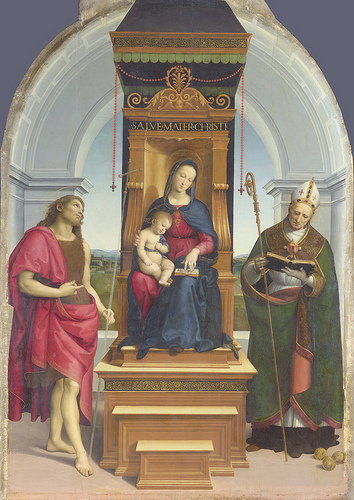
At the centre of the painting are Mary seated upon a high throne and the Christ Child upon her lap. Mary wears a red dress and blue mantle. She inclines her head slightly downward and directs her attention toward the book in her hand. The Christ Child sits upon his mother’s lap and engages with the book. This small movement forms the inner centre of the scene: sacred knowledge placed beside the incarnate Child.
Mary’s throne is positioned within an architectural niche. Above it are a dark baldachin, golden decorations, and the inscription “Salve Mater Christi.” This inscription functions as a ceremonial sign glorifying Mary as the Mother of Christ. Saint John the Baptist stands on the left, wearing a red drapery and maintaining a restrained bodily posture. On the right is Saint Nicholas in episcopal vestments, holding a book and crozier. The golden spheres near his feet support his iconographical identity. An arched architectural opening in the background places the figures within a sacred setting.
Three-Level Analysis through Panofsky’s Method
Pre-iconographical
At the centre of the painting is a woman seated upon a throne with a nude child upon her lap. Standing saints appear on either side. The setting is constructed through an arched architectural opening and an elevated throne. The garments of the figures are distinguished by red, blue, green, and gold tones.
Iconographical
The woman at the centre is Mary, and the child is Christ. The figure on the left is Saint John the Baptist, while the bishop on the right is Saint Nicholas. Mary’s throne indicates that she carries not only the identity of a mother, but also the position of sacred mediation and exaltation. The book signifies sacred knowledge and destiny. Saint Nicholas’s episcopal vestments and golden spheres make his saintly identity visible.
Iconological
The work constructs sacredness not through dramatic action, but through an ordered space of worship. Mary remains silent at the centre, while the Christ Child is still within the body of infancy. The book and throne, however, suggest that divine destiny already resides within this childhood. The two saints on either side are witnesses and figures of mediation. The painting therefore places the intimate relationship between mother and child within the institutional order of the Church, prayer, and sacred authority.
Representation – Gaze – Void
Representation
Raphael represents Mary not within domestic privacy, but as a ceremonial centre appropriate to an altarpiece. Her body is serene, her head inclined, and her movement measured. The nudity of the Christ Child reveals his human body, while the book and throne strengthen his divine meaning. The saints complete the sacred order surrounding this centre.
Gaze
The gaze is not directed immediately toward the viewer. Mary’s attention descends toward the book and the Child. The Christ Child also participates in this inner centre. The postures of Saint John the Baptist and Saint Nicholas create silent fields of witnessing that guide the viewer toward the centre. Within this scene, the viewer becomes not an external spectator, but a praying subject positioned before the altar.
Void
The architectural niche creates a measured openness around the figures. The height of the throne and the distance between the saints on either side give the scene a ceremonial sense of space. The void is not an absence, but a distance opened so that sacred order can become visible. The figures do not press against one another; each occupies a hierarchical and balanced position.
Style – Type – Symbol
Style
The work is distinguished by linear clarity, symmetrical balance, and soft transitions of colour. The vertical architecture of the throne establishes the central axis of the composition, while the placement of the saints on either side balances this axis. Mary’s blue mantle creates a broad and serene surface, while the red dress appears beneath it as a warm emphasis. The folds of the garments are not rigid, but controlled and fluid. The architecture functions as a silent frame that gathers the figures without dispersing them.
Type
The fundamental type of the work is the altarpiece composition of the “Enthroned Virgin and Child.” To this is added the arrangement of a sacred assembly with saints standing on either side. The painting is therefore not merely a scene of the Madonna and Child, but an image of devotion and worship intended for a church interior.
Symbol
The throne symbolises Mary’s exaltation and sacred position; the book represents divine knowledge and destiny; and the nude body of the Christ Child signifies the Incarnation of God. Saint John the Baptist carries the ideas of witnessing and forerunning. Saint Nicholas’s episcopal vestments, crozier, and golden spheres make visible spiritual authority, generosity, and saintly identity.
Explicit Identification of the Art Movement
The Ansidei Altarpiece reflects the early sixteenth-century Italian Renaissance understanding of altarpiece painting. The symmetrical balance of the composition, the idealised tranquillity of the figures, the organising role of architectural space, and the lucid presentation of the sacred subject are fundamental qualities of Renaissance painting. Raphael preserves the serenity inherited from Perugino, but gives greater definition to the volume of the figures, the balance of colour, and the visual power of the sacred centre.
Conclusion
Raphael’s The Ansidei Altarpiece constructs the sacred scene through silence, order, and the idea of the centre. Mary sits upon the throne, yet this exaltation does not create a severe distance. The small relationship between the Christ Child and the book forms the theological centre of the scene. The saints on either side stand as witnesses and supporters of this centre.
Raphael’s achievement lies in combining the ceremonial nature of the altarpiece with human serenity. The work establishes sacredness not through ostentatious movement, but through a measured gaze, balanced architecture, and a silent order of colour.
