




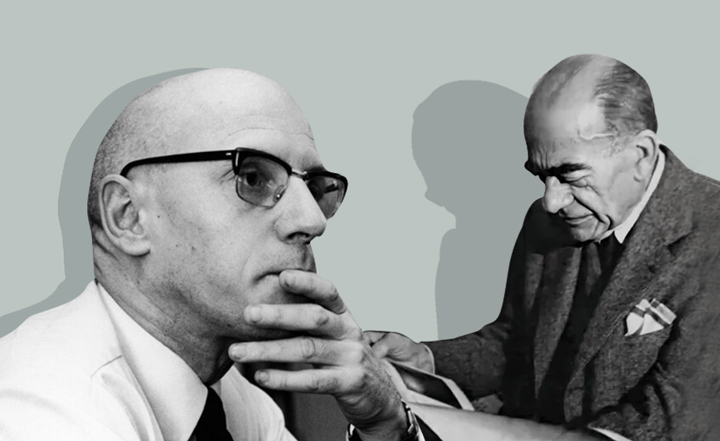
Panofsky’s art-historical interpretation and Foucault’s archaeological method investigate, in different disciplines, the historical conditions of possibility that operate beneath individual works and discourses. The concepts of intrinsic meaning, episteme, historical a priori, and worldview intersect around the question of what makes seeing, thinking, and knowing possible.
Erwin Panofsky and Michel Foucault belong to different disciplines, different generations, and considerably different philosophical orientations. While Panofsky addresses the methodological problems of art history through iconology, symbolic form, perspective, and cultural meaning, Foucault reconstructs the history of knowledge through the concepts of discourse, episteme, archive, and historical a priori. It would therefore be historically indefensible to equate the two thinkers or to suggest that the concepts Foucault subsequently developed were already present in Panofsky’s work. Nevertheless, they share a significant philosophical problem: both investigate the conditions that make particular thoughts, images, and forms of knowledge possible within a given historical period, prior to examining their individual contents.
For Panofsky, this question requires investigating not merely what a work of art represents, but why it could become visible and meaningful in precisely a particular form. For Foucault, the issue is not initially whether a thought is true or false, but how certain objects become subjects of knowledge, which concepts become available, and which statements can be recognized as scientific or meaningful within a given period. Both thinkers thus move beyond manifest content toward the structures that make such content possible. Yet this shared question leads to two distinct conceptions of history and two different methodological conclusions.
Panofsky’s Starting Point: How Can Art History Produce Knowledge?
To begin Panofsky’s theoretical development solely with the distinction between iconography and iconology would be to overlook his fundamental epistemological problem. The central concern of the young Panofsky was how an art historian could arrive at historically valid knowledge through the examination of individual works of art. Reducing a work to the psychology of its artist is insufficient, since the artist may not have consciously formulated the full historical significance of their own production. Nor is it sufficient to regard the work merely as a product of its social environment, since very different works may emerge under similar historical conditions. Purely formal analysis is likewise inadequate to explain why particular artistic forms appear in particular ways during specific historical periods.
Panofsky is therefore compelled to conceive the object of art history beyond a simple scheme of cause and effect. A work of art emerges under historical conditions, yet possesses its own internal organization. It has form, but form is not independent of meaning. It represents a particular subject, but that subject does not exhaust the work’s entire content. It is produced by an artist, yet its meaning may extend beyond the artist’s conscious intentions. The problem Panofsky increasingly develops around “intrinsic meaning,” or Sinn, concerns the explanation of these multiple relationships.
Here, the question inherited from Kant and Neo-Kantian philosophy becomes decisive: if knowledge is not merely the accumulation of data obtained from an object, then the categories that make the object knowable must also be investigated. Panofsky transfers this epistemological problem into art history. However, his categories do not remain the mental forms of an unchanging, ahistorical subject. The art historian encounters different systems of space, form, representation, and meaning across historical periods. The task of art history is therefore not simply to assign works to categories, but also to explain the historically changing conditions of seeing and artistic formation.
The treatment of perspective as a “symbolic form” is one of the clearest consequences of this orientation. Perspective is not a neutral reproduction of natural vision; it is a particular historical culture’s way of organizing space. Panofsky’s question is therefore no longer simply, “How did Renaissance painters use perspective?” The more fundamental question is: Under what historical conditions of thought did it become possible to represent the world as a homogeneous, measurable space organized according to a single viewpoint?
This question marks the first significant point of convergence between Panofsky and Foucault.
Foucault and the Historical A Priori
Foucault likewise refuses to regard the history of knowledge as merely a chronological sequence of ideas, discoveries, or theories. Particularly during his archaeological period, his interest shifts from what individual thinkers said to the conditions determining which statements could emerge within a particular historical epoch. The possibility that certain objects become subjects of scientific investigation, that particular concepts are considered meaningful, that certain classifications appear natural, and that specific questions become possible is not accidental.
Foucault’s concept of the historical a priori designates this level of analysis. The a priori in this context differs from Kant’s transcendental a priori. It does not refer to the universal conditions of an unchanging human mind, but to the field of rules and relations that makes the formation of knowledge possible within particular historical periods. There are therefore conditions that precede particular forms of knowledge, but these conditions are themselves historical and subject to transformation.
The concept of episteme belongs to the same field of problems. An episteme is not the sum of the ideas shared by an epoch, its dominant ideology, or a worldview consciously held by everyone. More fundamentally, it consists of the historical regularities that determine which relations can be established across different fields of knowledge. Questions concerning the criteria by which objects may be classified according to similarities and differences, how the relationship between language and the world may be conceived, or which characteristics of living beings can become objects of knowledge arise at this level.
Foucault’s archaeology therefore does not investigate what the people of a particular period “really thought.” It poses a more radical question: What historical order made particular forms of thought possible within that period?
It is precisely here that a structural affinity with Panofsky’s iconological thought begins to emerge.
The Conditions Behind Worldviews
Panofsky’s iconological method does not merely establish that a work of art belongs to a particular narrative or symbolic tradition. At the iconological level, the work is understood as a symptom of more fundamental cultural tendencies within an epoch. A compositional structure, conception of space, arrangement of figures, or method of representation may be related to a historical structure of thought. Panofsky thus approaches the concept of worldview. A work of art can make visible, within a singular artistic structure, the fundamental attitudes of a particular nation, period, class, religious orientation, or philosophical outlook. This does not mean, however, that the artist consciously illustrates particular ideas. What matters is that historical principles extending beyond the artist’s individual intentions participate in the organization of artistic form.
Although this approach differs from the criticism Foucault would later direct toward the concept of worldview, both operate within the same field of problems. Neither accepts the statements of a conscious subject as the starting point and final explanation of historical meaning. For Panofsky, the artist’s intentions do not exhaust the intrinsic meaning of the work; for Foucault, the intentions of an author or scientist are insufficient to explain the rules governing a discursive formation.
In both approaches, investigation is directed toward broader historical conditions operating beyond individual consciousness.
Nevertheless, a fundamental distinction must be preserved. Panofsky tends to understand these broader structures in terms of cultural unity and mutual correspondence. Foucault, by contrast, is particularly resistant to reducing the culture of an epoch to a single spirit, mentality, or worldview. Rather than deriving all fields from one central idea, his archaeological analysis investigates the historical regularities operating between different discourses.
The affinity between Panofsky and Foucault therefore arises not from their reaching identical conclusions, but from their movement of the level of explanation from individual content to historical conditions of possibility.
Gothic Architecture and Scholastic Thought: A Problem of Conditions of Possibility
The relationship Panofsky establishes between Gothic architecture and scholastic thought makes this comparison more explicit. He does not propose a simple causal relationship. He does not claim that scholastic philosophers provided architectural plans or that cathedrals translated philosophical propositions into stone. His concern is rather with the possibility that similar principles of organization may emerge in two different domains of cultural production.
Panofsky investigates a homology between scholastic thought, with its clear differentiation of parts, systematic divisions, organization of oppositions, and construction of a whole through a visible logical order, and Gothic architecture, whose articulated and differentiated structure renders the whole intelligible through the relations among its parts. The term “influence” is insufficient here. What is involved is a shared cultural formation that makes similar habits of organization possible among people working in different fields. In this kind of explanation, Panofsky seeks not so much a direct line of transmission between architecture and philosophy as an understanding of why both could develop similar forms of organization within the same historical environment. The problem is therefore no longer the resemblance between two contents, but the historical conditions that made similar principles of organization possible.
Foucault’s archaeological method likewise investigates how comparable historical regularities emerge across different fields of knowledge. However, Foucault is considerably more cautious about explaining such similarities through a shared mentality or cultural essence. For him, the important question is not whether different fields originate from a single center, but how similar rules of classification, differentiation, and discourse operate within different domains of knowledge during a particular period.
This difference clearly indicates both how closely the two methods may approach one another and where they ultimately diverge.
Panofsky’s “Intrinsic Meaning” and Foucault’s “Episteme” Are Not the Same
It would be a serious theoretical error to directly equate Panofsky’s concept of intrinsic meaning with Foucault’s concept of episteme. Panofsky’s iconology investigates how a work of art can be interpreted as a symptom of particular historical tendencies, whereas Foucault’s episteme concerns the field of relations determining the conditions of knowledge production within a given historical period. The former belongs to the interpretation of art history; the latter to the archaeological analysis of discursive formations.
Panofsky’s method also preserves a humanist assumption: forms produced by human beings provide access to the historical world of human meaning. The art historian does not merely classify works from an external standpoint, but seeks to understand and historically reconstruct them. The work of art is one of the privileged documents through which humanity’s efforts to give form to the world can be approached.
Foucault’s method, by contrast, maintains a much greater distance from the humanist tradition of interpretation. The purpose of archaeology is not to re-experience meanings supposedly concealed within the consciousness of people in the past. Foucault specifically displaces the subject from the position of the absolute origin of discourse. Discourse is not simply the expression of an individual subject’s thought; it takes shape within a historical order that also determines the positions from which a subject can speak.
Consequently, while Panofsky seeks to reconstruct the historical coherence of meaning, Foucault investigates the discursive rules through which such coherence is produced. Panofsky’s iconology tends toward synthesis, whereas Foucault’s archaeology questions the conditions and limits of synthesis itself.
Between Continuity and Discontinuity
Another important distinction between the two thinkers concerns their understanding of historical change. In explaining transformations in art history, Panofsky investigates how forms, symbols, and intellectual structures change between periods. The renewed significance of ancient forms during the Middle Ages and the Renaissance, transformations in systems of perspective, and the historical differentiation of iconographic types are all areas in which continuity and transformation can be considered together.
In Foucault’s early works, however, discontinuity is a much more prominent concept. The transformation from one episteme to another does not mean that the same questions gradually receive more accurate answers. When the objects, concepts, and relations of knowledge change, the field of what can be thought also changes. Earlier forms of knowledge therefore cannot simply be interpreted as incomplete or primitive versions of contemporary knowledge.
Panofsky’s understanding of history does not reduce the past to a simple narrative of progress either. Nevertheless, his humanist approach is more open to establishing intelligible continuities between cultural products. Foucault, by contrast, regards the disruption of continuities that historians tend to take for granted as a methodological necessity.
This distinction matters because the same question concerning the “conditions of possibility” is connected to two different conceptions of history.
Where Does the Historian Stand?
One of the strongest epistemological points of convergence between Panofsky and Foucault concerns the position of the researcher. If every historical period operates within particular conditions of thought and representation, the historian cannot place themselves outside this historicity. It is impossible to observe the past from a completely neutral and timeless perspective.
Panofsky recognizes this problem particularly in the dual position of the humanist historian. The historian examines works inherited from the past but understands them through present-day concepts, questions, and instruments of knowledge. The historian cannot completely abandon their own historical position. Nevertheless, interpretation is not arbitrary. Documents, forms, iconographic traditions, and comparative historical knowledge establish limits upon interpretation. Objectivity becomes possible not through the historian’s complete liberation from their own standpoint, but through the continuous examination of their assumptions in relation to evidence.
For Foucault, too, the researcher does not stand outside history. Archaeology demonstrates that contemporary forms of knowledge have themselves emerged historically, rather than accepting them as natural and universal. Criticism is consequently directed less toward judging the past according to present-day categories than toward investigating how categories that now appear self-evident came into existence.
In both approaches, historical investigation therefore does more than produce knowledge about the past. It also makes visible the conditions under which the researcher’s own thinking becomes possible.
The Limits of Investigating Conditions of Possibility
The problem that brings Panofsky and Foucault into proximity also contains a methodological danger. When a common order is assumed to exist behind the visible products of an epoch, the historian may be tempted to reduce differences to a single explanatory principle. For Panofsky, the danger is interpreting every work as an expression of one comprehensive “worldview.” For Foucault, a comparable reduction may occur if the episteme is understood as a homogeneous, closed superstructure that determines everything.
Investigating conditions of possibility therefore does not mean discovering a single hidden cause. A historical condition is not a metaphysical essence standing behind works or thoughts. Rather, it should be understood as a historical order that permits certain relations to be established while making others more difficult.
In Panofsky’s strongest iconological analyses, form, subject matter, and historical context test one another reciprocally. In Foucault’s archaeology, too, the discursive order is not derived from a single center; it is reconstructed through recurring relations between different statements. In both cases, investigation moves from observable examples toward the conditions that make them possible. Yet the conditions identified must themselves remain subject to examination against historical evidence.
The concept of a “condition of possibility” is therefore not the final word of explanation, but the beginning of a new level of historical investigation.
Conclusion
The relationship between Panofsky and Foucault should not be established as a line of influence, but through a shared epistemological problem in twentieth-century thought. Both recognize that it is insufficient to seek explanations of individual works of art, thoughts, or forms of knowledge solely within their manifest contents. Asking how a work of art can carry meaning or how a particular form of knowledge can be constituted requires investigating the historical conditions that make such possibilities available.
Panofsky develops this problem within art history through form, intrinsic meaning, symbolic form, and iconological interpretation. Foucault carries it into another field through the archaeology of knowledge and the concepts of episteme, discourse, archive, and historical a priori. For Panofsky, cultural products are documents through which the historical world of human meaning can be approached; for Foucault, what must be investigated are the historical rules within which such worlds of meaning can be constituted. This difference separates the two thinkers, yet situates them on different sides of the same fundamental question.
The common ground between Panofsky and Foucault, therefore, is not that they “say the same thing.” It lies in their relocation of the center of explanation from individual content to historical conditions of possibility. Panofsky examines works of art to investigate the possibilities of seeing and giving form to the world within an epoch; Foucault examines discourses to investigate the possibilities of thinking and knowing within an epoch. In both approaches, history ceases to be a passive stage upon which already constituted thoughts unfold. History itself becomes an active condition determining what can be seen, what can be thought, and what can become meaningful.
