




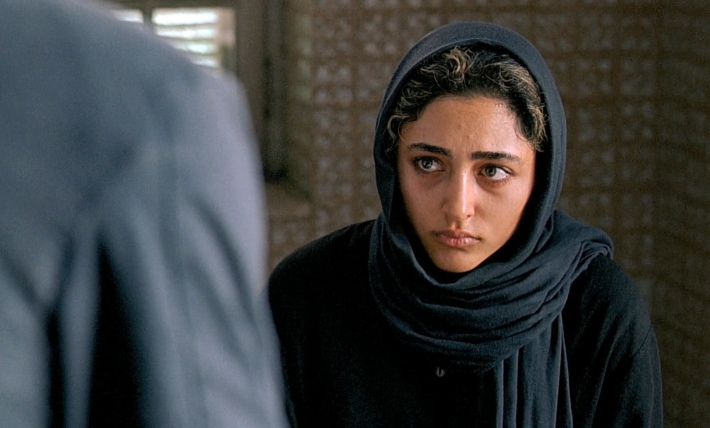
Director and Context
One of the strongest films from Asghar Farhadi’s early period, About Elly is a 2009 Iranian drama. The film earned Farhadi the Silver Bear for Best Director at the Berlin International Film Festival and later emerged as one of the foundational works of contemporary Iranian cinema.
Introduction to the Film and Composition
The film opens with a short holiday taken by a group of middle-class friends from Tehran on the coast of the Caspian Sea. When Elly, who joins the group at the last moment, disappears, this seemingly simple excursion gradually becomes burdened by guilt, shame, lies, and social pressure.
Farhadi constructs the narrative not through great ruptures but through minor tensions and relationships that become increasingly constricted. The holiday house, the shore, enclosed rooms, and collective conversations become decisive elements within the film’s composition.
Three-Level Analysis Through Panofsky’s Method
Pre-iconographical Level
At the first level, the film presents several families attempting to enjoy themselves by the sea: children, games, food preparation, brief conversations, and then the sudden weight of disappearance.
The opening section appears lively, crowded, and ordinary. Women, men, and children share the same space, yet from the beginning it remains uncertain who knows what and who is concealing something.
The wind, the sea, the empty house, and the group’s disordered movement establish the film’s visible surface.
Iconographical Level
At this level, the film foregrounds signs of Iranian middle-class life: family order, expectations surrounding marriage, engagement, a divorced male friend, the social position of women, and anxiety over reputation.
Elly is not merely a missing woman. She becomes a figure upon whom everyone imposes their own meaning.
The holiday house is also more than a location. It functions as a temporary stage upon which repressed tensions emerge.
Throughout the film, small lies and apparently well-intentioned concealments produce increasingly serious consequences.
Iconological Level
At the deepest level, About Elly concerns not simply the discovery of truth but the difficulty of carrying truth within society.
An event occurs, yet the central problem is how people defend themselves and one another afterwards.
Farhadi does not use the disappearance merely as a dramatic knot. He uses it to reveal how class, morality, honour, reputation, and responsibility come into conflict.
The film consequently narrates less a mystery than the collapse of a shared conscience.
Representation – Gaze – Void
Representation
The film does not construct Elly as an intensely visible character. Her absence instead forms the centre of the narrative.
This is significant because Elly becomes less a person than the bearer of meanings produced by others around her.
Sepideh occupies a more visible central position. She appears as a woman acting from good intentions but increasingly unable to carry the weight of her own decisions as events become more serious.
Farhadi does not reduce the characters to moral labels. Everyone is both justified and flawed. The field of representation therefore remains unstable and tense.
Gaze
The gaze functions as one of the film’s strongest forms of social control.
The characters do not merely look at one another. They assess, judge, accuse, and defend each other.
After Elly’s disappearance, the tone of the gaze changes. Eye contact that initially appeared friendly gradually becomes interrogative.
The different responses of the men and women also reshape the regime of looking.
Questions of responsibility, truthfulness, and concealment begin to appear through faces, silences, and brief pauses.
The film constructs social pressure precisely within this network of gazes.
Void
One of the film’s greatest strengths lies in its refusal to close the void surrounding Elly too quickly.
Questions concerning what Elly felt, thought, or decided remain unanswered.
This absence is not a flaw in the narrative but its central power.
It is not only a person who disappears. Certainty itself also vanishes.
Farhadi does not provide the viewer with complete knowledge. Instead, he shows how people begin to fragment within uncertainty.
The void is therefore both narrative and moral.
Style – Type – Symbol
Style
Farhadi’s formal approach is extremely measured.
The camera is not ostentatious, the dialogue flows naturally, and tension arises less from music than from the fragile structure of human relationships.
Even within crowded scenes, the film never loses control.
This restraint makes the event feel more severe because the viewer is placed inside the group rather than being directed from outside.
Type
Sepideh represents the mediating figure trapped between good intentions and responsibility.
Ahmad, as the divorced man introduced into the group, is brought toward the centre but cannot remain there.
Elly becomes a type that grows through absence and is shaped through what others say about her.
The other families function not merely as individual characters but as different faces of middle-class social pressure.
The film establishes these types without reducing them to clichés.
Symbol
The sea is the film’s principal Symbolic field.
It carries a sense of freedom and openness while simultaneously opening the possibility of disappearance and irreversible loss.
The holiday house initially appears to offer temporary relief but soon becomes a confined space in which hidden matters accumulate.
The presence of the children is also important. Their games and innocence form a sharp contrast with the increasingly heavy moral burden carried by the adults.
The film thereby gives meaning to ordinary objects and spaces without transforming them into exaggerated symbols.
Art Movement / Cinematic Context
About Elly belongs to the social-realist and moral-tension tradition of contemporary Iranian cinema.
It uses a disappearance not to produce conventional detective suspense but to reveal the fragility of relationships and the invisible operations of social pressure.
Conclusion
About Elly begins like the story of a holiday and gradually becomes a film about the fracture of a shared conscience.
Farhadi requires no grand dramatic gestures.
The expansion of lies, the hardening of gazes, and the growth of uncertainty are sufficient.
The film’s power lies not in solving a disappearance but in showing how those who remain behind are transformed by it.
