




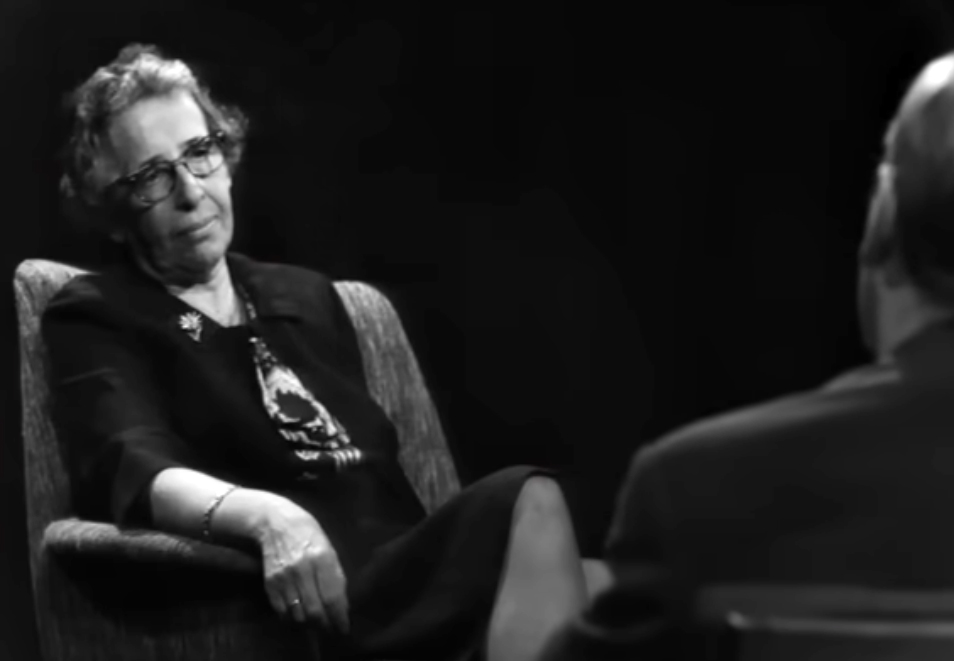
Hannah Arendt’s 1964 interview with Günter Gaus constitutes an important intellectual testimony concerning the relationship between thought and the political world, individual responsibility in the face of historical catastrophes, and the conditions under which human beings act together. Arendt defines herself not as a philosopher in the traditional sense but as a thinker working in the field of political theory. This distinction is not merely a matter of academic specialization. The tension between the thinking human being of philosophy and the acting human being of politics constitutes one of the fundamental problems throughout her work. The political world is not simply an object to be explained by thought from the outside, but a shared reality created by human beings through speech, decision, and collective action.
Arendt’s political thought cannot be separated from the historical experiences of the twentieth century. The rise of National Socialism, her forced departure from Germany in 1933, exile, the mass extermination carried out at Auschwitz, and the trial of Adolf Eichmann were decisive in shaping her reflections on political action, responsibility, and truth. Nevertheless, Arendt does not regard her intellectual activity merely as a series of responses to historical events. For her, thinking arises from the necessity of understanding what has happened. Writing, before communicating this understanding to others, is an activity through which thought achieves greater clarity about its own subject matter. The relationship between understanding, truth, and action that emerges throughout the interview constitutes three inseparable dimensions of Arendt’s political theory.
Not a Philosopher, but a Political Theorist: The Tension Between Thinking and Acting
Günter Gaus’s introduction of Arendt as a philosopher at the beginning of the interview immediately provokes an objection. Arendt declares that she does not regard herself as belonging to the community of philosophers and that, although she studied philosophy, she identifies her field of work as political theory. This distinction does not amount to a rejection of the value of philosophy or a complete abandonment of philosophical thought. Rather, Arendt questions how the political realm has been understood within the philosophical tradition and what limitations this understanding may contain. Her reluctance to use the expression “political philosophy” arises particularly from the conceptual burden the term has acquired within the tradition extending back to Plato.
According to Arendt, a structural tension exists between philosophy and politics. This tension arises from the difference between the human being as a thinking being and the human being as an acting being. When a philosopher investigates nature, the philosopher may stand before the same world as other human beings. In the political realm, however, the thinker does not occupy the position of a neutral consciousness observing events from outside. Politics is a sphere in which people establish relationships, make collective decisions, and live with the consequences of those decisions. Political reality therefore cannot be reduced to an object explained solely in terms of conceptual consistency or theoretical truth.
Arendt argues that, beginning with Plato, many philosophers have developed a certain distrust of political life. She locates this distrust not primarily in the personal characteristics of individual philosophers but in the different conditions governing philosophical thought and political action. Philosophy seeks knowledge of truth, whereas politics requires people with different opinions to act within a common world. A tension may arise between what the philosopher considers a true principle and the plurality inherent in political life. Arendt does not want this traditional distance from politics to determine her own thinking. Her aim is to understand politics through the realities of political life itself, rather than through assumptions inherited from philosophical abstraction.
The discussion concerning the position of women in philosophy at the beginning of the interview also reveals how Arendt understands her intellectual identity. Gaus raises the question of her position in a field traditionally associated with men. Arendt does not accept the proposition that a woman cannot be a philosopher, yet she explains that she never made the construction of a professional identity based on her sex a central concern of her life. She also openly acknowledges holding certain conventional assumptions about women’s social roles. These statements belong to her personal outlook in 1964 and should not be treated as general propositions necessarily derived from the entirety of her political theory. What determines Arendt’s intellectual identity is not a particular obligation to represent a social category, but her relationship with the problems she seeks to understand.
“I Must Understand”: The Relationship Between Thinking and Writing
One of Arendt’s most important statements about her intellectual activity is “I must understand.” When Günter Gaus asks whether she wants her work to influence large audiences, Arendt replies that she does not pursue such an objective while working. The effects a completed text may have upon others do not constitute the primary criterion guiding her writing process. What matters first is whether she has succeeded in understanding the issue she is investigating. This approach does not imply that intellectual activity has no political or social consequences. Rather, Arendt emphasizes that the original need underlying thought is different from the desire to influence others.
For Arendt, writing is not simply the transcription of ideas that have already been fully formed. Thought acquires a certain order and clarity through the process of writing. Translating relationships formed in the mind into words makes it possible to examine them more precisely. Arendt remarks that she cannot know whether she would feel the same need to record her thoughts if she possessed an exceptionally powerful memory. Nevertheless, she also makes clear that writing serves a purpose beyond recollection. Written expression is an activity that clarifies what thought is saying and makes it available for reconsideration.
Arendt’s explanation of her writing habits is particularly revealing. She states that she does not begin writing before having sufficiently developed her thoughts and that much of the text is produced almost as though she were recording something already considered. This does not mean that writing is an entirely mechanical stage following the completion of thought. The formation, organization, and expression of an idea are different phases of the same process of understanding. Arendt’s interest is directed not only toward the finished work but also toward the movement of thinking that makes the work possible.
The possibility that other people may come to understand the same problem demonstrates, for Arendt, the communicable character of thought. Such communication does not mean that the thinker establishes superiority over others or binds them to a particular position. Understanding brings human beings into relation with problems belonging to a shared world. When others comprehend an idea, the individual activity of thinking finds a response within a common field of meaning.
The importance Arendt assigns to the relationship between thinking and personal experience also becomes apparent in later parts of the interview. For her, thinking is not an activity entirely independent of the world one inhabits. To think is to reconsider a matter, to reflect upon it, and to attempt to comprehend an experience one has encountered. Nevertheless, beginning with personal experience does not reduce thought to a narrative of individual biography. Experience provides the ground from which an intellectual problem emerges, while conceptual reflection seeks to clarify its wider significance.
1933: The Beginning of Political Responsibility
The year 1933 marks a decisive turning point in Arendt’s engagement with political thought. During her youth, she had been primarily interested in philosophy, literature, and theology, without placing historical and political events at the center of her systematic research. This did not mean that she was unaware of political developments. In the interview, she states that she had believed since 1931 that the National Socialists would come to power and had discussed this possibility with people around her. Her political transformation therefore did not begin with the sudden discovery of politics upon Hitler’s rise to power. What changed was that political events became a responsibility she could no longer observe from a distance.
The Reichstag fire of February 27, 1933, and the unlawful arrests that began that same night constituted the concrete beginning of this transformation. The detention of people for political reasons and their transfer to prisons and concentration camps revealed the exercise of state power beyond the limits of the legal order. Arendt explains that after these events she decided she could no longer remain merely an observer. Political responsibility was no longer an abstract idea but a necessity to act under specific circumstances.
Arendt’s refusal to join a political party during this period did not signify an acceptance of inactivity. Although she seriously doubted whether party politics could be effective under the existing conditions, she was willing to assume direct responsibility when a particular task could be carried out. Through Kurt Blumenfeld, she established contact with a Zionist organization that asked her to collect antisemitic statements appearing in German professional associations, teachers’ organizations, and various publications. Much of this material was not reaching international public opinion. The purpose of the work was to document antisemitic practices within German society under the National Socialist regime.
Arendt emphasizes that she was not a member of the organization and did not identify herself politically as a Zionist. Nevertheless, she acknowledges being influenced by the critical attitude the Zionist movement had developed within Jewish society. Her decision to work with a particular organization in the face of a concrete danger did not mean that she accepted all its intellectual and political commitments. What mattered in her understanding of action was the specific responsibility demanded by the situation.
Her arrest in Berlin during this work provides one of the clearest examples of the relationship between thought and action in her personal life. Arendt recounts how the relationship she established with the police officer who interrogated her, together with the misleading explanations she gave in order to protect the organization, contributed to her release. After approximately eight days in detention, she was released, but the continuing investigation forced her to leave Germany secretly. Her striking assessment of the arrest is that she felt a certain satisfaction in having at least done something. Political action here goes beyond the expression of an opinion; it requires a person to assume responsibility in the face of a particular danger.
The Conformity of Intellectuals and the Trap of Thought
Arendt explains that the greatest shock she experienced in 1933 was not simply the National Socialists’ seizure of power. Because she had already recognized the regime’s hostility, she did not regard this development as entirely unexpected. What proved more devastating was the rapid accommodation of intellectuals and friends within her immediate circle to the new regime. The process known in German as Gleichschaltung, referring to the coordination of institutions and individuals with the regime’s political direction, also brought about the dissolution of personal relationships in Arendt’s experience.
The point Arendt particularly emphasizes is that this accommodation did not always result directly from physical coercion. Some intellectuals did not merely accept their support for the regime as a practical necessity; they developed intellectual justifications for it. For Arendt, this problem differed from the compromises people might make in order to protect their families or preserve their livelihoods. The more serious problem was that they transformed political conformity into an intellectual conviction and began believing the explanations they themselves had invented.
This experience is significant for the relationship between intellectual ability and political judgment. The capacity to construct complex concepts, produce elaborate explanations of historical events, or possess advanced academic knowledge does not guarantee the ability to judge political reality correctly. When thought is employed to adapt facts to a predetermined position rather than to clarify them, it may lose its critical function. Arendt’s observation that intellectuals became trapped in their own ideas refers to precisely this transformation.
The distance Arendt developed toward academic circles after 1933 was connected with this experience. She had seen that intellectual production did not automatically generate political responsibility and could even become a means of concealing reality through elaborate justification. This does not imply that intellectual activity as such is worthless. Rather, the value of thinking cannot be determined solely by conceptual sophistication or theoretical productivity. Thought must remain capable of testing its own judgments against reality and must not become an instrument for escaping the responsibilities created by political circumstances.
Jewish Identity: Facticity, Dignity, and Concrete Self-Defense
Arendt’s reflections on Jewish identity establish an important distinction between political belonging and the acceptance of the factual conditions of one’s existence. In her correspondence with Gershom Scholem, she describes being Jewish as one of the unquestionable facts of her life. This identity was not a characteristic acquired through an individual decision, nor something that needed to be denied or independently demonstrated. Yet accepting Jewish identity as an unquestionable reality did not require adopting every position of a particular political organization or collective ideology.
Arendt recounts that she did not receive a strongly religious Jewish upbringing and that she first became explicitly aware of her Jewish identity through antisemitic remarks made by people around her. Her mother’s attitude was particularly important in this experience. Within the family, Jewish identity was not treated as something to conceal or feel ashamed of. Arendt was taught to resist rather than withdraw when confronted with antisemitic behavior. Her mother’s practice of making formal complaints against discriminatory remarks by teachers, while expecting Arendt to defend her own dignity in conflicts with other children, represented this attitude in everyday life.
The conception of political responsibility Arendt developed after 1933 was connected with this childhood experience. In her view, when someone is attacked because of a particular identity, the concrete character of the attack cannot be ignored. The principle that a person attacked as a Jew must defend themselves as a Jew expresses this approach. It does not suggest that universal rights are unimportant. Arendt’s emphasis is that an appeal to abstract humanity should not render invisible the specific attack taking place in a particular historical situation.
This distinction prevents identity and action from being reduced to one another in Arendt’s political thought. Belonging to a community by birth does not mean identifying with all its political positions. Yet when identity becomes the target of political persecution, a person must be able to act without denying the factual reality of their own existence. Arendt’s attitude toward Jewish identity rests neither upon its denial nor upon the explanation of every intellectual problem exclusively through identity.
Practical Action in Exile: The Youth Aliyah Experience
Arendt’s activities in France after leaving Germany demonstrate that political responsibility did not remain merely an intellectual preference in her life. Working in Paris with the organization known as Youth Aliyah, she participated in efforts to educate and protect Jewish young people and arrange their transfer to settlements in Palestine. This work opened a field of social experience very different from the academic life she had previously pursued.
The organization was particularly concerned with enabling refugee children and adolescents to continue their education, acquire occupational skills, and live under safer conditions. Arendt recounts assuming numerous practical responsibilities, including preparing documents, organizing educational and living arrangements, obtaining financial resources, and communicating with families. Legal restrictions affecting refugee children in France made access to education and employment difficult for some young people. Her work also involved developing concrete solutions to these difficulties.
The importance of this experience for Arendt lies in its demonstration that political problems cannot be understood solely through theoretical analysis. People’s living conditions, legal status, educational opportunities, and forced displacement constitute realities requiring direct intervention. When Arendt describes the year 1933 as having both destructive and transformative consequences for her life, she particularly emphasizes the importance of these practical activities. The collapse of her confidence in academic circles did not lead her to abandon thought altogether; instead, it encouraged a reconsideration of the relationship between thinking and human life.
Auschwitz: The Irreparable Boundary of Political Catastrophe
Although 1933 was decisive in Arendt’s experience of National Socialism, learning in 1943 about the extent of the mass extermination carried out at Auschwitz constituted a different and more profound rupture. In the interview, she recounts that she and her husband initially found the reports difficult to believe. Although they considered the National Socialist regime capable of committing extremely serious crimes, the organized structure of mass extermination seemed to exceed ordinary political and military calculations. Once the information was confirmed, however, the reality they confronted became an irreversible boundary in her thought.
Arendt distinguishes between the damage caused by war, exile, and political persecution and the systematic extermination carried out at Auschwitz. The consequences of political conflicts may sometimes be repaired, damaged relationships may be reestablished over time, or certain harms may be addressed. The mass extermination at Auschwitz, however, was not for her simply an exceptionally large crime. The transformation of human killing into a systematic process of production represented an event that exceeded the familiar boundaries of political and moral judgment.
Arendt’s statement, “This should never have happened,” expresses the meaning of this historical rupture. Its significance does not rest solely upon the number of victims or the magnitude of the suffering involved. The organized process that made the mass destruction of human beings possible represented the crossing of a boundary that should never have been crossed in the human world. Auschwitz therefore cannot be comprehended merely through a quantitative comparison with other historical acts of violence.
This experience forms part of the background to Arendt’s investigations into totalitarian forms of government. Yet understanding a historical catastrophe does not, in her thought, mean justifying it or making it acceptable. Understanding seeks to comprehend the character of what occurred and investigate the conditions that made it possible. Examining the historical causes of an event does not eliminate its moral gravity. For Arendt, responsibility toward facts requires that explanation should never be confused with justification.
Exile, the Mother Tongue, and the Continuity of Thought
In Arendt’s experience of exile, the mother tongue occupies a special place in preserving intellectual continuity. After leaving Germany, she lived in France and later in the United States, and she also wrote her works in English. Nevertheless, she emphasizes that she consciously maintained her relationship with German. Despite the historical and personal ruptures caused by exile, her mother tongue retained its place in her intellectual life.
For Arendt, the mother tongue is not merely an instrument of communication learned during childhood. It is a world in which memory, literature, habits of thought, and linguistic creativity develop. She explains that she knew a considerable number of German poems by heart and that these poems remained present in her mind. Being able to write in another language does not mean that all the relationships formed within one’s mother tongue can be transferred to a new language in the same way. Human beings may think and write in different languages, yet the historical depth each language has acquired within an individual life may differ.
Arendt’s statement that “It was not the German language that went mad” expresses the distinction she draws between language and political regime. The crimes committed under National Socialism do not require German itself to be identified with those crimes. Language possesses a historical and cultural continuity extending beyond the boundaries of a particular political period. Arendt’s preservation of her relationship with German did not express an attachment to the National Socialist era or to what occurred during it. Rather, it concerned the preservation of an intellectual and literary inheritance that exile could not completely destroy.
Her observations concerning the loss of the mother tongue are equally important. Arendt notes that some exiles who lost their connection with their native language became technically proficient in a new language while their expression grew increasingly dependent upon clichés. For her, the problem was not learning a foreign language. It was the interruption of the accumulated experience that nourishes linguistic creativity. This assessment indicates that language consists of more than vocabulary and grammatical knowledge; it is connected with thought, memory, and lived culture.
Her return to Germany in 1949 made the historical and personal dimensions of this linguistic continuity more visible. Returning on an assignment related to the preservation of Jewish cultural property, Arendt describes the powerful experience of recognition produced by hearing German spoken again in the streets. Yet the familiarity of encountering her mother tongue once more did not mean that all her political and social assessments of postwar Germany were positive. The restoration of old relationships and the return of social life to an apparently ordinary order did not eliminate the question of how the events of the past should be understood.
The Eichmann Trial: Irony, Judgment, and Political Responsibility
Arendt’s book on the trial of Adolf Eichmann in Jerusalem, published in 1963, constitutes one of the most intensely discussed subjects of the 1964 interview. Eichmann in Jerusalem provoked severe criticism, particularly concerning the role of Jewish councils under National Socialist rule and the style Arendt employed in describing the events. Günter Gaus raises these objections, including allegations that her book lacked sufficient sympathy for the Jewish people and that some of her judgments amounted to blaming the victims.
Arendt firmly rejects the allegation that she accused the Jewish people of failing to resist. She states in the interview that questions concerning why Jews had not resisted were directed at witnesses during the trial by the Israeli prosecutor Gideon Hausner and that she herself regarded those questions as cruel and foolish. She considers the claim that she blamed the Jewish people as a whole to be a misrepresentation of her book. Nevertheless, the fact that she discussed the historical role of the Jewish councils does not prevent her assessments of those institutions from being subjected to independent criticism. Arendt’s own defense must therefore be distinguished from the broader historical controversy surrounding the book.
A central issue in Arendt’s assessment of Eichmann concerns the relationship between his personality and the magnitude of the crimes he committed. Arendt explains that she had carefully read thousands of pages of police interrogation transcripts and found something ridiculous in Eichmann’s manner of speaking, self-presentation, and justifications. Her description of Eichmann as a buffoon should not be understood as diminishing his responsibility. What struck Arendt was that a person associated with crimes of extraordinary magnitude could display an intellectually and linguistically ordinary, clichéd, and at times absurd character.
This approach is connected with Arendt’s concept of the banality of evil. The issue is not that evil is insignificant or harmless. Rather, the commission of enormous crimes does not necessarily require exceptional intellectual depth, a demonic personality, or a coherent doctrine of evil. The clichéd expressions and intellectual inadequacy apparent in Eichmann’s language did not, for Arendt, eliminate his responsibility for his actions. On the contrary, they revealed a separation between the consequences of his actions and the way he understood and justified himself.
The book’s ironic tone therefore became a significant source of controversy. Arendt acknowledges that she can understand why some readers considered irony inappropriate in the face of such a historical catastrophe, yet she maintains that she cannot entirely alter her own intellectual and personal response. In this context, irony serves a function different from mocking the suffering of victims. In Arendt’s account, it exposes the discrepancy between the magnitude of the crime and the manner in which the perpetrator presents himself. Nevertheless, the fact that this style produced different reactions among readers and became a subject of criticism remains part of the historical debate.
For Arendt, the central issue is that facts must not be adjusted to conform to the expectations of any particular community. Yet responsibility for expressing facts accurately cannot be entirely separated from the question of how and in what style they should be presented to the public. The controversy surrounding the Eichmann book clearly demonstrates the tension between these two questions.
Factual Truth, Impartiality, and Historical Responsibility
One of the important distinctions Arendt develops through the Eichmann controversy concerns the difference between factual truth and opinion. Political life is a sphere in which different opinions, judgments, and interpretations confront one another. People may disagree about the meaning, consequences, or significance of the same event. Nevertheless, whether a particular event actually occurred does not depend solely upon the opinions of those involved. What Arendt calls factual truth concerns historical realities that may be interpreted but whose existence cannot be changed arbitrarily.
The task of historical inquiry is not simply to construct narratives about the past but to establish what happened through documents and testimony. Arendt assigns historical scholarship an important responsibility for preserving factual truth. When states or political movements rewrite the past according to their own interests, the result is not merely a change in historical interpretation. The elimination of particular events and individuals from the historical record damages the field of knowledge that sustains a shared reality.
Arendt’s example of the political disappearance of figures such as Leon Trotsky from Soviet historical narratives illustrates this problem. The historical importance of an individual may be debated; however, erasing that person’s existence or role in particular events is something different from disagreement over interpretation. Factual truth is not material that political power or a social majority may reconstruct according to preference.
Arendt traces the historical origins of impartiality to the narrative traditions of Homer and Herodotus. Homer’s inclusion of the lives and actions of the defeated, rather than exclusively those of the victors, is significant because historical reality is not confined to the interests of one side. Herodotus’s intention to record the deeds of both Greeks and other peoples similarly expresses a form of historical openness. Impartiality here does not mean the refusal to make judgments. It means being capable of examining facts concerning one’s own community with the same responsibility for truth applied to others.
This approach also clarifies Arendt’s criticism of the relationship between collective belonging and truth. Belonging to a community does not require that every event in its history be presented favorably or that disturbing facts be concealed. For Arendt, constantly suppressing the truth in the name of protecting one’s own people does not fulfill historical responsibility. Preserving factual truth requires not only exposing the errors of opposing groups but also acknowledging realities concerning one’s own world.
Nevertheless, Arendt accepts that the question of when a known truth should be published may be considered separately. Writing something and deciding to publish it are not identical decisions. By raising this distinction in the interview, she separates the alteration of truth to satisfy an audience’s expectations from the responsibility involved in deciding whether to publish. Her position therefore rejects the distortion of historical facts for political purposes without eliminating the question of judgment concerning the public consequences of intellectual work.
Love, Collective Belonging, and the Boundaries of the Political World
Arendt’s statement that she has never loved a people or a collective group and understands love primarily in terms of personal relationships is among the most striking passages of the interview. These remarks must be understood together with her distinction between political belonging and personal love. A person may belong to a community through birth, history, or shared experience. Such belonging, however, does not mean that the individual maintains a relationship of personal love with every member of that community. Political association is not simply an enlarged form of love.
For Arendt, love and friendship arise through direct relationships between particular persons. Political organization, by contrast, takes shape when people come together around shared concerns within a common world. Individuals acting toward the same political objective are not required to love one another personally. Their relationship is established through their orientation toward a common issue and their capacity to act together in response to it. Political relations therefore acquire a reality distinct from personal intimacy.
Arendt’s criticism of the dangers of bringing love into politics concerns the collapse of this distinction. When a community’s political relationships are defined through personal love or emotional attachment, the concrete issues of the common world may recede into the background. Political relations among individuals can become dependent upon emotional expressions of collective belonging rather than publicly discussable objectives. The danger Arendt describes as worldlessness emerges at precisely this point. Politics is not simply a sphere in which people establish personal or emotional bonds; it is a world in which they can speak and make decisions about shared reality.
Arendt’s rejection of collective love therefore does not amount to a rejection of responsibility toward others or of solidarity. Her decision to act when persecuted because of her Jewish identity, together with her work to improve the living conditions of young people in exile, demonstrates that political responsibility does not have to be identical with personal love. Political relationships arise first from the fact that people encounter the same problems within a common world and can respond to them together.
The Public World, Labor, and Consumption
The understanding of the vita activa developed in Arendt’s The Human Condition seeks to explain how the public world has been weakened in modern society. In the interview, she examines the increasingly central position occupied by labor and consumption in human life in relation to the possibilities of political action. When human existence is organized almost entirely around the satisfaction of needs and the cycle of production and consumption, the significance of the common world may be pushed into the background.
Arendt’s concept of worldlessness does not merely refer to an individual’s inability to establish relationships with other people. A person may live among large numbers of people, participate in economic activities, and belong to social institutions, yet remain distant from a common world in the political sense. Here, the world does not refer only to the physical environment. It also denotes the public realm in which people live together, discuss common concerns, and make their actions visible to others.
When the cycle of labor and consumption becomes overwhelmingly dominant, human activity is increasingly tied to the continuous satisfaction of individual needs. Production, consumption, and the reproduction of life are necessary for survival, but they do not exhaust the possibilities of political action. Human beings do more than satisfy their needs. They can speak with others, make decisions about shared matters, and initiate political relationships that did not previously exist. What distinguishes action from labor and consumption in Arendt’s thought is the possibility of new beginnings within a common world.
Arendt also considers the rootlessness and loneliness of mass society in this context. When people’s relationship with a shared world weakens, political matters may be displaced from everyday life. Individuals may withdraw into their private needs and fail to exercise their capacity to act with others. This situation cannot be explained solely through individual indifference; it is also related to the kinds of activities prioritized by social organization.
Nevertheless, Arendt does not regard political action as the exclusive activity of specialists occupying positions within particular institutions. Wherever human beings come together, shared concerns may arise and public relationships may form around them. The political realm therefore cannot be confined to state institutions or professional politicians. When people speak and act together concerning matters affecting their common world, they exercise one of the fundamental possibilities of political life.
Political Judgment, Expertise, and Common Sense
An important distinction in Arendt’s understanding of political action lies between expertise and judgment. In modern states, political decisions increasingly depend upon technical knowledge and expert opinion. Complex issues concerning economics, law, security, and social administration require specialized fields of knowledge. Yet the expansion of expertise does not eliminate responsibility for political decision-making. Political actors must make decisions among different expert recommendations and evaluate the consequences of those decisions for the common world.
Arendt emphasizes that political judgment is not identical with technical knowledge. An expert may arrive at particular conclusions within a field of research, but the significance of those conclusions for shared life constitutes a different question. Since political decisions affect a world inhabited by different human beings, they cannot be determined exclusively through criteria of technical correctness. Those who make decisions must be able to consider a matter from different perspectives and assume responsibility for the common world.
In this context, Arendt assigns importance to common sense. Common sense is not simply the collection of opinions accepted by the majority or the sum of everyday habits. It is connected with the capacity to recognize that human beings inhabit the same world while experiencing it from different positions. Political judgment requires individuals to consider the existence of others and their shared circumstances rather than proceeding exclusively from private interests.
The reference to voluntary associations in the United States during the interview also reveals possibilities for political action outside formal state institutions. The voluntary associations and civic organizations discussed by Alexis de Tocqueville demonstrate that people can gather around particular public issues and act together. When a shared problem emerges, those affected by it are not required to wait passively for intervention by the state or by experts. They can deliberate, organize, and initiate public action.
The idea that political capacity belongs exclusively to a privileged social group is therefore incompatible with Arendt’s understanding of action. The existence of the political realm depends upon the possibility that people can come together around shared concerns. Expertise may provide information for decision-making, but responsibility for determining the future of the common world cannot be assigned exclusively to specialists.
Karl Jaspers: Reason, Freedom, and Dialogue
Karl Jaspers occupies an important place in Arendt’s intellectual development not merely as an academic teacher but as a figure who demonstrated how philosophical dialogue could take place. When describing Jaspers’s manner of speaking, Arendt draws attention to his intellectual openness, his willingness to speak without reservation, and the trust that characterized his relationships with others. Her statement in the interview that Jaspers brought clarity wherever he spoke indicates that she does not explain his philosophical influence merely in terms of transmitting particular concepts.
For Arendt, Jaspers’s significance also lies in his refusal to separate freedom from reason. The thinking person is not a closed consciousness concerned only with preserving personal opinions. Human beings can speak with others, consider their objections, and change their own understanding through such encounters. Jaspers’s philosophical attitude made visible to Arendt this dimension of openness through which thinking takes place between persons.
One of Jaspers’s strongest influences upon Arendt, as she explains in the interview, was the possibility of sustaining intellectual life through conversations grounded in trust. This approach is also connected with Arendt’s conception of political action. Human beings cannot live together merely by acquiring information about one another. They must also remain capable of listening to the words of others and continuing to speak about the common world.
Jaspers’s understanding of freedom acquires particular importance in Arendt’s reflections on the public realm. Freedom is not simply a matter of withdrawing into private thought or remaining free from external interference. Its political dimension becomes visible when human beings speak and act together. Yet this visibility also requires entering relationships whose consequences cannot be entirely controlled. Freedom therefore cannot be understood independently of the risks inherent in the public world.
The Risk of the Public Realm: Action, Plurality, and Trust
Arendt’s interview with Günter Gaus concludes with reflections on the risk involved in entering the public realm. This risk does not consist merely in the possibility of criticism, misunderstanding, or exposure to the judgments of others. For Arendt, speaking and acting in public means revealing oneself as a particular person before others. When human beings act, they do not merely produce results; who they are becomes visible through the relationships they establish with others.
Speech and action are therefore inseparable in Arendt’s thought. When a person speaks, they express an idea while simultaneously participating in the common world. What is said becomes available for the judgment of others, may generate new relationships, and may initiate a political situation that did not previously exist. The distinguishing feature of action is not merely the implementation of a predetermined objective, but its capacity to begin something new within the network of human relationships.
The consequences of such action, however, cannot be fully predicted. A person may speak or act with a particular intention, yet once the action encounters the responses of others, it may generate consequences extending beyond its original purpose. Arendt’s conception of human relationships as a web explains this unpredictability. Every new action enters an already existing network of relationships and encounters other actions within it. The person who acts bears responsibility for the beginning they initiate, but cannot determine all its consequences alone.
Political action therefore differs from technical production or the mere application of established rules. In technical production, the object to be produced may be conceived through a predetermined design. In political action, however, the freedom of other people to respond prevents the result from being calculated with certainty in advance. Human plurality is simultaneously the condition that makes action possible and the source of its unpredictability.
Arendt’s connection between the risk of public action and trust in human beings becomes especially important here. Trust does not mean certain knowledge that all people will act correctly under every circumstance. Arendt’s own historical experience demonstrates that such confidence could not be justified. The accommodation of intellectuals to the regime in 1933, the collapse of friendships, exile, and mass extermination revealed the destructive possibilities of human behavior. Nevertheless, political action cannot be sustained without a fundamental trust in the possibility of relationships among human beings.
This trust concerns the human capacity to establish a common world with others. People differ from one another; they carry their own opinions, histories, and purposes. Political action does not take place within a unity that abolishes these differences, but within a shared world characterized by plurality. Speaking and acting without knowing in advance how others will respond is an unavoidable risk of political freedom.
Arendt’s conviction that humanity cannot be attained in isolation must also be understood in this context. Merely developing one’s own thoughts or presenting a written work to the public does not exhaust the meaning of public action. When a person brings their existence, speech, and action into a world inhabited by others, they open themselves to relationships that cannot be determined beforehand. The distinctive significance of political life lies in the possibility of this encounter.
Conclusion
In Hannah Arendt’s political theory, understanding, factual truth, and public action are not independent activities. Understanding expresses the human effort to comprehend the historical world; factual truth establishes responsibility toward events that have actually occurred; and public action makes it possible for people to initiate new beginnings within a shared reality. From her experience of 1933 to Auschwitz, from the Eichmann controversy to the preservation of her mother tongue and her intellectual relationship with Karl Jaspers, Arendt’s life reveals the concrete historical significance of these concepts. In her political thought, freedom is realized not merely by retreating into individual consciousness, but by participating through speech and action in a world inhabited by others. The consequences of this participation cannot be guaranteed in advance. Yet the possibility of political life depends upon the capacity of human beings to speak and act together while preserving their differences.
