




Introduction to the Artist
Hendrick van Balen the Elder is among the artists who treated mythological, religious, and allegorical scenes through crowded arrangements of figures in early seventeenth-century Flemish painting. The Mystic Marriage of Saint Catherine constructs the theme of sacred union through a monumental staircase and numerous saints, angels, putti, and witnesses. Rather than focusing solely upon the spiritual experience of a single figure, the work establishes a magnificent scene in which the entire sacred community participates.
Introduction to the Work and Composition
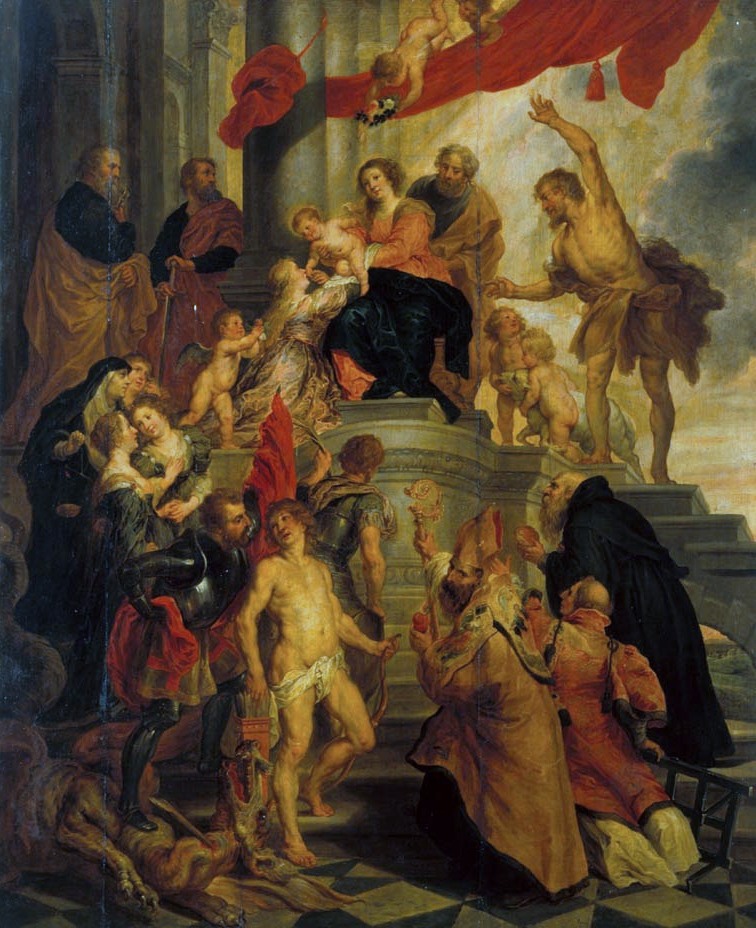
At the upper centre of the composition, the Virgin Mary holds the Christ Child upon her lap. Before Mary, Saint Catherine kneels in richly decorated clothing; the Christ Child reaches towards her, establishing the theme of the mystic marriage. On the right side of the scene, Saint John the Baptist, half-nude and dressed in animal skin, stands upon the steps with one arm raised.
Two male saints appear at the upper left, while clerics, military figures, children, and saints gather across the right and lower sections. A half-nude young male figure occupies the lower centre, while an animal and various sacred figures appear in the foreground. Above, red drapery and a putto provide the scene with a theatrical, celestial covering. The stairs, columns, and architectural background place the event within an ascending sacred order.
Three-Level Analysis Through Panofsky’s Method
Pre-iconographical Level
At the pre-iconographical level, the work presents a multi-figured composition rising vertically. The Virgin Mary and the Christ Child occupy the centre, with a kneeling female figure before them and saints, children, military figures, and members of the clergy surrounding them. Red, blue, gold, and dark fabrics separate the groups of figures. The stairs allow the scene to be read from the lower section upwards.
Iconographical Level
At the iconographical level, the title identifies the scene as the mystic marriage of Saint Catherine. The Christ Child’s movement towards Catherine signifies the establishment of a spiritual and divine bond distinct from earthly marriage. Mary is the principal witness to this union. Saint John the Baptist’s powerful gesture on the right carries his prophetic role of pointing towards Christ. The surrounding saints and clerical figures indicate that the event is not merely personal but a union approved by the entire sacred order.
Iconological Level
At the iconological level, the work constructs spiritual union as a sacred order taking place before a community. Catherine’s kneeling posture makes individual submission visible, while the Christ Child’s movement towards her represents divine acceptance. The stairs elevate the scene from the earthly realm towards the celestial centre. The painting therefore presents sanctity not merely as an inner experience but as a hierarchy made visible through architecture, body, gesture, and witnessing.
Representation – Gaze – Void
Representation
Representation is organised around the spiritual bond established between Saint Catherine and Christ, yet this bond does not remain confined to the two figures. Mary, the saints, putti, and witnesses surround the union and transform it into a public and theological scene. The work removes sacred marriage from the realm of an invisible bond of faith and turns it into a ritual that can be seen and witnessed.
Gaze
The gaze gathers towards the centre. The mutual orientation between the Christ Child and Catherine forms the principal axis of the scene. The surrounding figures either look towards this centre or support it through their gestures. The viewer is also incorporated directly into this order of witnessing, becoming not someone outside the event but another witness standing before the sacred community.
Void
The void appears around the steps and within the transitions between the groups of figures. The red fabric and celestial putto above enclose the scene from above, while the central space opened by the stairs becomes the setting of spiritual ascent. The contrast between the dark lower section and the illuminated upper centre emphasises the elevating power of the sacred event.
Style – Type – Symbol
Style
The work is constructed through brilliant fabrics, animated bodies, curving gestures, rich chromatic contrasts, and a multi-figured arrangement. The figures are not static; they are connected through kneeling, reaching, pointing, looking, and turning. The red drapery and golden tones provide the scene with ceremonial intensity.
Type
The Virgin Mary is the sacred mother and mediating centre, the Christ Child the divine bridegroom and saviour, and Saint Catherine the chosen spiritual bride. Saint John the Baptist is the pointing prophet, while the surrounding saints and clerics form the community of witnesses. The military figures carry the realm of earthly power, while the children and putti represent celestial joy and innocence.
Symbol
At the symbolic level, kneeling represents submission, while the Christ Child’s movement towards Catherine signifies spiritual union. The stairs represent ascent, and the red drapery signifies sacred ceremony and sublimity. Saint John the Baptist’s pointing arm strengthens the orientation towards Christ. The architectural columns indicate that this mystical event takes place not only within an emotional sphere but also within an institutional and cosmic order.
Explicit Identification of the Art Movement
The work should be evaluated within Flemish Baroque painting. Hendrick van Balen constructs the sacred subject through a multi-figured composition, animated bodies, rich colours, theatrical drapery, and an intense scene of witnessing. Baroque sensibility appears here not only through dramatic effects but through the transformation of the sacred event into a crowded, rhythmic, and ascending theatrical arrangement.
Conclusion
The Mystic Marriage of Saint Catherine presents spiritual union not as a silent and solitary inner experience but as a magnificent ritual taking place before the entire sacred community. Mary and the Christ Child occupy the centre, Catherine kneels before them, and the surrounding saints and witnesses form the visual environment of this divine bond. In Van Balen’s composition, the mystic marriage ceases to be an invisible bond of faith and becomes a monumental sacred scene constructed through bodies, steps, fabrics, and gazes.
