




Introduction to the Artist
René Magritte (1898–1967), the Belgian Surrealist painter, was one of the pioneers of an artistic language that questioned the unconscious, the paradoxes of thought, and the fragility of our perception of reality by placing everyday objects within unexpected contexts. Magritte’s art is not merely aesthetic but also philosophical; his paintings function like a chain of visual riddles.
In the mid-1920s, as he became associated with the Paris Surrealists, Magritte brought together Symbolism, Metaphysical Painting—particularly the influence of Giorgio de Chirico—and psychoanalytic associations.
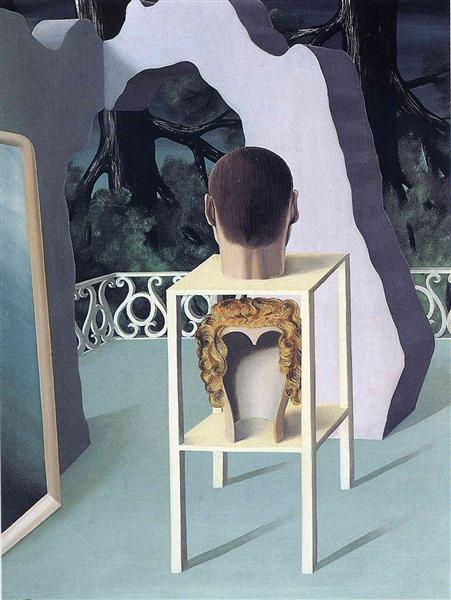
Painted in 1926, Le mariage du minuit (Midnight Marriage) is one of Magritte’s early works questioning the layers of identity, Representation, and reality. By dissolving the boundary between the figure’s visible appearance and its objectified Representation, the work confronts the viewer with uncertainty regarding the nature of being itself.
Introduction to the Work and Analysis of the Composition
In the foreground, a model in the form of a human head is placed upon a white frame or stand. The head is turned away from the viewer and seen from behind. Yet when viewed through the front of the frame, the head appears almost hollow, revealing another internal surface surrounded by golden-yellow curly hair.
A single object therefore presents two different and contradictory Representations at the same time.
In the background are dark trees and shadows resembling a nocturnal forest. On the right appears a form recalling a natural rock or cave opening, while on the left an apparent mirror introduces reflections and reversed images into the space. A white, curving iron railing in the middle ground functions like a boundary separating the scene from the external world.
The palette begins with cool and neutral tones. The golden-yellow hair becomes the only distinctly warm color and draws the viewer’s attention toward the head. Perspective follows the logic of a dream: figures, objects, and background do not establish a rational relationship with one another, yet they form a visually convincing whole.
René Magritte’s Midnight Marriage presents a human head simultaneously from behind and from within, questioning the nature of Representation. This Surrealist conflict between interior and exterior directs the viewer toward problems of identity and reality.
Three-Level Analysis through Panofsky’s Method
a) Pre-iconographical
A model of a human head is seen from behind within a stand or frame. At the front of the stand, the inner surface of the head becomes visible, though not realistically; it resembles a hollow wig mannequin. Trees, a cave-like opening, a white iron railing, and a mirror appear in the background.
b) Iconographical
The simultaneous visibility of the back and interior of the head overturns the relationship between subject, object, and Gaze. It corresponds to themes Magritte repeatedly explored: the impossibility of seeing and the dual nature of Representation.
The mirror evokes problems of identity and reflection, while the cave-like opening recalls Plato’s allegory of the cave, suggesting the boundary between reality and illusion.
Although the “outside” and “inside” of the head are displayed simultaneously, the interior does not reveal an organic skull but resembles a decorative wig stand. This introduces the possibility that the subject’s supposed inner truth may itself be an artificial construction.
The metaphor of marriage contained in the title suggests a union between night and day, visible and invisible, interior and exterior.
c) Iconological
At the deeper level of the work, Magritte’s existential and philosophical concerns become visible. Even when the human being attempts to look inward, what appears is still a Representation, an image; direct access to truth remains impossible.
The phrase Midnight Marriage suggests a moment at which consciousness and the unconscious, darkness and light, are brought together. Yet this union does not produce complete integration. It remains a state of continuing estrangement.
Identity is therefore not a fixed essence but an image continually reproduced, displaced, and fragmented.
Representation – Gaze – Void
Representation: The human head is represented not as a coherent portrait of an individual but as a hollowed object whose rear and interior views are presented in contradiction. This suggests the impossibility of the subject possessing a completely coherent image of the self.
Gaze: The figure itself does not look toward the viewer, yet the mirror in the background creates a potential field of Gaze. Within this world without reciprocal looking, the viewer becomes conscious of the act of seeing itself.
Void: The hollow interior of the head becomes more than physical emptiness; it becomes a Void of meaning. The nocturnal landscape and cave-like opening in the background extend this Void toward the unconscious and toward an inaccessible truth.
Style – Type – Symbol
Style: The work belongs to Surrealism. Magritte’s characteristic visual paradoxes, dream logic, and coolly precise rendering of figures and objects are clearly visible.
Type: The head becomes the antithesis of the traditional portrait Type. Rather than embodying personal identity, it becomes a Type of identitylessness and unstable selfhood.
Symbol:
- Back / interior of the head: The fracture between appearance and essence.
- Mirror: Reflection and the subject’s estrangement from itself.
- Cave opening: Threshold of truth and an echo of Plato’s cave allegory.
- Night landscape: Darkness of the unconscious.
- Golden hair: Artificial beauty and masked reality.
Conclusion
Le mariage du minuit—Midnight Marriage—is one of Magritte’s early works in which visual paradox is used to question the fragility of truth and identity. The contradiction between the interior and exterior of the head opens toward the idea that human knowledge of the self can never become complete.
The mirror, cave, and nocturnal landscape invite the viewer into the dark corridors of the unconscious.
Magritte does not merely construct a Surrealist scene; he visualizes the existential predicament of the modern individual: even when we attempt to look at ourselves, what we encounter is only another image.
