




Introduction to the Artist
Salvador Dalí (1904–1989) was one of the most recognizable representatives of Surrealism. The Spanish artist produced images that challenged the boundaries between reality and imagination not only in painting but also through sculpture, photography, and collaborations in cinema. Through the creative approach known as the paranoiac-critical method, he visualized the contradictions of the unconscious and the irrational world of dreams.
Salvador Dalí, 1939.
The second half of the 1930s was one of the most turbulent periods in Dalí’s personal and artistic life. Psychoanalytic references, eroticism, death, and existential anxiety became intertwined in the works of these years. Woman with Flower Head (1937) is an important work produced during this tense period, combining Surrealist imagery with erotic Symbolism.
Introduction to the Work and Analysis of the Composition
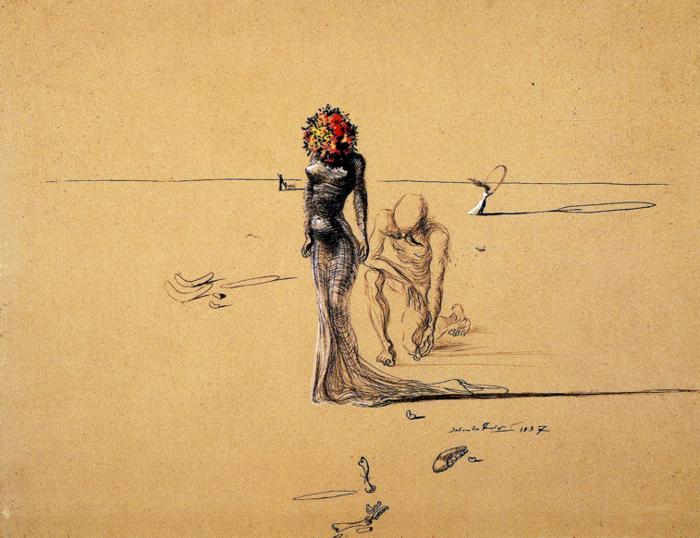
The painting presents a tall female figure whose nude body is covered by a black, veil-like dress. Instead of a face, her head consists of red flowers. Beside her is a crouching male figure; his head is lowered, and his hands appear to touch the ground. In the background, broad emptiness and several fragmented objects create the impression of a Surrealist desert landscape.
The dominance of line and the minimal use of color upon the paper reflect the graphic simplicity Dalí frequently employed during this period. While the elongated body of the woman is defined with erotic elegance, the flower-head represents both beauty and the erasure of identity.
Three-Level Analysis through Panofsky’s Method
a) Pre-iconographical
Two figures occupy an empty, desert-like ground: a woman standing in a long garment whose head is composed of flowers, and a crouching nude man. Small scattered objects and an expanse opening toward the horizon surround them.
b) Iconographical
Replacing the woman’s head with flowers substitutes a Surrealist conception of body and identity for conventional notions of beauty. The image contains an explicit reference to Freudian psychoanalytic thought: the flower-head becomes a Symbol of desire and eroticism.
As the shadow of war intensified across Europe during the 1930s, the human figure in Dalí’s paintings was repeatedly reconstructed as fragile, anonymous, and erotic.
Salvador Dalí’s Woman with Flower Head (1937) explores eroticism and loss of identity within a Surrealist Void. The flower-headed figure represents both the attraction and the alienation of desire.
c) Iconological
Woman with Flower Head is a profound allegory of the erasure of individual identity and the objectification of desire. The woman merges with the flower as a Symbol both of natural fertility and eroticism. Yet the absence of a face points toward the loss of individuality and the reduction of the subject to an object of desire.
The bent male figure beside her assumes a passive, almost enslaved position before this desire.
Representation – Gaze – Void
Representation: The female figure represents both eroticism and fertility, yet the absence of her face introduces incompleteness and anonymity into this Representation.
Gaze: The woman has no face, and therefore no Gaze is directed toward the viewer. Confronted with an empty identity, the viewer is compelled to supply desire and interpretation independently.
Void: Much of the composition is deliberately left empty. This Void intensifies the isolation and disconnection of the figures, as well as the disturbing silence of the Surrealist space.
Style – Type – Symbol
Style: Minimal use of line, a restricted palette, and Surrealist imagery are dominant. The female body is elongated through Dalí’s characteristic erotic-Surrealist aesthetic.
Type: The flower-headed woman belongs to one of Dalí’s recurring female Types: an image of desire that is simultaneously idealized and fragmented. The crouching figure beside her becomes a typical collapsed body, symbolizing human vulnerability and submission.
Symbol:
- Flower-head: Desire, beauty, fertility, and at the same time loss of identity.
- Crouching man: Passivity, powerlessness, and submission.
- Empty desert space: The loneliness and absurdity of human existence.
Conclusion
Salvador Dalí’s Woman with Flower Head is a striking example of the erotic and psychoanalytic dimensions of Surrealism. The erasure of identity, the objectification of desire, and the isolation of the human figure appear here in an especially restrained yet disturbing form.
Through Void and distorted imagery, Dalí gives visual form to both individual and cultural alienation.
