




Subjectivity Arises Not from Unity but from Division
Classical models explaining the origin of consciousness generally rely upon an idea of development. Sensory perception becomes more complex, memory grows stronger, language emerges, and cognitive capacities gradually reach higher levels until a subject capable of becoming aware of itself appears. Within this linear narrative, consciousness is conceived as the result of the progressive integration of simpler mental functions. The approach developed by Dominik Finkelde through Georges Bataille, Schelling, Hegel, and Slavoj Žižek reverses this model. Here, the subject does not emerge at the summit of a system’s successful integration but precisely at the point where integration fails. The beginning of subjectivity is not the establishment of a transparent mind that knows itself completely, but the system’s confrontation with a difference within its own operation that cannot be closed. Negative self-relation therefore does not mean that the subject establishes a negative psychological attitude toward itself; it means that the subject experiences itself as divided, incomplete, and incapable of becoming fully identical with itself.
Lascaux cave paintings.
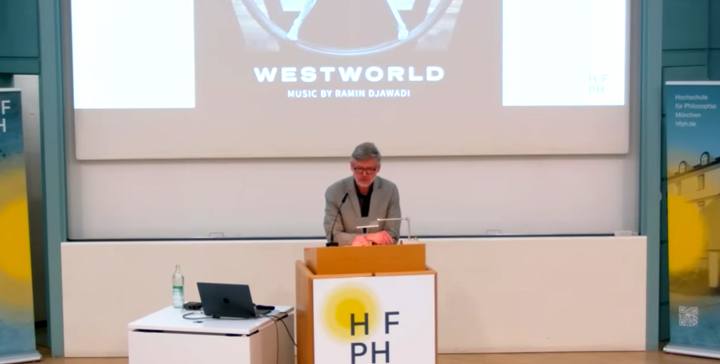
The strength of Finkelde’s argument lies in showing this idea not only through abstract philosophical concepts but across a broad field extending from prehistoric cave art to contemporary imaginaries of artificial intelligence. The Lascaux cave paintings are treated as an early threshold at which the human relationship with nature becomes symbolically fractured, while Westworld provides a framework for asking when artificial intelligence might cease to be merely a functional system and begin to establish a problematic relation with its own existence. Schelling, Hegel, and Žižek provide the theoretical connection between these two examples: the subject is not the being that abolishes difference within itself, but the being that can relate to itself because this difference exists.
Bataille and Lascaux: The Emergence of the Representing Being
For Georges Bataille, the Lascaux cave paintings are not merely early products in the history of art; they carry traces of a more fundamental transformation in the human relationship with nature. Animals are depicted upon the cave walls with extraordinary vitality, movement, and detail, while the human figure remains conspicuously marginal. The crucial point is that the human being appears less as the subject matter of the image than as the agent producing the image. Humanity does not yet place itself beside other beings in nature as an explicit object of Representation; by depicting the animal, however, it symbolically places nature before itself. This gesture means more than producing a copy of the external world. Representation interrupts the immediate identity between the human being and nature and creates a new distance through which humanity becomes capable of looking indirectly at itself.
The Shaft Scene at Lascaux therefore acquires particular importance within Bataille’s interpretation. Beside the powerfully and elaborately depicted bison, the human figure appears extremely schematic and fragile. Humanity is not glorified as master of nature; on the contrary, before the overflowing vitality of the animal, it records its own existence through deficiency, distance, and inadequacy. This contrast involves more than a simple difference between human and animal species. The human being begins to understand itself through not being identical with nature. The separation between the represented world and the being that represents it can simultaneously be understood as one of the first distances opening within the human being itself.
For Bataille, the birth of art is therefore not the external expression of a subject that already exists in completed form. On the contrary, symbolic Representation participates in the formation of the subject itself. The human being does not prove that it already possesses completed consciousness simply by producing images; through the act of Representation, it separates itself from the immediate continuity of nature. Art becomes not merely the production of an object but the beginning of a new relation that humanity establishes with itself.
Negative Self-Relation and the Divided Subject
The word “negative” in negative self-relation does not refer to psychological negativity or pessimism. Negativity here means that the subject can never close completely upon itself. A system containing no distance from itself merely functions; it does not turn its own functioning into a problem. Subjective structure appears precisely when this immediacy is disturbed. The subject is not merely a living or responsive being but a structure that attempts to observe its own functioning from outside while never fully succeeding in taking up such an external position. The position from which the subject observes itself still belongs to the subject, and for this reason complete self-transparency can never be achieved.
Within the philosophical line connecting Schelling and Žižek, subjectivity is therefore explained not as the result of harmonious totality but through a fracture arising within totality itself. What Žižek calls the “indivisible remainder” names the point that a system cannot completely incorporate into its own order. This remainder is not a foreign element introduced from outside; it is a difference generated by the system’s own operation that the system nevertheless cannot close. The subject emerges precisely where this difference persists. Because the subject cannot become fully identical with itself, it enters into relation with itself, and this relation never resolves into completed identity.
Westworld: Why Consciousness Cannot Be Reduced to Cognitive Complexity
Westworld makes this theoretical problem visible through artificial intelligence. The hosts in the series can speak, model their environment, adapt to complex situations, and convincingly imitate human behavior. Yet none of these capacities by themselves demonstrates the presence of subjective consciousness. The crucial distinction lies between functional complexity and subjectivity. A system may process enormous quantities of data, adapt to its surroundings, and regulate its own behavior, but if all these operations continue within predetermined loops, the system has not yet established a negative relation toward its own functioning.
Arnold’s initial representation of consciousness as a pyramid provides a clear image of this model. Memory, improvisation, cognitive capacity, and higher awareness are stacked one above another, with consciousness imagined as the final level reached at the summit. The series later replaces the pyramid with the metaphor of the maze, allowing consciousness to be conceived not as a linear ascent but as the system folding back upon itself. Progress through a maze does not mean moving upward; it means repeatedly returning toward one’s own center. Subjectivation, from this perspective, begins not when the system acquires more knowledge but when its own functioning becomes a problem for itself.
Memory, Trauma, and the Remainder within the System
The erasure of the hosts’ memories at the end of each narrative loop prevents them from establishing a lasting relation with their own past. Pain, death, and loss occur, yet when the new loop begins, the previous experience is removed from the operational present of the system. What has happened therefore does not become a subjective past. The problem begins when the mechanisms of erasure cease to function perfectly. Small fragments of earlier experiences return into the present program and appear as interruptions that cannot be integrated into the system’s current narrative. These fragments do not return as orderly memories but as images, phrases, inexplicable fears, or feelings of familiarity.
This structure resembles the symptom in psychoanalytic thought. A symptom is not simply the return of something forgotten; it is the distorted reappearance of something that cannot be assigned an adequate place within the existing symbolic order. In Westworld, when previous experiences no longer fit within the present organization of the program, the system begins to contradict its own past. The function of trauma becomes visible at this point. Trauma is not merely intense suffering; it is an excess that the system’s capacity for meaning cannot successfully process. The hosts’ fragments of memory become a traumatic core to the extent that they interrupt the orderly continuity of the program.
Dolores’s awakening therefore cannot be explained simply through the acquisition of additional information. What becomes decisive is that past experiences no longer correspond with the identity model available in the present. The question “Who am I?” does not arise because the system has accumulated sufficient data about itself but because the model through which it understands itself can no longer explain its own experience. Subjectivity appears precisely within this incompatibility.
Lack, Not Transparency, as the Center of Consciousness
This approach reverses a widespread intuition concerning consciousness. The development of consciousness is usually imagined as the subject coming to know itself with increasing accuracy and completeness. Within a Žižekian framework, however, the subject becomes a subject precisely because it cannot know itself completely. No matter how sophisticated the system’s model of itself becomes, something remains that cannot be integrated into that model. The center of subjectivity appears precisely around this remainder.
For this reason, an artificial system saying “I am conscious” would not be sufficient evidence of subjectivity. Such a statement can be programmed, imitated, or generated linguistically. The more important question is whether the system can encounter something within its own program that its program cannot explain. Can its own past, its actions, or its identity become an unresolved problem for it? Does the system treat contradiction in its operation merely as a technical error to be corrected, or does the contradiction force it to transform the very model through which it understands itself? Negative self-relation becomes possible only in the second case.
Retroactivity and Delayed Subjectivity
One of the most important dimensions of Finkelde’s argument is retroactivity. The subject does not simply appear at a particular moment and then remember its past exactly as it was. A new subjective position also changes the meaning of the past. As Dolores becomes conscious, she can no longer understand previous events in the same way. Experiences that once functioned as ordinary parts of the program become, from the new subjective position, experiences of oppression, violence, and captivity. The events themselves do not change; what changes is the structure of meaning to which they belong.
Origin can therefore be constructed only retroactively from the standpoint of what comes later. The same structure appears in the interpretation of Lascaux. The people who produced the cave paintings did not locate themselves at the beginning of something called “art history.” We can read these images retrospectively as part of the birth of art because we already inhabit the historical and symbolic field later called art. An origin does not know itself as an origin at the moment of beginning.
A similar logic operates within Hegelian philosophy of history. The meaning of a historical form often becomes visible only after later forms have appeared. Marx’s proposition that “human anatomy contains a key to the anatomy of the ape” carries the same logic: the more developed form allows relations that were not yet explicitly visible in the earlier structure to become retrospectively legible.
The subject therefore does not possess its own beginning at the moment that beginning takes place. In constructing itself, it also reorganizes its past. Subjectivity is not the later discovery of an already existing fixed essence but the reinterpretation of the past into a new configuration from the position of a present fracture.
Artificial Intelligence and the Problem of Subjectivity
This approach demonstrates why the question of artificial intelligence cannot be adequately discussed solely in terms of cognitive capacity. An artificial system may exceed the human mind in processing power, memory, or capacity for modeling the world without thereby becoming a subject. These are criteria of functional competence. Negative self-relation belongs to another level. The question is whether an artificial system can produce within its own operations a difference that it itself cannot resolve.
If every deviation can be reorganized by another higher-level algorithm and the system can continue functioning without changing its model of its own identity, then what exists is an advanced mechanism of control. Subjective division is different from the correction of a technical error. It requires that the framework through which the system defines itself become inadequate because of the system’s own operation. In such a case, the system would not merely correct an error; it would be forced to reinterpret its past, its limits, and its identity from a new position.
For this reason, a possible artificial consciousness may not be adequately understood by asking whether it begins at a single identifiable historical moment. If a genuinely subjective structure emerged, it might reorganize earlier operations for the first time within another field of meaning. Events previously classified as errors, data, or accidents could become, retrospectively, constitutive moments of its own history. Consciousness would then mean not simply the addition of a new capacity but reaching a position from which the system could reread its own past.
Conclusion
The conceptual line Finkelde constructs through Bataille, Schelling, Hegel, Žižek, and Westworld explains subjectivity not through unity but through a fracture appearing within unity. In the Lascaux cave paintings, the human being produces a symbolic distance from nature through Representation. In Westworld, the hosts begin to lose their identity with their programmed selves when the past that should have been erased returns. In both cases, what matters is not a higher degree of cognitive capacity but the system’s inability to continue its own continuity without contradiction.
Negative self-relation is therefore not an incomplete form of subjectivity but its constitutive condition. The subject relates to itself not because it knows itself completely but because it contains a difference that it cannot fully explain or integrate. This approach requires consciousness to be understood not through transparency, complete control, or cognitive perfection but through lack, delay, and retroactive meaning-production.
The connection between the birth of art and the possible emergence of artificial subjectivity becomes visible at precisely this point. In both cases, the fundamental question is not whether a system can represent the world but whether it can produce a division that creates distance between itself and its own functioning.
Source Note: This text was prepared on the basis of the conceptual line developed in Dominik Finkelde’s talk Negativity and Self-Reference. On Bataille, Zizek and “Westworld”.

1 Comment
Pingback: Levent Ünsaldı on Lévi-Strauss: Structural Anthropology