




Brief Introduction to the Artist
Claude Monet (1840–1926) was one of the founding figures of Impressionism. Known for his effort to capture the moment, light, and atmosphere in painting, Monet is regarded as an artist who transformed both the observation of nature and visual perception. The Impressionist movement, which emerged during the 1870s, advocated painting the effects of light and color obtained through direct observation at the level of impression rather than through detailed description. Monet’s Impression, Soleil Levant (1872) gave the movement its name.
The artist generally constructed the relationship between nature and the human figure through silence, light, and permeability. Gardens, water surfaces, misty mornings, and flower-lined paths recur throughout his visual memory.
Introduction to the Work and Composition Analysis
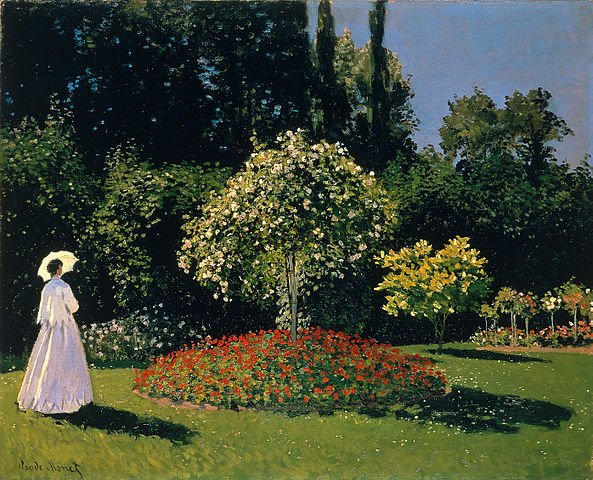
In Woman in the Garden, a tree covered with white blossoms stands in the middle of an expansive flower-filled area. Immediately to its left is a woman dressed in light-colored clothing. Wearing a large hat that places her face in shadow, the figure establishes the compositional balance together with the tree. The dark green trees and blue sky in the background make the pale lawn and floral arrangements more distinct.
The colors are highly vivid, while the brushstrokes remain more controlled than those associated with Monet’s mature Impressionist style. Under direct sunlight, the woman’s white clothing creates an almost luminous effect. The red flowers arranged beneath the central tree draw the eye toward the middle of the composition.
The painting represents a space shaped by human intervention without becoming artificial: the garden, together with the woman within it. The woman does not occupy the center; she stands at the side as a relatively passive observer or passerby. Yet her presence quietly determines the meaning of the composition.
Three-Level Analysis through Panofsky’s Method
a. Pre-iconographical Level
A tree surrounded by flowers stands within a green garden. On the left, a woman in a long white dress and a hat appears to be walking. Dark trees occupy the background, while smaller trees with yellow leaves and various floral arrangements appear on the right. The sky is clear, creating the impression of an afternoon setting.
b. Iconographical Level
The relationship between garden and woman is a theme frequently encountered in Impressionism: the human figure within nature. The woman’s clothing carries the codes of decorum and elegance associated with the Victorian era. Her hat and white dress provide both protection from the sun and a form of moral covering. Here, the woman is a figure experiencing nature. At the same time, as a presence incorporated into the order of the garden, she assumes a posture as “silent” as that of the flowers and trees.
c. Iconological Level
The woman’s position within nature emerges as a visual metaphor of silence. Monet constructs no narrative here; there is neither an event nor a defined action. Instead, we witness an expanded moment in time. The woman does not appear to be going anywhere, and the tree remains still. Everything seems to be waiting, surrendering itself to the passage of light.
This condition forms the basis of Impressionist perception: the world can be understood not by describing it but by watching it. In this sense, the female figure becomes a transitional element between the viewer and the painting. We do not look directly at her body but at the way light touches it. The woman is not a subject but a surface that attests to the presence of light.
Explicit Identification of the Art Movement
This work belongs to Impressionism. The defining features of the Impressionist style — direct observation, changing effects of light, figurative ambiguity, and atmospheric color — are clearly present in Monet’s painting.
A Body in Silence: Following Representation and Gaze
In Monet’s Woman in the Garden, the female figure is not merely a person walking through nature but a presence that almost merges with its rhythm. Her face remains unseen, and her movement is uncertain. She seems to exist only to reveal how light touches her. This mode of representation transforms the woman from an active subject into an object of silence absorbed into nature.
The woman does not establish eye contact with the viewer; even the direction of her gaze remains concealed. This closure draws the figure inward and distances her within representation. The intervals between the woman and the tree, as well as the lack of contact between the figure and the viewer, produce silence not only spatially but also within representation itself.
Within Monet’s Impressionist world, the figure is not an individual with a story but a surface witnessing the passage of light. The woman exists together with nature; she does not transform it but bears witness to it.
Conclusion: A Silence Constructed through Light
Claude Monet’s Woman in the Garden is an early work that carries the fundamental principles of Impressionism without yet becoming excessively stylized. The female figure is positioned gracefully within nature, yet this grace does not express a role; it visualizes surrender to the movement of light.
Monet neither transforms womanhood into a mythological figure nor places it within a dramatic narrative. He simply paints the way light touches flowers and a woman’s clothing at a morning hour. This represents a position that summarizes the full depth of Impressionism.
