




Introduction to the Artist
Edvard Munch (1863–1944) is one of the founding figures of Northern European modernism and Expressionism. His childhood in Norway was marked by illness, death, and religious guilt; these early traumas return throughout nearly all of his work as bodily vulnerability and existential anxiety. As in paintings such as The Scream, Death in the Sickroom, and Vampire, Puberty carries a psychological threshold onto the canvas through intense emotional tension. For Munch, the body—particularly the female body—is a stage less for sexuality than for anxiety, loneliness, and guilt.
Introduction to the Work and Composition
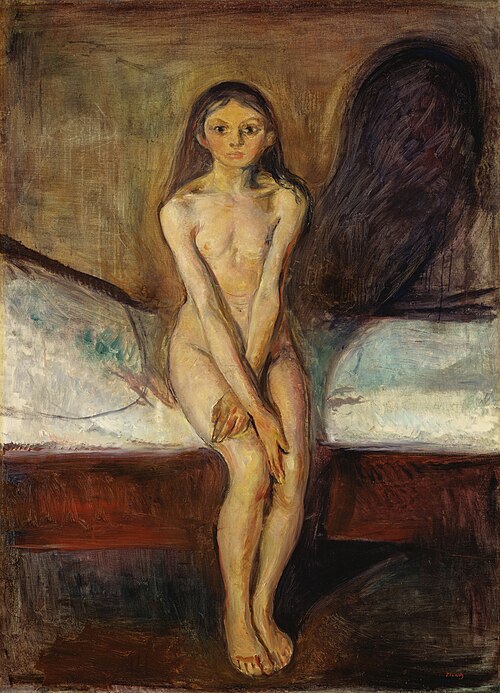
In Puberty, a single young figure sits on the edge of a bed in a narrow room. The nude body is depicted frontally in an almost symmetrical posture; the hands attempt to cover the pubic area, the shoulders fall forward, and the torso contracts slightly inward. Behind her are a pale bedsheet and a dark, dense shadow rising along the wall. A reddish-brown strip on the floor defines the underside of the bed and the ground. The room is almost completely empty: there is no furniture, ornament, or curtain. The entire painting is reduced to the triangle of figure, shadow, and bed.
Three-Level Analysis through Panofsky’s Method
Pre-iconographical Level
A young girl sits on the edge of a bed within a narrow interior. She is nude, with long hair falling over her shoulders. She sits with her hands clasped in front of her legs and her feet close together. Behind her, a dark shadow rising upward from her body appears along the wall almost like an independent figure. The bedsheet is white, the wall yellowish-brown, and a reddish tone dominates the floor. The brushstrokes are irregular and the surface is rough in places.
Iconographical Level
The title of the painting is Puberty, referring to the transition into adolescence. We see a figure whose body has not yet fully matured and whose expression appears caught between childhood and adulthood. The gesture of covering herself with her hands evokes privacy, shame, or protection. The bed is a space capable of simultaneously evoking sexuality, illness, and death. The shadow behind the figure functions like a visual equivalent of the fear, guilt, and anxiety toward the unknown emerging at this threshold.
Iconological Level
In Munch’s life, the death of his sister from tuberculosis, the early loss of his mother, strict Protestant morality, and the guilt he felt toward sexuality coded every exposure of the body as a moment of crisis. Puberty therefore concerns not only the biological transformation of a young girl but also the modern individual’s alienation from the body. The poverty of the room, its almost cell-like character, combines with the shadow to symbolize “anxiety locked inside”; this carries the existential tone that extends throughout Munch’s work. Adolescence here is not merely a biological threshold but also a metaphysical one: the weight of existence descends upon the body.
Representation – Gaze – Void
Representation
At the level of representation, the painting does not repeat the cliché of the “loss of innocence”; instead, it shows a subject newly becoming aware of her own body and uncertain about what to do with that awareness. The gesture of covering herself with her hands is both a defense against the gaze coming from outside and an expression of hesitation within a newly forming relationship to the body. The bed ceases to be the place of childhood sleep and becomes a threshold where sexual identity, illness, and the possibility of death overlap.
Gaze
The matrix of gaze is highly tense in this painting. The young girl’s gaze does not settle completely on the viewer; it slips slightly to the side, seeming to look simultaneously into emptiness and outward. This evasive gaze unsettles the viewer’s position and disrupts the comfort of “looking.” It is as though the figure, ashamed before a judgmental gaze imagined beyond the painting, also senses that our own gaze has come “too close.” Munch thus reverses the voyeuristic tradition of nudity often encountered in modern painting; the nude body is present not to be observed but to make the violence of looking visible. The shadow behind her functions like a second layer of gaze: a dark self emerging from the figure and watching her from behind.
Void
The void emerges through the room’s almost exhausted simplicity. The walls are bare; apart from the floor and bed, there are no objects. This absence intensifies the loneliness concentrated around the figure. The dark field condensed within the shadow becomes both a spatial void and a psychological “hole”: marginalized desires, fears, and guilt accumulate there. Through this void, the work also opens a space for the viewer’s own memories of adolescence and bodily experience.
Style – Type – Symbol
Style
Munch’s style oscillates between late Symbolism and early Expressionism. The body deviates slightly from natural proportions and is rendered through exaggerated lines, particularly in the hands, face, and torso. Brushstrokes are at times harsh and at others applied in translucent layers; cool browns, dirty whites, and the reddish ground give the painting an uneasy atmosphere. Anatomical accuracy is not the objective; only as much reality as is needed to carry psychological tension is retained, while the rest is distorted in favor of emotion.
Type
The young girl in the painting represents less the portrait of a specific model than the type of the “solitary young individual of the late modern period.” She is neither a mythological figure nor an idealized classical nude but an ordinary, vulnerable young body outside the protections of social security. She also occupies one side of the duality frequently encountered in Munch’s female figures: not the “dangerous seductress,” but the vulnerable subject surrounded by her own inner fear.
Symbol
The shadow carries the unconscious fears and repressed desires associated with adolescence with symbolic intensity; it appears almost like a second being detached from the figure and attached to the wall. The white sheet simultaneously carries associations of childhood innocence and the hospital or morgue; the cold light falling across the body intensifies this double meaning. The reddish strip along the floor introduces undertones of blood, shame, and danger into the painting. The body therefore becomes the stage not only of biological transformation but also of consciousness of sin, guilt, and mortality.
Explicit Identification of the Art Movement
Puberty is chronologically positioned between Symbolism and Expressionism. The simplicity of the composition, the desire to foreground psychological intensity, and the distortion employed through shadow and color make it an early Expressionist work. At the same time, the conceptual weight of the title and the imagistic use of the shadow correspond to a Symbolist sensibility. By radically breaking with classical ideals of beauty and the academic tradition of the nude, the painting provides an important transition toward modern art’s “painting of the inner world.”
Conclusion
Munch’s Puberty does far more than show a nude young girl; it visualizes an unnamed anxiety descending upon the body, the silent crisis of adolescence. At the level of representation, the body carries the threshold between innocence and guilt; at the level of gaze, a tension is established that unsettles the viewer and forces them to question their voyeuristic position. Void and shadow bring forward the darker side of this threshold—the fears that identity has not yet learned to name. Style, type, and symbol together transform Puberty from a moment of biological transition into a fundamental modernist icon of the troubled relationship modern humanity establishes with the body, sexuality, and mortality.
