




Introduction to the Artist
Egon Schiele (1890–1918) represents one of the sharpest lines of Viennese modernism. He transforms Klimt’s decorative legacy through psychological nakedness and hard contour; he flattens volume across the surface, fractures the body, and transfers emotion into line. The year 1915 marks Schiele’s movement toward a darker and more inward language under the shadow of war: he was conscripted, and although he was released from service shortly afterward, the emotions of death and separation increasingly weighed on his paintings. This work becomes the image of both a personal and historical threshold—marriage, farewell, and the shadow of war.
Introduction to the Work and Composition Analysis
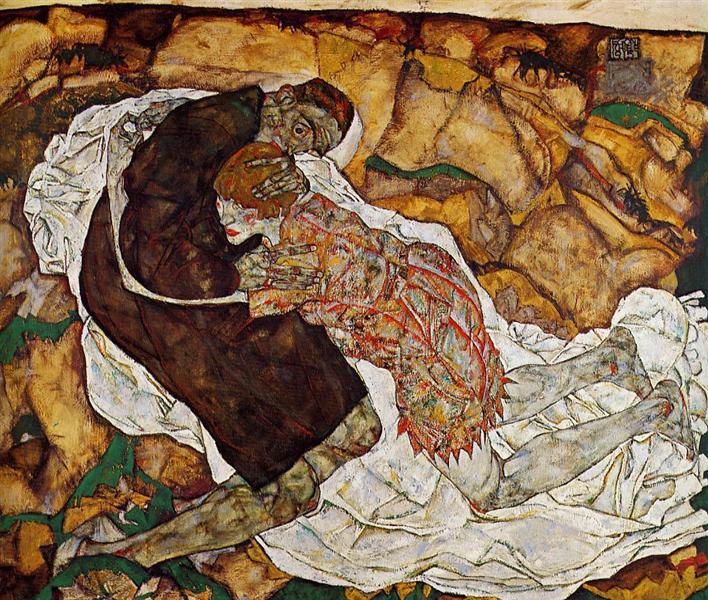
The canvas is viewed almost entirely from a low, ground-level plane. On the left, the figure of “Death,” dressed in a dark brown robe with the head covered, kneels; on the right, the young woman in a patterned, thorn-like dress presses herself into him, her face marked by red lips. Together, they kneel or lie upon a white cloth, which evokes both shelter and shroud. The background consists of a cracked stone/earth texture: yellow-ochre patches are split by green fragments; rather than functioning as landscape, it operates like a broken ground.
The composition develops through a closed ellipse and fractured diagonals. Death’s arm completes the ellipse as it holds the young woman’s head; the legs and folds of the cloth flow toward the right, reinforcing the diagonal structure. The figures’ flesh is lead-grey, almost petrified through veins, bruises, and broken lines. The red-green web-like pattern of the girl’s dress creates a thorny texture across the surface, while the brown mass of “Death” descends like a heavy object. The folds of the white cloth form the only luminous field in the scene; they simultaneously separate and bind the figures.
Schiele brings the faces close to masks: the eyes of Death are dark, with a gaze that seems almost dislodged, while the young woman’s eyes are closed and her head is buried against the chest. The hands speak as strongly as the faces: broad fingers grasp the head, fingertips hold onto the body, and a thin boundary trembles between flesh and fabric. The ground does not establish perspectival space; the painting resembles a flat map stretched between earth and body.
Three-Level Analysis through Panofsky’s Method
Pre-iconographical Level
Two kneeling figures; a man in a brown robe, a young woman in a patterned dress; a white cloth; cracked stone or earth ground; skeletal hands and feet; a flattened surface; red lips.
Iconographical Level
The title evokes the long-standing “Death and the Maiden” theme extending from the Middle Ages. Death is not a skeleton here but a living yet death-like figure wrapped in a brown robe. The embrace carries a double meaning: prey and consolation, separation and attachment. The white cloth oscillates between shroud and bed; the cracked ground suggests the fragility of the world being inhabited. The girl’s closed eyes and red lips carry Eros and farewell simultaneously.
Iconological Level
In 1915, war formed part of the everyday atmosphere of Vienna; ruptures in Schiele’s private life—marriage, farewell to a former lover, military service—add a personal resonance to the theme. The work is not merely a Vanitas warning but the collision between bodily embrace and the consciousness of finitude. Death is represented not as an external enemy but as a fate that has entered the beloved. The cracked ground transfers time and decay into the body; human being and world become joined within the same map of fracture.
Representation – Gaze – Void
Representation
Volume is constructed not through classical modeling but through contour and texture. Flesh appears cold as stone; clothing is as hard as a thorny net. Material—paint itself—seems to become the fate of the body.
Gaze
The figures close in upon one another; they do not seek eye contact with the viewer. The scene is not an outward display but an inwardly closed farewell.
Void
The background is not a landscape but a broad negative field woven through the rhythm of cracks. The white cloth surrounding the figures becomes the only soft region within this hard void, creating a sense of refuge.
Style – Type – Symbol
Style
The distinctive language of Central European Expressionism: nervous, fractured contour; flat and hard color fields; veined texture. Schiele transforms Klimt’s decorative quality into an emotional fissure.
Type
A modern interpretation of the “Death and the young woman” type; humanized Death instead of a skeleton, bodily encounter instead of allegorical distance.
Symbol
The white cloth signifies refuge and shroud; the brown robe, weight and inevitability; the cracked ground, the map of time; the red lips, a spark of life; skeletal hands, a gesture oscillating between holding on and letting go.
Explicit Identification of the Art Movement
The work belongs to Expressionism: psychological tension is carried through deformation and emphasis on surface. Rather than naturalistic depth, the organization of the surface is fundamental; color and line become carriers of emotion. At the same time, the work represents a rupture from the decorative plane of the Austrian–Viennese Secession after Klimt: pattern is no longer ornament but resembles wounded skin.
Conclusion
Death and the Maiden condenses Schiele’s major statement into a single embrace: life establishes proximity with its own finitude. The dialectic between the dark robe and the white cloth holds two faces of existence together; the cracked ground reminds us of the fragile foundation upon which this union takes place. The figures are neither condemned nor exalted; they simply reveal how remaining together and farewell can exist within the same gesture. Schiele’s achievement lies in transforming ethical and existential tension not into narrative but into form: fractured contour, thorny texture, elliptical closure, and the silence of the white cloth.
