




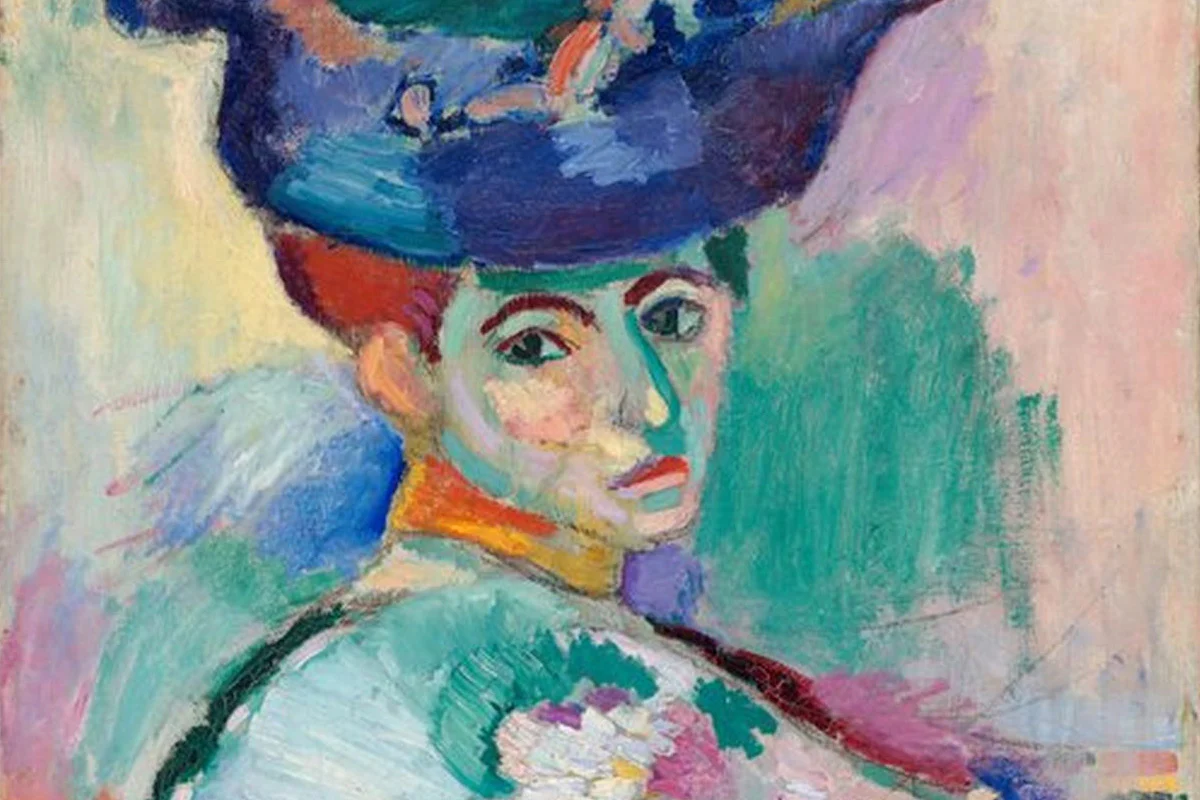
Henri Matisse’s Woman with a Hat (Femme au Chapeau), painted in 1905, is not simply a portrait of his wife Amélie; it is the visual equivalent of a moment of rupture that profoundly shook twentieth-century art history. The proclamation of Fauvism, the aesthetic revolution within figurative painting, and modern art’s cry for liberation all emerge through this work. Matisse’s painting is critically important not only for its understanding of form and color but also because it raises fundamental questions about the meaning and purpose of art and the crisis of representation.
The Historical Context of Fauvism and the 1905 Salon d’Automne in Paris
When paintings by young artists such as André Derain, Maurice de Vlaminck, Henri Manguin, and Matisse were exhibited at the Salon d’Automne of 1905, Woman with a Hat stood out as one of the most radical works among them. Viewers were confronted not primarily by the woman’s face but by the violence of the brushstrokes, the unexpected use of color, and the almost caricatural form of the figure. The art critic Louis Vauxcelles mockingly described the group as the fauves—the “wild beasts.” From that moment onward, this radical group became known as Fauvism.
Yet this “wildness” was not a primitive or uncontrolled form of expression. It was a deliberate aesthetic choice that overturned the centuries-old representational order of classical painting. Matisse’s Woman with a Hat reflects this destruction almost like a mirror.
A Portrait of Matisse’s Wife Amélie, or a Rebellion of Color?
At first glance, the painting recalls the composition of a classical portrait. The woman is seated; she wears a large hat, has a slender, elegant neck, and appears in fashionable clothing suggesting an upper-class female figure. Yet a gaze approaching the portrait in these terms is overturned within seconds. The face is not modeled through transitions of light and shadow but through intense and seemingly unrelated colors such as green, orange, blue, violet, and red. These colors are expressive rather than descriptive. They resemble not the color of flesh but the intensity of an emotion.
Matisse’s aim is not to reproduce his wife’s physiognomy exactly but to reveal an inner emotional state, an impression of the surrounding environment, and the intuitive relationship the painter establishes through color. Amélie’s expression is not fixed. It seems to oscillate among joy, melancholy, anger, and acceptance. One eye is painted darker and the other lighter; this represents not symmetry but emotional complexity.
Color: An Instrument Not of Description but of Creation
In classical painting, color serves form; it is used to describe nature and to create the illusion of three-dimensionality. Matisse reverses this relationship and places form at the service of color. Color is no longer simply an instrument of representation but becomes a direct means of creation. In this respect, Woman with a Hat embodies one of Fauvism’s fundamental aesthetic principles: color becomes an essence capable of carrying emotion directly.
The green used on Amélie’s face, for example, does not carry the conventional meaning of illness or a literal association with nature. Here, green corresponds to an emotion, even to something arising from Matisse’s own inner world. The explosions of blue, green, and orange in the hat transform the upper part of the figure into an almost abstract decorative plane.
Matisse’s use of color also differs from that of the Impressionists. Whereas the Impressionists used color according to the fragmentation of natural light, Matisse treats color as a field of mind and intuition. The break from Impressionism therefore becomes unmistakable.
Brushstrokes and the Flattening of the Surface
Matisse does not conceal his brushstrokes; on the contrary, he makes them visible across the surface of the painting. This visibility brings forward not the subject matter of the figure but the materiality of the painting itself. The illusion of depth based on Renaissance perspective gives way to a flat and decorative conception of surface.
The flattening of the pictorial surface is simultaneously a rebellion against the representational epistemology of Western art. Painting is no longer a window; it becomes as concrete, immediate, and intuitive as wallpaper. This is one of the fundamental positions that makes Matisse not only a Fauvist but also a modernist artist.
A Tense Relationship with the Viewer
In classical portraiture, the viewer may establish eye contact with the figure, creating a sense of communication. In Woman with a Hat, however, the figure’s gaze is unstable and does not settle firmly upon the viewer. The dissonance of the colors and the formal character of the surface make it difficult for the spectator to approach the painting as a unified illusion. The viewer can no longer “enter” the painting in the classical sense but is forced to maintain a distance from it. The aesthetic experience therefore shifts from the “beautiful” toward the estranging.
The shock effect of Fauvism becomes visible here as well: what matters is not what is “beautiful” but what is intense. Art is no longer merely a space of emotional comfort but a source of tension capable of stimulating and disturbing consciousness.
The Crisis of Fauvism: Brief but Transformative
Although Fauvism was a relatively short-lived movement within art history, its effects were long-lasting. One of its greatest contributions was the fundamental transformation of art’s relationship with the subject. Matisse’s Woman with a Hat is one of the earliest, boldest, and most disruptive examples of this transformation.
Color, figure, composition, viewer, and surface are all redefined within the work. The path of modern painting would henceforth be constructed not primarily through representation but through intensity and immediacy. For this reason, Woman with a Hat is not merely the emblem of a period but a signal of a profound transformation in artistic consciousness.
Conclusion: Not the Painting, but Color Itself
Woman with a Hat is not simply a portrait. It is a declaration of the independence of color and a manifesto for art’s liberation from the burden of representation. Matisse paints not merely a figure but the nature of painting itself. Figure, color, line, and surface are equalized upon the same plane, compelling the viewer to reconsider the new meanings of art.
In this sense, Woman with a Hat remains one of the most iconic and most debated works of Fauvism. The aesthetic transformation initiated by Matisse through this painting marks not merely the birth of a style but one of the birth moments of modern art itself.
