




Introduction to the Artist
Marc Chagall is one of the artists who stands out within modern art through his distinctive language of dream, memory, love, Jewish folklore, animal imagery, village life, and fairy-tale figures. In his paintings, reality often does not conform to the ordinary rules of space; figures fly, animals occupy the same emotional plane as human beings, and colours carry inner atmosphere rather than merely describing objects. For Vava is a characteristic example of Chagall’s image-world centred on love and memory. The name Vava is associated with the artist’s second wife, Valentina Brodsky; the work can therefore be read not merely as an image of a woman, but as a dreamlike portrait dedicated to personal love.
Introduction to the Work and Composition
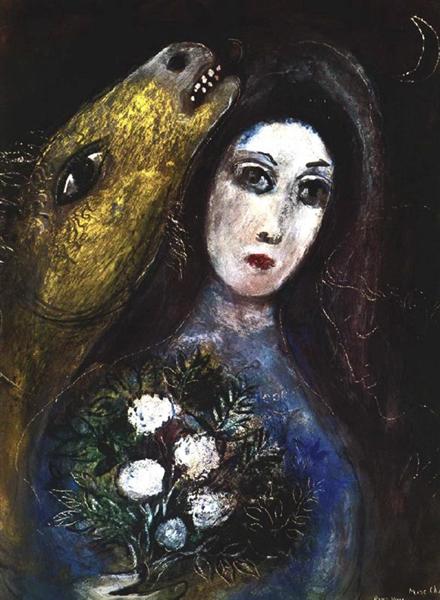
Against a dark nocturnal background appears a female figure with a white face. Her body is rendered in blue tones, and she holds a bouquet of white flowers in her hands or before her chest. On the left, a fairy-tale animal head in yellow-green tones appears close behind the woman’s head. In the upper right is a slender crescent moon. The centre of the composition is formed by a knot of love and memory between the woman’s pale face and the bouquet upon her chest; the animal head and moon open this knot toward night and the realm of dream.
Three-Level Analysis through Panofsky’s Method
Pre-iconographical Level
The painting contains a female figure, a bouquet of flowers, a large animal head, and a crescent moon against a dark background. The woman’s face is rendered in pale white tones, and her eyes are large and pronounced. Her hair is dark, while her body is painted in blue tones. The animal head on the left is very close to the woman; its mouth is open and its teeth are visible. The flowers appear as white, rounded patches concentrated around the woman’s chest.
Iconographical Level
Together with the bouquet, the female figure evokes the image of a beloved, bride, gift, or dedication. The white flowers carry associations of purity, love, memory, and ceremonial devotion. The animal head is one of the fairy-tale companion figures frequently encountered in Chagall’s paintings; it can represent nature, instinct, village memory, and dreamlike protection. The crescent moon removes the scene from daytime reality and carries it into the realm of night, dream, and inner life. The portrait therefore shows not only a person, but also constructs the symbolic universe surrounding love.
Iconological Level
At the deeper level of the work lies the reconstruction of the beloved not primarily through realistic appearance, but through memory and dream. The woman’s face approaches portraiture, yet the animal, moon, and flowers surrounding her distance her from everyday identity. Vava becomes not merely the person standing before Chagall, but an image multiplied within love, protection, night, and memory. The animal’s proximity to the woman dissolves the boundaries between human and animal, consciousness and instinct, portrait and fairy tale. For Chagall, love is not merely a relationship between two people, but the coming together of all beings within the same dreamlike field.
Representation – Gaze – Void
Representation
The female figure is represented not through realistic bodily proportions, but through colour and symbol. The face emerges like a field of white light, while the body is drawn into blue, reducing its material weight. The bouquet covers the chest and transforms the body from a directly erotic field into an area of ceremonial offering. The animal head stands behind the figure like a second presence; the woman is not left alone, but appears together with a fairy-tale protector or inner companion.
Gaze
The woman’s large eyes possess an openness directed toward the viewer, yet the gaze is not entirely direct or fixed. Her face seems oriented less toward the external world than toward an inner distance. The animal’s eye and open mouth create a second field of gaze and movement. Gaze therefore does not come only from the woman; the animal also participates in the emotional tension of the scene. The viewer begins as though looking at a portrait, but soon realises that this portrait is surrounded by a dream scene.
Void
Void opens within the dark background. This darkness is not an emptiness that consumes the figures, but a deep field connecting them with night, memory, and dream. The crescent moon stands within this darkness as a small yet powerful sign. Space remains undefined; there is no room, garden, or landscape. This reduction places the woman not within a specific location, but within Chagall’s inner universe of images. The deeper void lies in the absence of explanation regarding the figure’s past and story; we see only the symbolic surface of love.
Style – Type – Symbol
Style
The work carries Chagall’s naïve-looking yet highly personal modernist language. Figures are constructed not through anatomical realism, but through fields of colour, fairy-tale proportions, and symbolic intensity. A strong chromatic tension is established among the dark background, white face, blue body, yellow-green animal head, and white flowers. The forms appear simple upon the surface, yet this simplicity produces a dreamlike and poetic intensity.
Type
The figure approaches the type of the portrait of the beloved or the image of a woman to whom the work is dedicated, yet Chagall removes this type from the structure of classical portraiture. The woman does not appear alone, but together with the animal, flowers, and moon. The work therefore functions less as a portrait than as an icon of love. The animal head is likewise not an ordinary depiction of an animal; it belongs to the type of the dream-companion frequently encountered in Chagall’s world.
Symbol
The bouquet symbolises love, gift, devotion, and memory. The crescent moon evokes night, dream, and the unconscious realm. The animal head carries associations of instinct, protection, fairy tale, and connection with nature. The woman’s white face functions like the light of memory emerging from darkness. The blue body removes the figure from earthly weight and carries her into a spiritual and dreamlike realm. Together, these symbols transform Vava from merely the subject of a portrait into the centre of Chagall’s universe of love.
Explicit Identification of the Art Movement
The work can be described as modern symbolic painting influenced by Naïve Art / Primitivism. It is connected with Chagall’s Surreal and folkloric world of imagery, yet it belongs less to the unconscious shock logic of classical Surrealism than to a fairy-tale-like and poetic Modernism. Through figure, animal, moon, and flowers, love is carried into a personal, symbolic, and dreamlike realm.
Conclusion
For Vava presents the beloved not within the direct reality of portraiture, but within the realm of memory and dream. The woman’s white face emerges from the darkness like an image; the bouquet carries the gift of love; the animal head gives the figure a fairy-tale companion; and the moon connects the entire scene with night and the inner world. Chagall’s painting constructs love not merely as a human relationship, but as a poetic state of existence in which human being, animal, flower, and sky meet upon the same symbolic plane.
