




Introduction to the Artist
Guido Reni (1575–1642) is one of the principal painters who combined the classical discipline of line associated with the Bolognese School with the dramatic energy of the Baroque period within a measured balance. Even moments of violence and crisis in Reni’s painting become visible not through an “excessive” realism but through a composition that establishes hierarchy: bodies are idealised, while light does not merely illuminate but also situates the moral order. This approach enables him to construct sacred narratives not as explosions of emotion but as stage arrangements in which the gaze is directed. In a subject as severe as The Massacre of the Innocents, Reni’s classicising Baroque language attempts to “lock” the ethical weight of the image within the composition without turning suffering into an aesthetic ornament.
Introduction to the Work and Composition
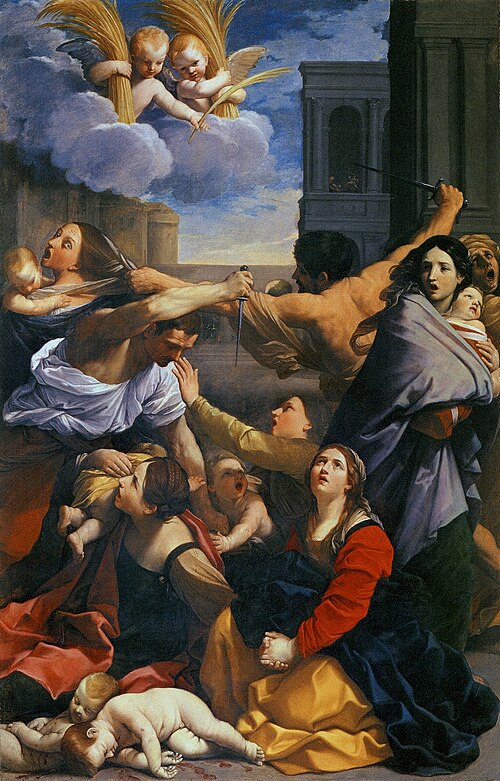
The scene is constructed before an architectural background open to the exterior, as a dense mass of intertwined figures. At the centre and on the left, mothers embrace their children with their arms; some figures have fallen to the ground, while others withdraw backwards. On the right, a soldier raises his sword; the arm of another soldier pulls the mother on the left backwards by her hair. The bodies of infants lying upon the ground are visible in the lower section. This area draws the composition’s centre of gravity downwards, bringing the viewer to the level of the scene’s “consequence.”
Above, two putti appear upon the clouds; the palm branches in their hands open a different field of meaning in the upper layer of the scene. In the upper-right section, a heavy curtain or fold of fabric frames the space like a theatrical stage. The architectural masses and narrow horizon in the background create a sense of pressure that restricts the possibility of escape.
Three-Level Analysis Through Panofsky’s Method
Guido Reni, The Massacre of the Innocents, early seventeenth century, oil painting.
Pre-iconographical Level
Armed male figures and women attempting to protect their children form a dense mass of conflict. Swords, bodies pulled backwards, and fallen infants make the violence of the scene visible. Two putti and clouds appear above, while an architectural background occupies the lower level.
Iconographical Level
The subject is connected to the narrative of the killing of infants by order of Herod. Mothers concealing their children, the soldiers’ swords, and the infant bodies upon the ground are the traditional signs of this scene. The palm branches carried by the putti recall the iconography of the innocents’ “martyrdom” and sacred witnessing.
Iconological Level
Reni’s interpretation constructs the event not as a historical record but as a structural conflict between the naked violence of power and the defencelessness of innocence. The palm branches above do not connect the scene to consolation; they function instead as a framework of meaning placed over earthly violence. The compression of the composition makes “escape” almost impossible. The painting suggests that violence is not merely an action but also a way of constructing space and order.
Representation – Gaze – Void
Representation
Reni does not confine representation to a single moment of attack; he establishes a knot in which several bodies are simultaneously pulled, pushed, protected, and displaced. Violence becomes visible not only through the sword but through small yet decisive forms of contact such as pulling hair, gripping an arm, and bending a body backwards. The mothers’ draperies and bodily turns transform the reflex of “concealing” the children into the painting’s principal formal language; the movement of protection causes the composition itself to close like a defence. Representation therefore speaks less through “what” the event is than through how the event displaces bodies.
Gaze
The painting does not place the viewer at a safe distance. The gaze begins near the ground, among the fallen bodies in the lower section, and inevitably rises towards the centre of swords and struggle. The figures’ gazes do not meet at a common point: the mothers look towards their children, the soldiers towards the action, while some faces turn upwards or outwards. This dispersion produces a sense of “witnessing” rather than establishing a single narrating gaze.
The putti and palm branches above briefly raise the gaze, yet this ascent does not offer escape; it creates a contrast that makes the weight of the scene even more distinct. Power is therefore distributed not within a single perpetrator but through the hierarchy that continually moves the gaze upwards and downwards.
Void
The void is felt most strongly within a space that “makes no room.” The architectural surfaces and narrow horizon in the background do not suggest that a broad world exists around the scene; on the contrary, they enlarge its enclosure. Although the area of sky above appears like a brief breath, together with the palm branches it becomes a “void of meaning”: consolation is not fully provided but merely indicated.
The principal void is the impossibility of intervention placed within the scene. The painting shows no rescuing figure; it only freezes the moment in which the tension becomes knotted. This suspension leaves the weight of “what follows” as a void within the viewer’s mind.
Style – Type – Symbol
Style
The classicising Baroque language is distinct: sculptural anatomies, controlled light and shadow, and a composition that intensifies the scene without dispersing it. Reni does not abandon chaos to randomness; by connecting the bodies through spiral and diagonal movements, he “orders” the violence. This increases the scene’s ethical tension because order becomes as disturbing a force as the violence itself.
Type
The mother is the type of the “protective body”; the child carries the type of “defenceless innocence”; the soldier becomes the type of “executing power.” The putti represent the “higher framework of meaning,” establishing a threshold between the scene’s earthly violence and the celestial sign.
Symbol
The sword represents naked decision and irreversible action; the palm branch signifies the martyrdom and witnessing of the innocents; the curtain or fabric forms the theatrical frame of the scene and the rupture of privacy; the architectural blocks represent violence emerging as an institutional order; and the fallen infant bodies become the heavy symbolic burden placed at the painting’s lower threshold as evidence of loss.
Explicit Identification of the Art Movement
Classicising Baroque within the Bolognese School.
Conclusion
The Massacre of the Innocents presents violence less as an “event” than as a mechanism: the bodies’ defensive reflexes, the compression of space, and the uncontrollable circulation of the gaze compel the viewer to witness. Reni’s classicising Baroque language constructs the scene without shouting, yet precisely this restraint enlarges the ethical weight of the image. The upper layer of meaning opened by the palm branches does not lessen the suffering; it stands as a sign that places it within history.
