




A Symbolic Map of the Unconscious and the Dissolving Shadow of the Figure
Brief Introduction to the Artist
Paul Klee (1879–1940) was one of the most distinctive figures of twentieth-century modern art. A key figure of the Bauhaus school, Klee produced works of considerable aesthetic and intellectual depth through the transitions he established between figurative structure and abstract form. His works are neither entirely abstract nor directly descriptive; rather, they structure inner states, emotional transitions, dreams, and unconscious realms through a graphic language.
For Klee, art is not merely a process of constructing form but the expression of a state of being. Colors, lines, and symbols do not each carry a fixed narrative, but they open a door to intuition. In this respect, Strong Dream is one of the works that most simply yet effectively demonstrates how he approached dreamlike and symbolic realms.
Introduction to the Work and Visual Analysis
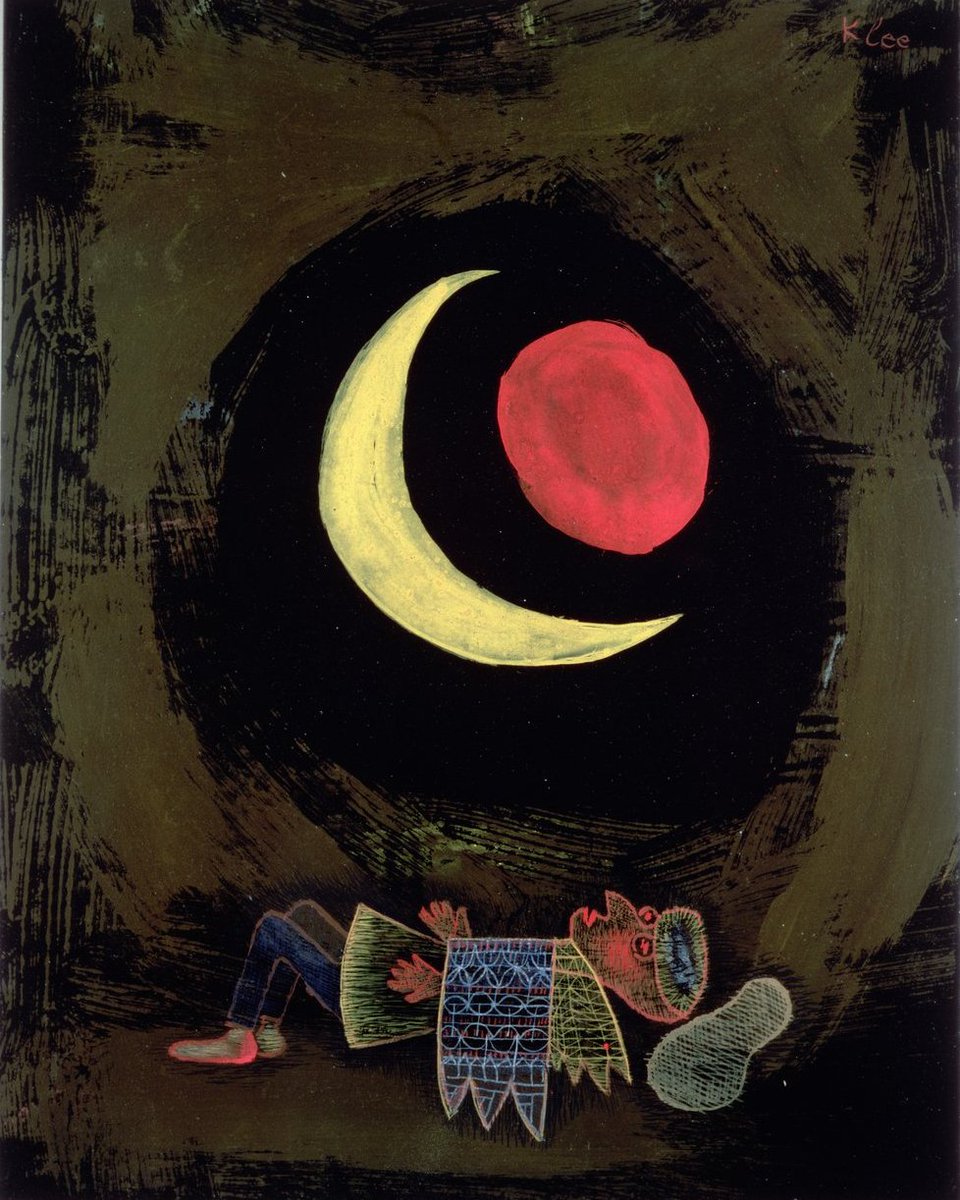
At the center of the painting, a yellow crescent and a red circle appear within a black void. Below them, a human figure that can still be identified figuratively lies on the ground. The figure’s body is fragmented, and its clothing is filled with symbolic and geometric motifs. It wears a head covering; its hands are open and its feet turned sideways. The background is dark and without depth—this is not a space but a ground of the unconscious.
The crescent and red circle evoke various concepts such as moon and sun, night and energy, the unconscious and psychological pressure. Yet these symbols do not carry a narrative; they merely suggest a condition: the figure is in a state of sleep—but this is not rest. It is a moment of dream carried by mental noise.
Klee neither tells a story nor constructs a plot here. He creates a mental atmosphere. Within this atmosphere, space is unstable, the figure is undefined, and time does not flow. Everything is as inconsistent as a dream, yet as meaningful as a symbol.
In-Depth Interpretation through Panofsky’s Method
Pre-iconographical Level
A figure lies before a black background; above it are a red circle and a yellow crescent. The figure’s limbs are open, and its clothing is filled with abstract motifs. The composition is constructed through blocks of color and linear structures.
Iconographical Level
The crescent and circle are two celestial symbols frequently used in Western iconography: they represent oppositions such as moon and sun, unconsciousness and wakefulness, passivity and activity. The reclining figure occupies a classical position associated with dream or unconscious processes. Klee neither romanticizes nor individualizes this figure. It is universal and anonymous—undefined enough to become anyone’s dream.
The red circle appears aligned with the figure’s forehead; this positioning transforms it into a center of thought, mind, or consciousness. The yellow crescent occupies a lower plane, within the realm of affect and intuition. The choice of colors should be understood not merely aesthetically but as psychological frequencies.
Iconological Level
Strong Dream represents not merely a dream but the act of dreaming itself. Klee depicts not simply the figurative condition of sleep but the figure’s dissolution from within, the deformation of its form, and the dispersal of the mind through line. This is not a Jungian “dream archetype” but a formless yet perceptible subject emerging within Klee’s own stream of consciousness.
The artist dissolves the figure because the dream does not allow the figure to remain fixed. Colors become not surfaces covering the figure but surfaces that carry inner content outward. The reclining posture suggests not surrender but an inner storm. The eyes are not closed—because this dream does not emerge from physical sleep but from mental exhaustion.
For Klee, art does not mean describing the external world but giving form to the voice of the inner world. For this reason, Strong Dream is less an image than the linear trace of an inner voice.
Positioning within an Artistic Movement: Abstract Figurative Modernism
Paul Klee’s work belongs directly within Abstract Figurative Modernism, particularly through:
- The dissolution of figurative elements into an abstract field
- Psychological spaces constructed through symbols
- The use of color not as meaning but as a carrier of emotion
- The visualization of an inner state instead of a story
Although the work carries Surrealist influences through these qualities, it is not fully Surrealist. Klee treats the dreamlike realm not as a “linguistic field” but as a field of visual vibration.
Paul Klee’s Strong Dream is historically classified within Expressionist art. This classification corresponds with the distorted structure of the figure, the emotional intensity of color, and the theme directed toward the unconscious. Formally, however, Klee establishes an abstract figurative balance and symbolic structure rather than Expressionist dramatic force. The work can therefore be positioned between Expressionism and Abstract Figurative Modernism.
Conclusion: The Surface of the Dream, the Content of the Figure
Paul Klee’s Strong Dream does not merely depict a state of sleep; it portrays the moment when the mind encounters line. There is no narrative here, but there is meaning. There is no story, but there is inner movement. The figure does not simply lie on the ground; it dissolves, disperses, and forms again.
Colors take the place of sound. The crescent and circle become compasses determining the direction of the dream. The figure is not an individual but a dreaming consciousness. And this dream is not alone within the darkness—because Klee presents a field constructed through line not for us “to see, but to feel.”
The painting does not invite us to understand the dream but to remain within it. This is precisely where its strength lies: a visual force born not from narrative but from the absence of a fixed image.
