




Introduction to the Artist
René Magritte was one of the artists who most incisively questioned the relationships among image, naming, object, and representation within twentieth-century Surrealism.
Painted in 1937, Representation removes the image of the nude body from the classical tradition of the nude and carries it toward the limits of pictorial representation itself.
Here, the body is not merely a subject being depicted. Representation itself is questioned through the relationships among frame, surface, and form.
Introduction to the Work and Composition
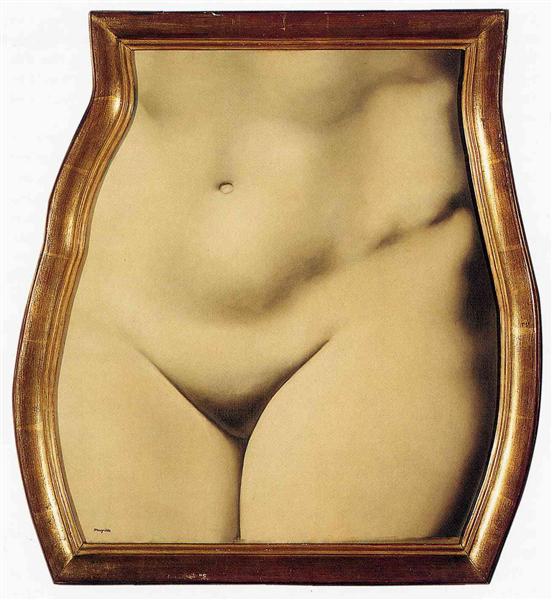
The work shows a female torso within a golden-toned, undulating frame that follows the curves of the body.
The head, arms, and lower sections of the legs are absent. Only the bodily fragment extending from below the breasts through the abdomen, waist, hips, and upper thighs is shown.
The navel, abdomen, waist, hips, and upper legs are rendered through soft tonal transitions.
The frame is not rectangular. Its curved form adapts itself to the body, as though the boundary of the painting had been bent by the body it represents.
The viewer therefore looks not only at a nude torso, but also at the way the torso transforms the frame.
Three-Level Analysis through Panofsky’s Method
Pre-iconographical Level
The work consists of a fragment of a female body displayed within a frame.
The visual field has been narrowed. The face, hands, feet, and surrounding space have been excluded.
The palette is limited, with the warm tones of the flesh, shaded transitions, and the golden-brown frame brought to the foreground.
The composition’s entire tension is concentrated within the formal correspondence between body and frame.
Iconographical Level
The work can be read as an image of the nude female body.
This nude, however, is not presented as a complete figure within a pose, setting, or mythological context, as it would be in classical painting.
The fragment of the torso separates the body from personal identity. The viewer is presented not with a portrait, but with the represented surface of a body.
The frame’s bending and curving according to the shape of the body indicates that the painting does not merely display the body. It also makes visible the representational apparatus through which the body is shown.
Iconological Level
The work turns the concept of “representation” directly into its subject.
While presenting the image of the body, Magritte simultaneously reveals how that image is bounded, cropped, and framed.
The body appears unable to fit within the painting, while the frame ceases to function as a neutral boundary surrounding it from the outside.
Representation therefore reveals not only what is visible, but also the formal framework that makes visibility possible.
Representation – Gaze – Void
Representation
Representation operates on two levels within this work: the painting represents the body while also displaying representation itself.
The nude torso appears as a bodily fragment offered to the gaze. The frame’s unusual form, however, prevents the viewer from concentrating solely upon the body.
The image does not conceal its own artificial construction.
Gaze
The gaze encounters a faceless and depersonalised fragment of the body.
There is no figure looking back at the viewer, and no reciprocal gaze can be established. Looking therefore appears to move in only one direction.
The frame’s adaptation to the body nevertheless compels the viewer to reconsider the scene: is the object of the gaze the body, or the form through which the body is represented?
Void
Void emerges through the sections of the body that have been excluded.
The absence of the head, hands, and feet constructs the painting not as an incomplete image, but as a deliberately cropped field of representation.
The interior of the frame is filled, yet the represented body is not complete.
This absence constitutes the work’s conceptual void.
Style – Type – Symbol
Style
The work is constructed through soft tonal transitions, a calm surface, a limited palette, and the tension between formal incongruity and correspondence in the relationship between body and frame.
The body retains a realistic sense of volume, yet the frame makes this realism strange.
The image is familiar, but the way it has been positioned is not.
Type
The classical type of the “nude” appears here in fragmented and depersonalised form.
The figure becomes less an individual person than the surface of a represented body.
The frame is not a passive boundary, but an active element of representation.
Symbol
The frame carries the boundary of the artwork and the order of representation.
The nude torso signifies the transformation of the body into a visual object, while the headless and incomplete figure carries the idea of representation stripped of identity.
The navel and bodily curves recall physical reality, while the artificial form of the frame reveals that this reality has been constructed within painting.
Explicit Identification of the Art Movement
The work should be evaluated within Surrealism.
Its Surrealist effect is produced not through fantastical creatures or dreamlike settings, but through the disruption of the conditions governing an ordinary image.
By presenting a familiar bodily fragment within an unfamiliar logic of framing, Magritte breaks the secure relationship between reality and image.

2 Comments
Pingback: Paul Delvaux Phases of the Moon: Night, Body, Gaze, and Surreal Estrangement
Pingback: René Magritte The Listening Room: Apple, Scale, Void, and Surreal Space