




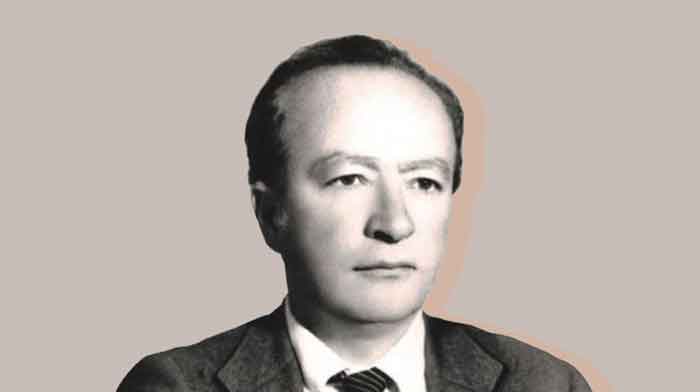
From Social Psychology to Turkey’s Cultural Problems
Erol Güngör was a social psychologist, academic, and thinker who examined Turkey’s experience of modernisation through the relationships among culture, values, history, nationalism, and religion. What distinguished him from many intellectuals of his period was his attempt to analyse contemporary debates through the concepts of the social sciences rather than explaining them through ready-made ideological judgements. Before declaring which view Turkey should adopt, he investigated how social change actually occurred, under what conditions cultural continuity could be preserved, and what position intellectuals assumed within this process.
Born in Kırşehir on 25 November 1938, Güngör learned Ottoman Turkish and Arabic at an early age and encountered foundational texts of Turkish and Islamic cultural history during his high school years. After beginning his studies at Istanbul University Faculty of Law, he transferred to the Faculty of Letters, Department of Philosophy, under the guidance of Mümtaz Turhan. Following his graduation in 1961, he became an assistant at the Chair of Experimental Psychology. His doctoral research examined aesthetic organisation in verbal structures, his associate professorship thesis investigated the role of language in resolving interpersonal conflicts, and his professorial study focused on the psychology of values. He participated in research at the Institute of Behavioral Science at the University of Colorado, was appointed rector of Selçuk University in 1982, and died on 24 April 1983 while still serving in that position.
Although social psychology stood at the centre of his academic work, Güngör’s interests were not confined to laboratory research. His refusal to separate human behaviour from the systems of value, historical experience, and social bonds within which it emerges led him directly toward Turkey’s cultural problems. The relationship he established between scientific knowledge and public thought becomes important here: while communicating academic concepts to a broader readership, he did not abandon scientific method, nor did he confine his intellectual essays within an abstract language of expertise. He continued the sociological line extending from Ziya Gökalp to Mümtaz Turhan, while also subjecting this inheritance to criticism and developing his own theory of culture.
Cultural Change and the Direction of Modernisation
The fundamental question connecting Erol Güngör’s works is how a rapidly changing society can participate in the contemporary world without losing its historical character. He does not treat modernisation as a simple choice between past and future. Preserving all older institutions would arrest social development, just as applying models imported from outside without transformation would fail to produce a healthy cultural change. Change is unavoidable; the real problem is how new elements become integrated with a society’s existing values and institutions.
At the centre of Kültür Değişmesi ve Milliyetçilik lies the problem of creating a “contemporary Turkish national culture.” Güngör does not present society with a list of elements to preserve and elements to discard. He believes that such an approach treats culture as a collection of independent components. Technology, economy, education, forms of work, ethics, and everyday life stand in reciprocal relationships; transformation in one field also changes others. Cultural policy cannot be constructed simply by preserving selected traditions while importing technological innovations from abroad. The process of change must first be understood, after which society’s capacity to produce and adapt under new conditions must be developed.
This approach moves away from the sharp distinction Ziya Gökalp established between culture and civilisation. Gökalp associated culture with values specific to nations and civilisation with shared knowledge and technologies that could be transferred among nations. For Güngör, these two fields cannot be separated so easily in practice. When an element of civilisation passes into another society, it does not remain unchanged; it acquires a new form within that society’s needs, values, and historical experience. Culture is not a closed essence protected from civilisation, but the way in which the elements of civilisation are lived and appropriated by a particular society.
Güngör’s critique of modernisation is not directed against technological development. He does not regard technology imported from the West as the sole cause of cultural deterioration; he considers the failure to understand the discipline of work, institutional organisation, responsibility, and systems of knowledge underlying technological instruments to be a more fundamental problem. It is easy to acquire a machine, but developing the scientific mentality and social organisation that produced that machine requires a much longer transformation. The disjunction within Turkey’s experience of modernisation arises from the failure to establish a relationship between material elements and values and institutions.
Nationalism, History, and the Intellectual
Erol Güngör does not define nationalism through ancestry, race, or immutable cultural characteristics. National culture is not a frozen inheritance transmitted unchanged from the past, but the reworking of historically formed values under new conditions. Nationalism is likewise an attempt to give this culture the power to produce a contemporary civilisation. Official programmes prepared without connection to the culture actually lived by the people cannot create a national culture; the task of intellectuals is not to impose an identity upon society from above, but to understand the existing cultural accumulation and investigate its possibilities for development.
Within this framework, history ceases to be a celebratory narrative of past events. It becomes a shared memory through which society can know itself. Interpretations that exclude Ottoman history or divide Turkish history into disconnected periods remain inadequate for explaining the formation of contemporary society. While Güngör recognises the transformations among the Seljuk, Ottoman, and Republican experiences, he preserves historical continuity. Attachment to the past does not mean restoring old institutions; it means recognising the historical processes from which present social structures emerged.
The problem of the intellectual is also connected with this understanding of history. The intellectual type Güngör criticises is one who attempts to apply externally prepared models of development to society without knowing that society. He believes that many intellectual debates in Turkey arise from repeating the concepts of particular ideological camps rather than investigating social reality. The separation between intellectual and people is a cultural problem deeper than educational difference: when intellectuals devalue the language and history of their society, they cannot connect their knowledge with social experience.
Güngör’s own mode of writing can be read as an attempt to overcome this separation. While bringing the methods of social psychology into contemporary cultural debates, he does not use academic knowledge to produce slogans. He first identifies the foundations of the view he is examining, then compares it with other approaches, and builds his judgement upon this analysis. His capacity to criticise assumptions within his own intellectual milieu is an important feature distinguishing him from the spokesperson of a party or movement.
Religion, Ethics, and Social Cohesion
In Erol Güngör’s theory of culture, religion is not a folkloric element inherited from the past. It is a living institution that continues to influence beliefs, ethical values, and social relations. While recognising the determining place of Islam in the historical formation of Turkish culture, he does not interpret religion as a closed structure that prevents change. The problems modern society encounters in science, economy, and politics require religious thought to work anew under changing conditions.
İslâmın Bugünkü Meseleleri approaches the situation of the Islamic world in relation to modern civilisation not through a defensive discourse, but in terms of its capacity to produce. For Güngör, the fundamental issue is not repeatedly recounting past achievements, but establishing an intellectual movement capable of responding to the scientific and social problems of the age. He searches for a third path between the withdrawal of religion from life and the unchanged preservation of inherited interpretations: an intellectual renewal that does not lose its connection with its sources, but recognises that historical conditions have changed.
İslâm Tasavvufunun Meseleleri likewise differs from approaches that either completely glorify or reject Sufism. Güngör values Sufism’s contribution to the inner world of the human being, ethical cultivation, and psychological integrity, yet he remains critical of the abandonment of social responsibility and the reduction of religious life solely to personal experiences of ecstasy. Sufism thus becomes a subject of research situated at the intersection of history, society, and human psychology.
The relationship between religion and ethics also connects with the problem of value in Güngör’s academic studies. Values are not abstract judgements learned externally by the individual; they are structures of meaning that organise preferences, behaviour, and relationships with others. The crisis experienced by society during periods of rapid change arises less from the disappearance of older values than from the inability to establish a value system consistent with new conditions of life. Güngör’s writings on culture, nationalism, and religion converge around this shared problem.
Works and His Place in Turkish Intellectual History
Erol Güngör’s principal works reflect the continuity between his academic research and his social analyses. Türk Kültürü ve Milliyetçilik examines nationalism within the context of culture and social psychology, while Kültür Değişmesi ve Milliyetçilik considers it within the social process of modernisation. İslâmın Bugünkü Meseleleri addresses the intellectual and institutional problems confronting contemporary Islamic thought, while İslâm Tasavvufunun Meseleleri examines the historical and psychological structure of Sufism. Dünden Bugünden Tarih-Kültür-Milliyetçilik brings together essays published at different times. Tarihte Türkler, which he was unable to complete in its final form, was published after his death; various writings and talks were later collected under the title Sosyal Meseleler ve Aydınlar.
What makes Güngör distinctive within Turkish intellectual history is his transformation of subjects that generate powerful forms of belonging, such as nationalism and religion, into objects of social-scientific analysis. He did not reduce culture to a romantic image of the past, modernisation to the transfer of Western institutions, or religion to the sphere of individual belief. He considered all these problems together within the historical continuity, system of values, and capacity for change of society.
Erol Güngör did not construct a philosophical system; he was a thinker of society and culture working between social psychology and intellectual history. Although his early death prevented some aspects of his work from reaching completion, the fundamental question he posed remains clear: How can Turkey transform its cultural inheritance into a creative force while participating in the scientific and technological transformations of the world? Güngör’s answer lies neither in preserving the past nor in imitating the future, but in understanding society, analysing the conditions of change, and producing a contemporary culture within historical continuity.
