




Introduction to the Artist
Albert Bloch, a German-born American painter, is one of the artists positioned within the harsher and more emotional current of early twentieth-century modern figurative painting. He is particularly notable for chromatic tension, his tendency to construct the figure through distortion, and his use of the body as a psychological surface. In his painting, the figure often appears not through the classical ideal of beauty but through inner compression, vulnerability, and an intense state of mind. Bloch’s paintings therefore bring to the surface not only the visible body but also the uneasy atmosphere carried by the body.
Introduction to the Work and Composition
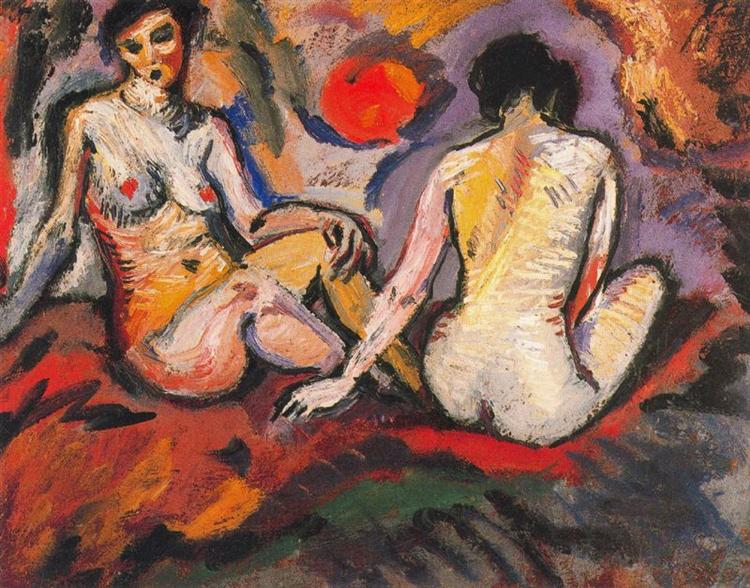
In this painting, two nude female figures are seated on the ground or on a low surface. The figure on the left turns her torso more openly toward the viewer; her legs are bent, one arm hangs loosely to the side, while the other rests on her knee or beside her. The figure on the right, by contrast, turns her back toward the viewer, lowers her head slightly, and sits with one hand resting on the ground. The composition therefore establishes a contrast between two bodies occupying the same scene: one is more visible and opens toward the foreground, while the other is more enclosed and withdrawn.
The background does not define a clear setting. The surface appears as an agitated field in which reddish, purple, black, grey, and dirty yellow tones rub against one another. In the upper central area, a round, glowing red-orange patch quietly intensifies the focus of the painting. This form may be read as a sun, an eye, a flower, or simply a warm knot of paint. The dark reds and black patches on the ground create an atmosphere that seems to draw the figures inward. The work therefore becomes less a nude scene than an image of two bodies existing within the same emotional climate.
Three-Level Analysis through Panofsky’s Method
Pre-iconographical Level
The painting depicts two seated nude female figures. The figure on the left is seen from the front or in three-quarter view, while the figure on the right is seen from behind. The background is abstracted and consists of dense, patch-like fields of color. A red circular form draws attention in the upper section.
Iconographical Level
Within the tradition of the nude, the work takes two female bodies as its principal subject. Yet these bodies are arranged not according to classical ideal beauty but in a more vulnerable and uneasy manner. The turned back of the figure on the right, together with the more open presentation of the figure on the left, produces two poles between visibility and withdrawal. The red circular form also introduces not merely bodily but symbolic tension into the scene.
Iconological Level
The work removes the body from the position of a brilliant object of desire and transforms it into an emotional carrier. Nudity here conveys vulnerability as much as openness. Although the two figures appear close to one another, there is no complete contact or unity between them. The painting therefore suggests that the body is not only erotic but also a field of existential loneliness and inward withdrawal.
Representation – Gaze – Void
Representation
Bloch constructs the figures through fractured lines, rough brushstrokes, and sharp chromatic transitions rather than polishing them according to anatomical accuracy. Flesh is not a smooth and idealized surface but an area fragmented by brushwork and charged with emotion. Representation here is not realistic imitation but a way of loading psychological intensity onto the body.
Gaze
The face of the figure on the left turns toward the viewer; even if her eyes do not look completely directly outward, they open the field of viewing. The figure on the right, however, conceals her face and presents her back. This arrangement of gaze is crucial: the painting does not place the viewer in a comfortable position of observation. One figure invites us inward while the other pushes us away. The gaze therefore cannot establish one-directional mastery; the painting creates a distant, uncertain, and fragile relationship with the viewer.
Void
The undefined background is neither a conventional interior nor a natural landscape. The void does not describe a place here; it constructs a state of mind. The patch-like ground surrounding the figures makes their spatial belonging uncertain. This gives the composition a psychological sense of emptiness. Although the two bodies occupy the same field, the silence between them stands in the painting almost like an invisible third element.
Style – Type – Symbol
Style
The work carries an Expressionist structure through hard contours, distorted proportions, intense color contrasts, and seemingly rapid brushwork. Form is used not to stabilize beauty but to increase tension.
Type
The figures are far removed from the classical type of the “ideal nude.” They are not mythological Venuses or academic model bodies but modern, tired, inwardly withdrawn bodies. The figure seen from behind in particular carries the type of privacy and withdrawal, while the figure in front appears more open yet remains equally vulnerable.
Symbol
The red circular patch above evokes heat, tension, and an inner burning within the painting. The seated positions of the two bodies make visible the thin boundary between closeness and disconnection. Nudity functions here not only as openness but also as a symbol of defenselessness.
Art Movement
The work belongs to an Expressionist conception of painting through its transformation of the body into a direct field of emotional intensity, its destabilization of space, and its use of color as a psychological force.
Conclusion
Two Seated Nudes demonstrates Albert Bloch’s treatment of the body not merely as an object to be seen but as a surface of inner tension and silent loneliness. The proximity between the two figures produces not peaceful unity but a fragile side-by-side existence. The power of the painting lies precisely here: it reconstructs the tradition of the nude through emotion rather than beauty, unease rather than openness, and inward withdrawal rather than visibility.
