




Introduction to the Artist
Amedeo Modigliani (1884–1920) is one of the most distinctive portrait painters associated with the École de Paris. His work in sculpture brought a lasting poetry of proportion into his painting: the elongation of the head and neck, the joining of chin and nose within a single flowing line, the mask-like effect of almond-shaped eyes, and the rhythm created by dark contour. For Modigliani, portraiture is less about “likeness” than about “posture”; he intensifies the sitter’s inward state through simplified fields of color and the musical flow of line. Decoration and anecdote recede, while the figure becomes the focus of an intimate stillness gathered across a few surfaces. The late 1910s represent the most refined phase of this linear poetry.
Introduction to the Work and Composition
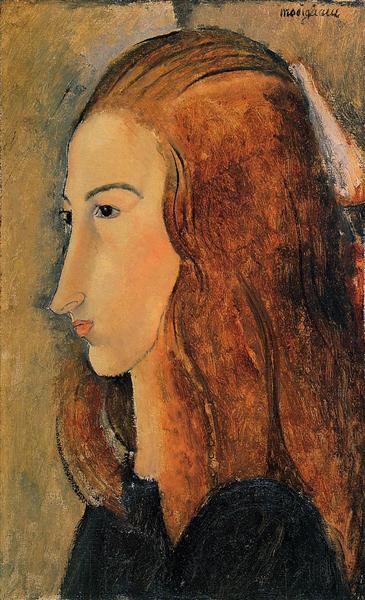
Portrait of Jeanne Hébuterne depicts the person closest to the artist in profile. Jeanne’s long chestnut hair flows like a warm curtain across the surface, while the dark garment creates a low wedge-like mass. Head and neck extend along a single curve; the line of the nose joins the inclination of the forehead, creating a sense of golden proportion. The eye is almond-shaped and inward-looking; eyelashes and eyebrow gather into a single contour line. The background consists of matte planes of reddish-brown and earth tones; a darkening panel on the right creates a wall of contrast against the figure’s profile. The brushwork is almost dry; the surfaces do not shine but breathe. Light opens a paler field around the face and neck, allowing the profile to separate almost “like sculpture” and balance against the hair and background. On the narrow vertical canvas, the movement of the profile toward the left edge creates a subtle compositional tension.
Three Levels of Panofsky’s Method
Pre-iconographical Level
A young woman is depicted in profile; she has long chestnut hair, a slender elongated nose, a small mouth, dark clothing, and a reddish-brown background with a dark rectangle on the right. The contours are distinct, while the surfaces are matte and layered.
Iconographical Level
Modigliani’s characteristic “elongated head-neck” schema idealizes Jeanne’s graceful and fragile presence. The use of profile refers to classical medallions and cameos; the wave of the hair contrasts with the flatness of the background. The absence of decoration removes the sitter from a specific temporal and spatial context and places her within a “lasting posture.”
Iconological Level
The portrait expresses the quiet dignity of the modern subject. Modigliani does not confine the beloved or muse figure within melodrama; instead, he establishes respect through the ethical distance of line. Jeanne exists here not through her individual story but as the representation of an “inward-looking” mode of being: an inner rhythm preserved against the noise of modernity.
Representation – Gaze – Void
Representation
Representation is constructed through a flowing proportional scheme rather than anatomical detail. The profile functions like a sculptural section; small shifts in value across the surface are enough to suggest volume. The mass of hair becomes the painting’s broadest “field of color,” while the darkness of the clothing lifts the head-neck line toward the light.
Gaze
Jeanne does not look at the viewer; her gaze seems suspended toward the horizon, perhaps toward an inner thought. This distance calms the viewer’s curiosity and invites empathy. The eye first settles on the pale area of the face, then moves toward the warm waves of hair, and finally toward the weight of the dark garment and the panel on the right. This movement back and forth operates like an invisible metronome establishing the rhythm of the portrait.
Void
The background planes are not a conventional “backdrop”; they produce a silent field that echoes the figure. Between the dark panel on the right and the lighter tones on the left, Jeanne’s profile stands at a “threshold of void.” The void is not subtraction but a stage purified enough to allow the figure’s inner voice to be heard.
Style – Type – Symbol
Style
Dark contour and matte fields of color define the work. There are no luminous glazes; the painting develops through a dry, breathable texture. The chromatic range is limited: reddish amber in the hair, pale peach in the face, and earth tones in the background. Line is sculptural and color restrained; this balance is one of Modigliani’s signatures.
Type
The figure approaches the type of the “modern-classical young woman”: understated elegance, inward stillness, and elongated proportions. This type carries not only the character of an individual portrait but also a sense of archetype, proposing a “balance” independent of temporal conventions.
Symbol
The elongated profile evokes continuity and fidelity; the wave of the hair, the warm flow of life; the dark garment, privacy and seriousness; the reddish background, emotion and intimacy. The half-closed line of the eye carries a state of wordless thought, while the firmness of the contour becomes resistance within fragility.
Explicit Identification of the Art Movement
Within the context of the École de Paris, the work can be understood as a modern-classical portrait in which Expressionist sensitivity is balanced by archaic proportion and decorative simplicity. Modigliani reduces the noise of expression, binding line to an ethical measure and color to a calm emotional register. The figurative tradition is preserved, yet it serves not the ideal of “likeness” but the idea of “presence and posture.”
Conclusion
Portrait of Jeanne Hébuterne clearly demonstrates Modigliani’s mastery in transforming portraiture into an “architecture of inwardness.” The simple yet precise balances established between profile, hair, and background intensify the figure without forcing her into exaggerated psychology. Jeanne’s face contains not drama but a measure of existence: quiet, calm, dignified. The painting’s distinct contour reminds the viewer of a boundary—come closer, but do not touch; look, but do not possess. This ethical distance removes the portrait from the private story of love and transforms it into an enduring image of modern humanity: a posture carried by the silence of the gaze, the fidelity of line, and the warmth of color.
