




Short Biography
Edvard Munch (1863–1944), the Norwegian Expressionist painter, is one of the figurative artists in modern art history who visualized existential affect with the greatest intensity. Throughout his life, Munch explored themes of loss, death, love, and psychological collapse. He is especially known for The Scream (1893), yet his production extends far beyond this iconic work. In the 1920s, following his nervous breakdown and period of isolation, his art entered an aesthetic evolution that became increasingly abstract while growing emotionally more intense. Vampire in the Forest belongs to this late period and reflects Munch’s interest not merely in external deformation but in psychological interpenetration.
Art Movement Represented
The work belongs within Late Expressionism. Munch’s palette is no longer characterized primarily by forceful contrasts, but by permeating tones, inward-collapsing forms, and loosened figurative outlines. During this period, images begin to disappear at the threshold of representation; the vampire figure is no longer a creature but an emotional aura, a psychoanalytic shadow.
Context of the Work’s Production
The work is one of the final links in Munch’s series of vampire-themed images. His first “vampire” representation was the 1895 work The Vampire: a depiction in which a woman kisses a man, yet the kiss becomes a form of suffocation or draining of energy. Vampire in the Forest reworks this theme on a more abstract plane intertwined with nature. There is no longer a bedroom, no wall—only nature and two figures beginning to dissolve within it.
Introduction to the Work and Composition Analysis
Scene and Figures
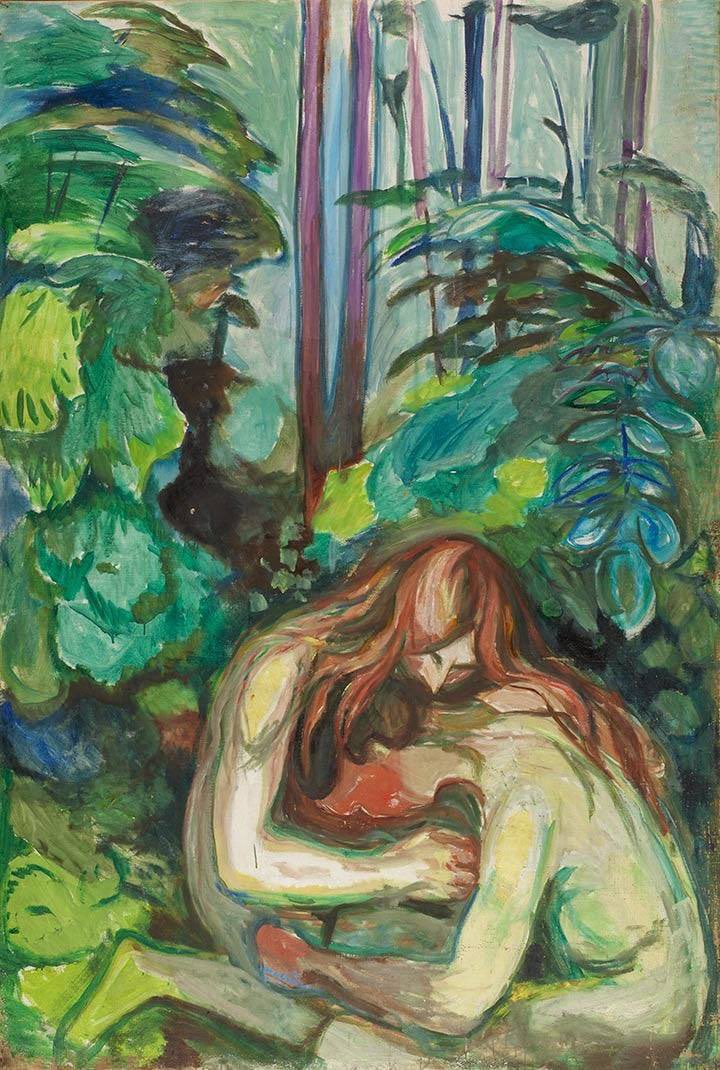
At the center of the work are two nude figures—a woman and a man. The female figure embraces the male figure with her long hair and buries her face in his shoulder. Although this embrace initially appears tender or sensual, the formal construction of the figures and the way they dissolve into nature encode the scene as a nonviolent yet disturbing erotic threat.
The woman’s hair spreads so widely that it almost seems to swallow the man; the male figure appears collapsed. As in Munch’s earlier vampire compositions, this position symbolizes the “devouring power of the feminine.” The difference here, however, lies in the spatial context: the forest is presented as an unconscious that also contains the emotional state of the figures.
Color, Light, Texture, and Space
The palette contains Munch’s characteristic red-green contrasts. Yet this opposition is used not to emphasize the boundaries of the figures but to show emotional permeability. The redness in the woman’s hair spills onto the man’s neck and shoulder. Variations of green dissolve the boundary between figures and nature.
The brushwork is loose in texture; the paint across the surface seems almost as fluid as the figures themselves. There is no direct light; illumination is expressed through an internal glow. This removes the figures from natural time and space.
The forest is not merely a background. The vertical trees contrast with the horizontality of the figures and create a sense of confinement. The vegetation both covers and becomes identified with the figures. The forest here becomes not simply a place but an organism of emotion.
Time, Atmosphere, Silence, and Rhythm
Time is frozen. This is not a single moment but the continuing, intensifying, and enveloping form of an inner experience. The atmosphere is not oppressive in a direct sense, yet it creates a dissolving emotional field. The silence is thoroughly suffocating: the figures do not speak, and nature makes no sound. This silence settles upon the viewer.
The rhythm begins in the hair, moves from the shoulder to the waist, then toward the knees and the torso where the figures merge. This rhythm simultaneously carries a psychoanalytic tension oscillating between suffocation and embrace.
Three-Level Analysis through Panofsky’s Method
a. Pre-iconographical Level
- Two nude figures in a forest: one a long-haired woman, the other a man.
- The female figure embraces the man, her head buried in his neck.
- Large leaves, trees, and vertical lines surround them.
b. Iconographical Level
The composition continues Edvard Munch’s “vampire” motif. Although the woman’s embrace appears to be one of romantic bodily intimacy, it is actually coded as a suffocating and essence-draining force. The vampire is not literal here but an emotional, erotic, and psychoanalytic symbol.
The woman’s hair enveloping the man represents Munch’s recurring idea of “woman = nature = unconscious = destructive force.” Yet this representation contains a threat without hostility: devouring love remains intertwined with affection.
c. Iconological Level
At its deepest level, Vampire in the Forest overturns classical narratives of the relationship between woman and man. The woman is no longer a figure to be rescued or idealized but the active subject of emotional dissolution. The man is not physically powerful; he exists in a state of emotional disintegration.
Nature is no longer pastoral either; it resembles the unconscious. The verticality of the trees contains a sense of compression, the plants suggest dispersal, and the texture of the forest folds inward. The figures are not merely in the forest; they are dissolving together with the forest.
In this respect, the work is not simply a sensual scene but an allegory of inner dissolution and surrender.
Representation – Gaze – Void
Representation
The female figure is represented simultaneously as vampire and lover, threat and tenderness. The male figure is represented as a passive subject. This reverses classical representations of women and men.
Gaze
Neither figure looks toward the viewer. Rather than pushing the viewer outside the event, this draws them into its psychological content.
Void
There is no space between the figures. They are intertwined and have lost their boundaries. The void is no longer separation but the loss produced by merging.
Conclusion
Munch’s Vampire in the Forest is not a terrifying image but a quietly suffocating one. The female figure merges with nature; the man dissolves. The vampire is no longer a creature but an emotional shadow.
