




Introduction to the Artist
Egon Schiele (1890–1918) is one of the sharpest linear voices of Viennese modernism. He inherited Klimt’s decorative legacy while foregrounding psychological tension; he compresses volume onto a flattened surface, fractures the body, and transforms it into a nervous line. Between 1910 and 1915, Schiele’s figures emerge through skeletal extremities, broken contours, and an intense earth-toned palette; eroticism, guilt, loneliness, and death seep into the very structure of the painting. His work of 1912 represents a threshold at which the figure dissolves not into space but into the topography of the surface, while human states are constructed as stark compositional problems.
Introduction to the Work and Composition Analysis
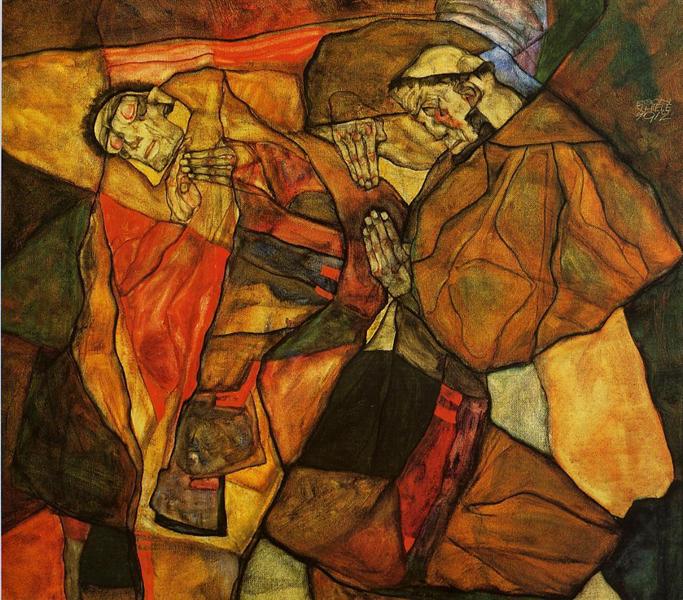
The canvas consists almost entirely of the interlocked masses of two figures. Their garments are divided into broad, angular sections suggesting robes or coverings; shades of brown, rust red, and ochre are woven together through black contours. The figure on the left lies close to the horizontal axis with eyes closed; the figure on the right bends toward the other with knees drawn inward, hands joined at the chest—oscillating between a gesture of prayer and consolation. The boundaries of the masses branch like a map; the folds resemble the lines of terrain divided into geometric paths. Whitish curtains or coverings curl beneath the figures; these folds form the only luminous area.
The entire movement proceeds through fractured diagonals running from left to right and from below upward: bodies and arms cut across the scene, while the proximity of the heads becomes the focal point. The chromatic economy depends on the weight of warm, dry earth tones; red bands function as small accents beating like a pulse. Depth is almost absent; the field is constructed through overlapping planes. Faces are mask-like, flesh is leaden, hands skeletal and point-like; gesture becomes stronger than narrative.
Three-Level Analysis through Panofsky’s Method
Pre-iconographical Level
Two figures; one lying on its side or being supported, the other bending toward it; broad coverings or garments; gestures of prayer or holding; red band details; fragmented earth tones; hard black contour; a ground without depth.
Iconographical Level
The title Agony invites associations with the deathbed, final breath, illness, or psychological collapse. The hands of the bending figure oscillate between prayer and consolation; the closed eyes of the horizontal figure and the hand near the chest suggest a moment of transition. Although the robe-like garments evoke religious care or observation, Schiele does not fix the iconography; he concentrates instead on a human threshold: confronting the end and remaining beside another person.
Iconological Level
In Vienna in 1912, the modern subject was caught between tensions of identity and morality. Rather than “narrating suffering,” Schiele constructs the form of suffering: the surface fractures, masses fuse into one another, and the body becomes a map of earth. The contact between the two figures suggests that guilt and compassion, helplessness and attachment, can exist on the same plane. Agony is therefore not the depiction of an event but a test of intimacy—a painting of how one human being leans toward the mortality of another.
Representation – Gaze – Void
Representation
Instead of volumetric modeling, representation operates through an organization of contour and patch. The garments behave less like fabric surrounding the body than like the geology of the surface; skin, stone, and cloth meet within a single material. Hands and heads become minimal yet effective points of emphasis.
Gaze
The gazes of the figures close inward toward one another; no eye contact is established with the viewer. The encounter is not presented outwardly but preserved as an intimate threshold.
Void
There is no conventional background; the field surrounding the scene consists of fractured pieces of color. Negative space glows within the folds of the white covering, opening a temporary refuge around the figures.
Style – Type – Symbol
Style
Central European Expressionism; nervous and interrupted line, flat and heavily fragmented fields of color, and a warm earth-toned palette. Form itself becomes content: the tension of line carries the theme.
Type
The “threshold/farewell” type; a modern scene that evokes religious iconography without fixing it, foregrounding human intimacy instead.
Symbol
Joined hands signify solidarity as much as prayer; red bands suggest inner circulation, pulse, and internal tension; the white covering evokes temporary shelter and the silence of the end; the fragmented ground becomes a fragile map of existence.
Explicit Identification of the Art Movement
Agony exemplifies the essential qualities of Expressionism: the abandonment of naturalistic space, the emotional violence of line, and the structural function of color. Schiele transforms Secessionist decorativeness into a fissure of emotion; instead of ornament, he produces a crack. Narrative is embedded within the organization of paint and contour.
Conclusion
In Agony, Schiele constructs suffering as a problem of surface: the masses of two figures interlock, fractured diagonals accelerate the breath, and the white covering becomes the only zone of stillness. The scene is not didactic; it proposes an ethics of intimacy: the way to confront the end is to remain beside another person and sustain touch. The thought of the painting lies in its line: while the hard black contours seem to separate us, they simultaneously stitch the figures together; suffering becomes the name of the simultaneous existence of what separates and what binds.
