




Introduction to the Artist
Émilie Charmy (1878–1974) was an important painter in Paris-centered modern French painting who combined a bold use of color related to Fauvism with a personal approach to the figure. She gained visibility around the Salon d’Automne in the early 1900s and attracted attention through thick paint, intimate interior scenes, and the place she gave to the female subject. She removed the nude and themes of everyday life from decorative idealization, constructing them instead through material paint and dynamic framing; in doing so, she produced a calm yet determined alternative from within the male-dominated tradition of the nude.
Introduction to the Work and Composition Analysis
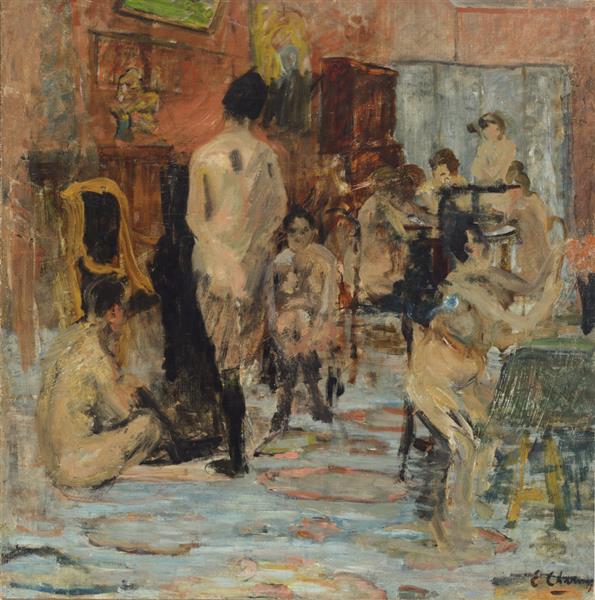
The canvas opens onto a room with reddish walls and a mottled blue-grey floor. On the right, figures gather around a small table or canvas; on the left are a fireplace and an armchair; at the center, a woman seen from behind wearing black stockings establishes the axis of the scene. Eight to ten figures are scattered across the room in various seated and standing positions; some converse, some arrange their hair, and others wait. Faces and bodies are defined more through patches and direction than through detail. In places, the brush approaches an almost dry application, exposing underlying layers of paint on the floor and weaving figures and objects from the same material. There is no clear effect of light entering through a window; instead, pale patches moving across the walls and floor seem to illuminate the room.
The composition functions like a horizontal frieze; the figures are connected by the rhythm of pink and blue patches across the floor. The standing figure at the center forms a vertical “pause,” while the seated bodies around her create an oval. The brown mass of furniture in the background—a cabinet or piano—presses against these oval formations from behind; the foreground-background relationship is established through the density of brushwork: the foreground is thicker and warmer, while the background becomes thinner and cooler. Color is structured around the contrast between the red wall and blue floor, while secondary yellow-green tones produce small flashes between them.
Three-Level Analysis through Panofsky’s Method
Pre-iconographical Level
An interior; numerous female figures; some nude or partially nude; chairs, an armchair, cabinet or piano; a painting and small sculpture on the wall; scattered objects; muted light constructed through patches of light and dark.
Iconographical Level
The title “dressing room” indicates a preparatory space associated with a theater, studio, or brothel. Figures looking into a mirror, conversing, and waiting inhabit an interval of time “before being put to work.” The standing central figure embodies a transition at the threshold of dressing or undressing; the area around the table or canvas on the right, like an allusion to a picture within the picture, reinforces the space’s function of “preparation for representation.” The furniture and wall decorations—the small sculpture and painting—suggest a professional interior.
Iconological Level
Charmy’s interest lies not in display but in the time women spend among themselves. This room is not a stage of spectacle for the viewer; it is an interval in which the rhythms of preparation, waiting, and conversation are held. The rawness of the paint and the lack of individualized faces push aside curiosity about singular portraits, making a collective economy of bodies visible: gestures of sitting, rising, bending, and waiting. The invisible preparatory space of women’s labor in modern urban life is thus carried onto the painted surface. Charmy’s female subject is embedded within her own environment; her gaze turns not toward the viewer but toward the other women or toward work. On an ethical level, the scene produces a distance that preserves privacy.
Representation – Gaze – Void
Representation
The figures are constructed through masses of paint rather than detail; anatomical accuracy gives way to the credibility of movement. Objects and bodies dissolve within the same breath of the brush, foregrounding the functional relationship between human beings and space.
Gaze
No figure establishes distinct eye contact with the viewer; gazes move horizontally, toward one another and toward work. This arrangement distances the scene from the sensation of “secret observation”; the viewer remains at the edge like a silent witness.
Void
The broad blue-grey areas of the floor are punctured by scattered pink patches; this void forms a flexible ground carrying the atmosphere of the room and the rhythm of waiting. The dark brown mass of the background divides the spread of figures into foreground and background layers.
Style – Type – Symbol
Style
The surface characteristic of early Charmy is Post-Impressionist, with a boldness of color that gestures toward Fauvism, loose yet persistent brushwork, and areas where impasto becomes increasingly dense. The construction depends on patches rather than line.
Type
The “preparation/dressing room” forms an intersection of genre and nude painting; instead of a single protagonist, the work presents a multi-figure scene of everyday life.
Symbol
The standing central figure signifies transition and threshold; the small sculpture on the wall signals representation, stage, or role; the table or canvas area marks production and preparation; the red wall conveys interior warmth and movement; the blue-grey floor carries a feeling of coolness and waiting.
Explicit Identification of the Art Movement
The work is situated within Post-Impressionism: structural patches and expression become more important than the optical impression of what is seen. The areas of color are not strictly bound to the logic of natural light; the composition is organized for rhythm and balance. Thick paint and warm-dark contrasts anticipate the emerging Fauvist language while also carrying a sensibility related to Parisian traditions of interior figure painting associated with Degas and Bonnard.
Conclusion
The Dressing Room is a work in which Charmy brings onto the painted surface the intimate threshold where women prepare to work or perform. The composition’s horizontal frieze and rhythm of patches record the sense of time within this interval: preparation, conversation, waiting. By reducing detail and bringing the materiality of paint to the foreground, the pictorial language makes visible not a search for individual beauty but the interior’s economy of movement. The painting thus opens the backstage of modernity—the everyday space of women’s labor and the politics of the body—to quiet yet effective reflection.
