




Introduction to the Artist
Ernst Ludwig Kirchner was one of the most important figures of German Expressionism. Particularly through his works associated with the Die Brücke circle, he reconstructed the modern city, the nude body, movement, and psychological tension through severe lines and striking colours.
During his late period, nature, the open air, mountain landscapes, and bodily activity became more prominent. This direction, however, never developed into a peaceful pastoralism. In Kirchner’s work, nature, like the city, is a field of tension that transforms the figure. Even his outdoor scenes therefore carry a nervous rhythm and structural severity.
Introduction to the Work and Composition
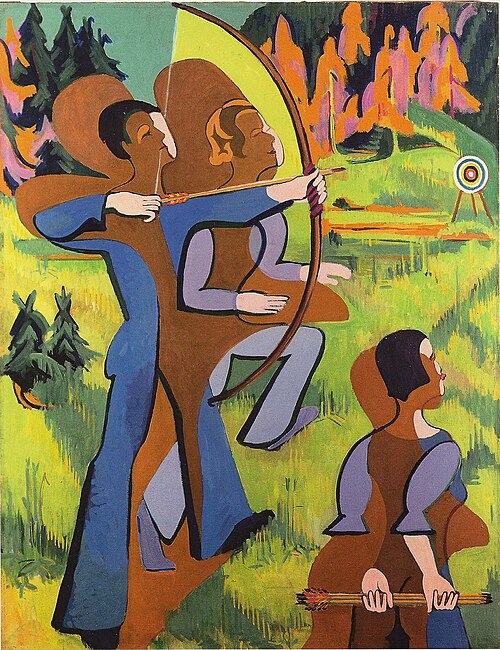
Archers is a three-figure composition set outdoors. On the left, a large standing figure aims toward the target with the bow fully drawn. A second figure, positioned immediately behind or appearing almost merged with the first, follows the same axis and forms a nearly unified bodily block with the principal archer.
In the lower-right section, a third figure is shown with their back turned, holding arrows. Rather than participating directly in the action, this figure appears to accompany it through a state of waiting. A circular target stands in the middle distance on the right. The entire composition therefore acquires a powerful directional movement from left to right, extending from the figures toward the target.
The ground opens through bright yellow-green fields, while dark green trees and clusters of purple-pink trunks fill the background. Colours are used not to imitate natural appearance, but to sharpen the figures’ direction even further.
The bow and arrow of the principal archer form the invisible linear spine of the painting. The composition’s principal power lies in the fact that this direction is not merely physical, but also mental and psychological: the entire painting represents a state of concentration.
Three-Level Analysis through Panofsky’s Method
Pre-iconographical Level
The painting shows three figures outdoors, a bow, several arrows, and a target in the distance. The large figure on the left draws the bow, while the second figure behind them occupies the same axis.
The third figure in the lower-right section holds arrows. Trees, a grassy field, and colourful clusters of vegetation appear in the background.
Iconographical Level
The title clearly identifies the figures as archers. The visible target removes the scene from being merely a sequence of gestures and places it within the context of aiming and striking.
This is not a hunting scene. The target is explicitly artificial and nonhuman. Archery is therefore constructed less as warfare or hunting than as a field of attention, bodily control, and shared rhythm.
Iconological Level
The work presents the human body’s attempt to establish direction within nature. The target is not merely an object to be struck, but the visual equivalent of focus, purpose, will, and orientation.
Kirchner therefore suggests archery not simply as sporting achievement, but as the modern subject’s attempt to find a centre within a fragmented world. The figures have not merged with nature, yet they try to establish a line, an axis, and a purpose within it.
Representation – Gaze – Void
Representation
Kirchner represents the figures not through anatomical accuracy, but as elongated and hardened bodies. The torso of the principal archer becomes almost like a tree or a vertical sign. Legs, arms, and bow operate together as a single rhythmic form.
What is represented is therefore not merely the human body, but the body in a state of direction: the aiming body itself.
The figure in the lower right represents waiting rather than action. The composition consequently becomes not only an image of the moment of release, but an organised field of collective preparation.
Gaze
Gaze is highly decisive within the painting. The principal figure’s eye line, arm, bow, and arrow all flow together toward the target. The viewer’s eye is drawn along the same trajectory.
The painting therefore compels us not merely to look at the figures, but to look together with them.
The third figure’s turned back slightly disrupts this shared direction, opening another layer of pause and waiting within the gaze flowing toward the target. Gaze is not simply vision here, but the discipline of concentration.
Void
The opening between the figures and the target is the painting’s most important void. This field is not merely a grassy distance, but the space of aiming, waiting, and the possibility of striking.
Nature does not fill this void. On the contrary, it makes it more distinct. The target on the right is small and distant, which makes the intervening space even more tense.
Void is not an absence, but the invisible line along which the action will take place.
Style – Type – Symbol
Style
Kirchner’s style is clearly Expressionist. The colours are unnatural; yellows, greens, purples, and browns intensify the tension between figures and surroundings.
Line does not soften the bodies, but sharpens them. The flatness of the composition and the elongated construction of the figures remove the scene from realistic outdoor representation and transform it into a psychological and rhythmic order.
Type
The three figures are not individual portraits, but become types of bodily discipline, direction, and collective action.
The principal archer is the active centre. The figure behind appears like an echo of this direction, while the third carries the type of waiting and preparation.
The painting therefore constructs not a scene centred upon a single hero, but a multipart order of action.
Symbol
The bow and arrow form the painting’s clearest symbolic core, carrying the meanings of will, focus, and direction. The target is not merely a sporting object, but the visual symbol of the search for a centre.
The similarity between the dark verticality of the trees and the upright forms of the figures strengthens the human effort to establish direction within nature.
The bright yellow-green ground transforms the scene from a peaceful meadow into an open field stretched taut by attention.
Art Movement
The unnatural use of colour, the hardened and elongated construction of the figures, and the transformation of an outdoor scene into a field of psychological and structural tension clearly position the work within German Expressionism.
Conclusion
Archers is a powerful work demonstrating that Kirchner conceived the body not merely as a moving figure, but as a being that directs itself, becomes tense, and establishes a target.
Nature is not a background here, but an openness within which concentration is tested. The figures do not exist within pastoral ease, but within attention and direction.
The work’s power lies in constructing even an outdoor scene through concentration and tense equilibrium rather than tranquillity.
