




Introduction to the Artist
Ernst Ludwig Kirchner was one of the most important figures of German Expressionism, particularly within the Die Brücke circle. The city, body, nudity, youth, tension, and the nervous rhythm of modern life come to the foreground throughout his paintings. During the war years, however, this tension became more inward and severe.
The figure no longer carries only the pressure of the external world, but also psychological fragmentation. Kirchner’s power lies in his ability to construct the body not merely as a visible presence, but as the surface of an inner rupture.
Introduction to the Work and Composition
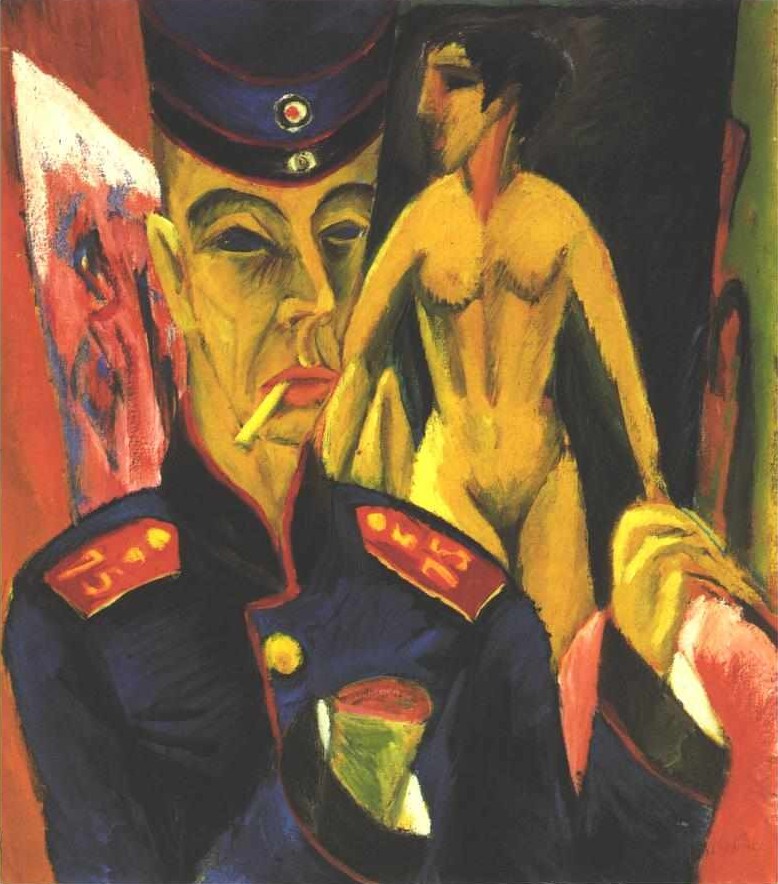
Self-Portrait as a Soldier is a vertical and compressed composition. In the foreground, the artist occupies the centre of the scene directly, wearing a dark uniform, with severe facial features and a cigarette in his mouth.
The military cap and epaulettes remove the figure from the condition of an ordinary portrait and place him within an institutional and severe field of identity. His facial expression, however, appears not powerful, but exhausted and tense.
The figure’s right arm and hand are particularly striking. The hand appears diminished, amputated, or rendered incapable of functioning. This detail removes the painting from being merely a portrait of a soldier and transforms it into an image directly addressing the bond between the artist’s creative power and bodily integrity.
A nude female model appears in the background. Although placed within the depth of the painting, she is not a passive decorative element. She functions like a reminder suspended between the military subject and the world of the artist’s studio.
A reddish surface on the left and dark areas on the right frame the figures. The space never fully opens, but closes around them oppressively. The principal power of the composition lies in the severe contrast between the uniformed man in the foreground and the nude model behind him: war and art, authority and vulnerability, uniform and nakedness collide upon the same surface.
Three-Level Analysis through Panofsky’s Method
Pre-iconographical Level
The painting shows a male figure wearing a military uniform and cap, with a cigarette in his mouth. A nude female figure appears in the background, surrounded by fields of red, black, yellow, and green.
The male figure’s hand appears diminished or amputated.
Iconographical Level
The title identifies the figure as the artist himself: this is a self-portrait. The uniform directly establishes the identities of war and military service.
The nude model in the background recalls the studio, artistic production, and the artist’s earlier relationship with the body. Within this context, the amputated or disabled hand can be read not merely as a physical injury, but as a threat directed toward the painter’s hand.
Iconological Level
The work presents war not as an external historical event, but as destruction entering the artist’s body and identity.
The subject transformed into a soldier has not merely put on a uniform. He has become alienated from his creative and erotic world and from his own body.
The painting makes visible how modern warfare psychologically mutilates the artistic subject.
Representation – Gaze – Void
Representation
Kirchner does not represent himself as a hero. Although the uniform evokes power, discipline, and state order, the figure’s face undermines these associations.
Yellowed skin, severe lines, and the diminished hand show that the body carries vulnerability rather than authority. The self-portrait is not an image of self-esteem, but a confession of a self ruptured by war.
The nude model in the background deepens this division. The artist’s earlier field of production remains present, yet now appears inaccessible.
Gaze
Gaze forms the most powerful core of the painting. Kirchner looks directly toward us, but this gaze offers no security. It carries both defiance and collapse.
The viewer cannot observe the figure comfortably because the diminished hand and the model behind him immediately enter vision alongside the face. The gaze is therefore directed not merely toward a portrait, but into a crisis.
The presence of the model in the background is equally significant. She does not look toward us, but functions more as the silent witness of the scene.
The viewer’s position is consequently divided: we are drawn toward the face of the military subject while also looking toward the artistic world he is in the process of losing.
Void
The space barely opens. The dark background and narrow interior compress the figures.
This enclosure suggests that war is not an event belonging only to the external world. It has occupied the interior, the studio, the body, and the mind.
Void does not provide relief, but creates a sensation of suffocation. The enclosed setting visualises psychological entrapment.
Style – Type – Symbol
Style
Kirchner’s style is clearly Expressionist. Colours are used not to follow natural appearance, but to intensify emotional tension.
Yellow, red, black, and green confront one another sharply. The lines of the face and body are hardened, while the figures are pushed into a disturbing pictorial plane.
Style carries the psychological wound into the aesthetic surface.
Type
Although the figure is an individual self-portrait, he also becomes the type of the modern artist mutilated by war.
The model in the background likewise functions not merely as a particular woman, but as the type of the bodily and studio-based world of art.
The painting therefore brings two typologies into collision: the military subject and the artistic subject.
Symbol
The diminished hand is the painting’s most powerful symbolic element. It carries not merely physical injury, but the threat directed toward the capacity to paint, creative identity, and masculine integrity.
The uniform symbolises institutional violence, the cigarette exhaustion and nervous tension, and the nude model the pre-war world of art and bodily existence.
The painting therefore declares that war destroys the artist not from outside, but from within.
Art Movement
Art Movement: Expressionism.
Severe line, unnatural colour, the transfer of psychological tension onto the pictorial surface, and the construction of the figure within a state of internal crisis clearly position the painting within German Expressionism.
Conclusion
Self-Portrait as a Soldier is one of Kirchner’s fundamental works in which the experience of war is painted not as a historical scene, but as psychological destruction inscribed upon his own body.
The uniform signifies not power, but alienation, while the hand is not merely an organ, but the centre of creative life. The painting’s power lies in its refusal to narrate war as an external event. It reveals that the true destruction occurs within the artist’s hand, gaze, and identity.
What ultimately remains is not merely a self-portrait, but an intense visual record of the destructive effect of modern warfare upon the artistic subject.
