




Introduction to the Artist
Ernst Ludwig Kirchner (1880–1938), one of the founders of the Die Brücke group, was a pioneering figure who painted the modern city in Germany through its “nervous system.” From his early period onward, the wood-like hardness of his line combined with the effect of woodcut and an acidic palette. The “street scene” series he developed during his Berlin years helped define the language of Expressionism through the choreography of women and men, the relationship between display window and looking, and the sensation of speed. The destruction of the First World War deepened the fractures of both body and gaze; Kirchner later withdrew to Switzerland, yet the memory of the city continued to live in his paintings. The 1920s became a period of late street scenes nourished by memory and observation: the brush became more open, but the tension remained.
Introduction to the Work and Composition Analysis
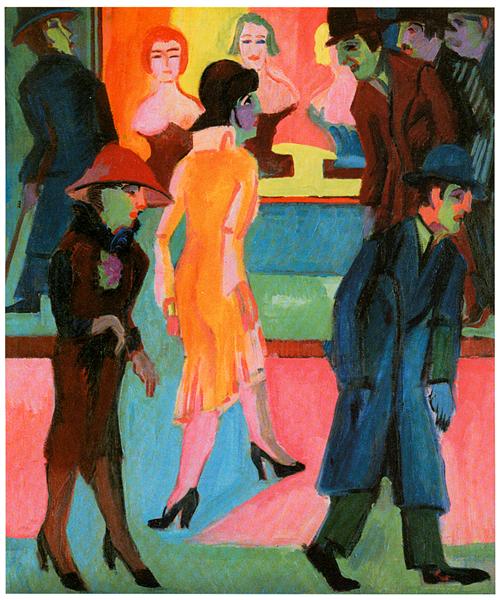
The painting is constructed almost like a stage before a shop window. In the middle ground, a woman in a yellow dress glides forward in a single step; on the right, a man in a navy overcoat and hat turns his face sideways; on the left, a woman in a dark red-brown dress looks back over her shoulder. Inside the display window behind them, busts of necks and chests are arranged in a row; pink and white surfaces set the warmth of the interior against the sharpness of the exterior. Colors operate not optically but psychologically: green and purple tones appear in the faces, red accents in the hands, and pink-turquoise bands across the ground. The contours are black and sharp; the figures appear almost as though they have been cut from wooden blocks and placed onto the surface.
The ground is tilted: the street curves upward like a band rising to waist height; the frame of the shop window and the parallels of the pavement pull the eye from left to right. The woman’s yellow dress becomes the rhythmic center of the composition, glowing like a bright chord that balances the dark masses on either side. The busts inside align almost like a “measuring chart” for the bodies outside; the steps of the figures and the immobility of the busts establish contrasting tempos. Void gains tension within the flat surfaces between the color bands; rather than perspectival depth, the painting offers a compressed stage design.
Three-Level Analysis through Panofsky’s Method
Pre-iconographical Level
Three figures walk in front of a shop window; a woman in a yellow dress stands at the center, a man in a navy coat on the right, and a woman in a hat on the left. Pink-white busts appear inside the window; the ground is organized in pink-green bands; faces are green-purple, hands red; black contour and flat fields of color dominate.
Iconographical Level
The “barbershop” sign evokes grooming, appearance, and the construction of identity. The busts in the window present not combs or scissors but idealized facial templates; the figures outside pass in front of these models. The single step of the woman in yellow sets the tempo of the city’s rhythm, while the men passing beside her conceal or avert their gazes. Green faces and red hands superimpose the sensations of nocturnal light and nervous intensity. A choreography of the city continues, recalling Kirchner’s Berlin “street women” series: proximity, commerce, looking, and escape.
Iconological Level
In the metropolis of the Weimar years, the body becomes a displayable surface together with the shop window. Kirchner does not narrate an event; he constructs the economy of being visible and being looked at through color and contour. The busts behind the glass suggest the “ready-made templates” of modern identity; as the bodies outside pass before them, they are caught at a temporary threshold: performance of identity, or alienated walking? The tilted ground and cropped framing continually undermine any sense of security. The painting thus makes the joy and unease of urban modernity vibrate on the same surface.
Representation – Gaze – Void
Representation
The figures are constructed not through anatomical volume but through patch and line; the woodcut-like effect flattens the surfaces. The flat color plates of the clothing transform the bodies into chromatic characters: yellow as attraction, navy as isolation, brown as uneasy withdrawal.
Gaze
The three figures in the street do not look at one another; the busts in the display window stand as symbols of a “fixed gaze.” There is no direct appeal to the viewer; the painting proposes a position of witnessing. This asymmetry intensifies the emotional climate of anonymous urban encounter: everyone passes beside everyone else, yet no one makes contact.
Void
The bands between ground and shop window operate as negative space; they separate the figures while simultaneously holding them within the same scene. The tilted surface transforms the space into a theatrical ramp; the void creates a slipperiness that increases the speed of passage.
Style – Type – Symbol
Style
The mark of German Expressionism is clear: black contour, an acidic palette, a surface recalling woodcut, and a sensation of speed. The brushstroke is visible but controlled; the color field carries the line continuously.
Type
Kirchner’s “street scene” type—a metropolitan flow woven through sexual codes, fashion, and consumption. The figure in the yellow dress assumes the role of the “center of passage,” while the dark masses on the right and left surround her.
Symbol
The yellow dress signifies the light of visibility; green faces, the trace of artificial light, fatigue, and nervous energy; red hands, movement and bodily warmth; the display-window busts, standardized faces of modern identity; the tilted pavement, unstable ground; black contour, the architecture of social boundaries. These are not simple one-to-one correspondences but carriers of meaning operating through the behavior of color and form.
Explicit Identification of the Art Movement
The work is one of Kirchner’s mature urban examples within Expressionism. Instead of natural light and color, it uses emotional deviation and the effects of artificial illumination; form is deliberately deformed. The security of perspective is rejected; figures appear almost cut out according to the speed of the city and pasted into the painting. This aesthetic transforms the individual’s inner tension into the design of public space.
Conclusion
Street Scene in front of a Barbershop transforms the modern city’s “economy of looking” into a visual diagram. The fixed faces of the busts inside the display window confront the hurried steps of the figures outside; the yellow dress becomes a center of attraction, while the green faces become an anxiety filter. The tilted pavement draws the space of displacement; black contours both separate and stitch the figures together. Kirchner’s achievement lies in constructing social commentary not through narrative but through a dialectic of color and line: the city is not a story but a nervous system, and the painting makes that system visible.
