



Introduction to the Artist
Erró is one of the most important artists of the second half of the twentieth century to bring reproduced images, propaganda imagery, comic-book aesthetics, and political iconography into collision upon the same pictorial surface. In his painting, the world does not appear as a single scene; images from different sources are pasted together, superimposed, and made to produce a new ideological tension. For this reason, in Erró’s works, the visual economies from which the figures originate are as important as the figures themselves. In this respect, Chinese Petroleum is not merely a political painting, but a collage logic that reveals how images become political.
Introduction to the Work and Composition
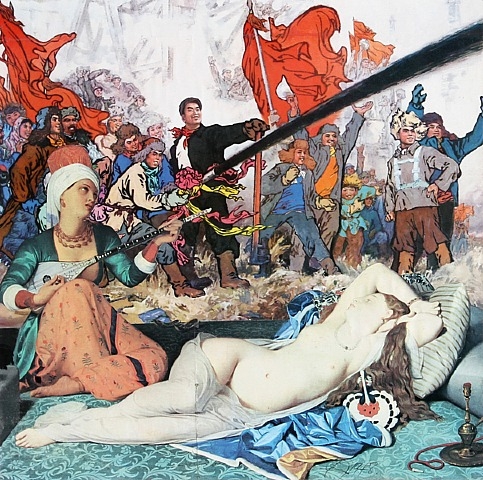
The composition brings two separate visual regimes into collision upon the same surface. In the foreground on the left is a seated, clothed woman wearing a head covering; she holds a flower, and her gaze is directed slightly upward or toward the right. In the lower right is a reclining nude woman with pale skin, surrounded by blue fabrics and pillows. These two female figures carry the space of the interior and intimacy. In contrast, the background contains a large crowd carrying red flags. At the centre, a standing male figure, together with the flag in his hand and a black diagonal line, carries the political energy of the scene. This long black line, resembling a pipe or barrel, cuts across the two fields of the painting and unites foreground and background along a single axis of violence.
The principal strength of the painting lies in the fact that these two planes do not merge. While the female figures in the foreground carry a soft, bodily, and inward-looking field, the crowd behind them produces a sense of movement, slogans, revolution, and collective energy. Petroleum becomes visible in the title, while within the painting it appears not as a direct object, but as the name of the political-economic connection between these two worlds.
Three-Level Analysis through Panofsky’s Method
Pre-iconographical Level
Two female figures appear in the foreground: on the left, a clothed and seated woman; on the right, a reclining nude woman. Behind them are numerous male figures, red flags, and a crowded gathering. A long black form cutting diagonally across the composition stands out. Blue fabric, pillows, and small decorative objects appear on the ground.
Iconographical Level
The title explicitly places the painting within the context of petroleum and China. The flag-bearing crowd in the background evokes a political mass image close to revolutionary or propaganda aesthetics. The seated and reclining female figures in the foreground recall the Orientalist interior, the odalisque, and the tradition of the body presented for viewing. The painting therefore becomes a visual encounter between an energy resource, political power, and the image of the East.
Iconological Level
The work conceives petroleum not merely as an underground resource, but as a modern geopolitical force connecting the body, the state, desire, and violence. By bringing the revolutionary crowd together with the female body transformed into an object of viewing upon the same surface, Erró demonstrates that resource politics concern not only economics, but also regimes of representation. Petroleum remains invisible, yet it is the spectral force determining every relationship within the painting.
Representation – Gaze – Void
Representation
Erró does not represent the figures within a coherent realist world; he takes them from different visual traditions and places them within the same political scene. While the two women in the foreground evoke the types of the odalisque and reclining nude from Western art history, the crowd in the background approaches the imagery of propaganda, posters, and revolution. What is represented is therefore not a single event, but two different regimes of imagery forcibly joined together.
Gaze
Gaze is fragmented in this painting. The seated woman looks toward the right; the reclining nude woman appears more passive and half-closed within herself. The crowd behind them surges forward, creating a sense of collective movement rather than individual faces. The black diagonal line also interrupts and directs the gaze. The viewer therefore cannot look at the painting calmly; the eye is drawn alternately toward the nude body, the red flags, and the black axis of violence. Gaze produces division rather than passive viewing.
Void
There is almost no void within the painting. The area between foreground and background is filled with figures and objects. Even the lighter spaces around the pale-skinned nude body are not restful; on the contrary, they make the pressure of the crowd behind more visible. Void is not a breathing space here, but a temporary fissure between colliding images.
Style – Type – Symbol
Style
Erró’s style here is clearly Pop Art, yet it operates through collage and the collision of images rather than through flat graphic simplicity. The figures appear to come from different traditions of painting, and the surface does not close itself within a single style. This deliberate heterogeneity intensifies the political force of the painting.
Type
The seated woman, reclining nude, flag-bearing crowd, and leading male figure are not individual characters here, but cultural types. The women approach types of desire and Eastern intimacy, while the group behind them approaches the type of the revolutionary mass. Read together, these types reveal not only figures, but also the distribution of ideological roles.
Symbol
The red flag symbolises political revolution and collective will. The black diagonal form becomes a line of force through its associations with violence, industry, weaponry, or pipeline. The nude body carries vulnerability, display, and desire, while the seated female figure offers a more enclosed and culturally framed form of visibility. Petroleum appears only within the title, yet operates as the principal symbolic force circulating throughout the painting and binding everything together.
Art Movement
The combination of images from different sources upon the same surface, the collision of political and popular iconography, and the transformation of reproduced imagery into pictorial construction clearly place the work within Pop Art.
Conclusion
Chinese Petroleum is a powerful work in which Erró sharply exposes the relationship between energy, politics, the body, and representation. Petroleum does not appear as an object, yet it operates like an abstract force determining all relations between the female body and the revolutionary crowd. The strength of the work lies in constructing geopolitics not through statistics or maps, but through colliding images. What remains is not merely a political collage, but a disturbing image of how the modern world binds desire, power, and resources together upon the same surface.
