




Introduction to the Artist – Frank W. Benson and American Impressionism
Frank Weston Benson (1862–1951), one of the leading figures of American Impressionism, is especially known for his figurative compositions set in nature and for creating vitality within stillness through his profound relationship with light. Trained within the Boston School tradition and influenced in Europe particularly by the French Impressionists, he adapted these influences to American everyday life, especially to simple forms of the relationship between women and nature.
Benson’s artistic approach embraces Impressionism’s emphasis on atmosphere and light while continuing to preserve figurative representation. In his paintings, light is not merely a physical effect but an instrument of emotional intensity. Bodies do not sink into light; they dissolve within it. As a result, although the figures occupy important positions in the composition, they never become sharply emphasized.
Benson emphasizes nothing — yet he conceals nothing either. His paintings do not draw the viewer into an event or a narrative; they simply leave the viewer within the scene.
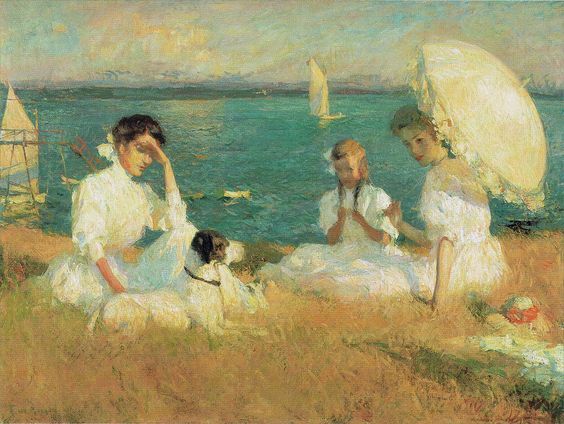
The 1906 painting Summer Afternoon is a powerful example of this aesthetic approach. The scene is simple: three women seated on the grass, a dog, a parasol, and the sea in the background. Yet everything placed within this simple scene — the seated postures, gestures, the fall of light, the absence of direct gazes, and the direction of the slight breeze — conveys a larger suspension of time, a more inward feeling.
And this feeling becomes the invisible center of the painting.
Thematic Background – Summer, White, and the Female Figure
Frank W. Benson’s Summer Afternoon appears on the surface to be a picnic scene or a pleasant summer moment spent outdoors. Yet the deeper structure of the painting is formed by an emotional suspension emerging within the everyday, an awareness of slowness freed from the speed of time, and especially a state of calm in which visibility recedes in the representation of the female figure.
A. Summer: The Season in Which the Everyday Is Suspended
In art history, summer is often associated with joy, nature, and movement. Benson’s summers, however, are not active; they are still. This stillness does not stop time from passing; rather, it allows time itself to be noticed.
Here, summer is not simply a season; it is a state in which the everyday becomes aesthetic. The sky is clear, the water calm, the breeze light, and the scene bright. Yet nothing accelerates. Summer is represented not as movement but as a state of remaining.
B. White: The Color of Light, the Silence of Representation
All of the female figures are dressed in white. Yet this whiteness is not simply a representation of purity. It is instead a whiteness that holds the effects of light, empties form from within, and prevents the figures from becoming sharply defined. Benson’s palette is soft here:
– White turns blue in shadow
– Garments are not sharply drawn but dissolve within light
– Instead of contours, there are transitions
This whiteness becomes a means both of merging with nature and of withdrawing the female figure from classical modes of representation. The women are visible, but they are not displayed. They are present within the scene, yet they are not presented for viewing.
This distances the painting from eroticism and removes the figure from the position of an object of the gaze. The figure here is not merely a body but a pause within time.
C. The Female Figure: Not Representation, but Existence
The women in Benson’s painting do not pose, offer their gaze, or serve as bearers of dramatic narrative. They are simply figures settled within the scene, remaining in the same rhythm as nature, independent of narrative.
In Summer Afternoon, three women are seated:
– One shields her eyes with her hand
– One rests her hands together in her lap
– One holds her parasol to the side
None of them looks at the viewer.
None occupies the center.
None appears to function as the bearer of a specific meaning.
Yet this condition of not presenting themselves does not remove them from representation; instead, it allows them to become figures that reconstruct representation itself. The woman here is not ornament but a state of being. And the summer afternoon becomes the clearest moment in which this state rises to the surface.
Frank W. Benson, Summer Afternoon, 1906. Three female figures seated outdoors occupy a summer scene. There is no eye contact or narrative connection between them. Through its use of light and space, the composition creates a sense of temporal suspension.
Source: Wikimedia Commons – Public Domain.
Analysis of the Work – Summer Afternoon: Light, Composition, Gestures, Color
Frank W. Benson’s Summer Afternoon initially gives the impression of a light, bright, and simple summer scene: three women seated at the edge of a hill, a dog, sailboats in the distance, a luminous sky, and light reflected without interruption across the water.
Yet beneath this surface lies not only Benson’s technical mastery of Impressionism but also his ability to conceal sensory tensions within simple forms.
A. Composition: Balance Within Breadth
The painting is structured in a broad horizontal format. The horizon line occupies the upper third of the composition. The lower section is filled by the figures and the grassy area on which they sit.
This breadth offers visual ease to the viewer. Yet the composition itself is not entirely relaxed — it maintains a delicate balance.
The three women are positioned in an almost circular relationship:
– One looks forward, toward the dog
– The central girl sits upright with her hands clasped
– The figure on the far right turns her head slightly to the side and holds a parasol
These small changes in direction prevent the composition from becoming symmetrical while establishing a concealed flow.
The eye circulates among the figures and does not leave them.
Although the landscape is open, the psychological field of the painting closes inward.
B. Light: Light That Does Not Define the Figures
Benson’s use of light is Impressionist, but contour is not decisive. Rather than illuminating details, light softens the bodies. In particular, the whites of the clothing are broken through tonal transitions; folds dissolve.
The shadows are short but not sharp.
Colors are distributed not according to the intensity of light but according to the rhythm of feeling.
The reflections on the water are blurred yet recognizable. This blurring creates both atmospheric depth and a sense of the figures’ distance from the external world.
Nature is visible, but the figures’ response to it remains thoughtful and silent.
C. Gestures and Postures: What Exists Around Inaction
There is no dramatic movement in the women’s postures. Each seems to be doing something — yet in fact they do almost nothing.
– The figure on the left shields her eyes with her hand. But this gesture is not an act of looking; it is protection from excessive light.
– The central figure rests her hands together in her lap, her eyes directed downward.
– The figure on the right looks sideways and merely holds the parasol without using it.
These postures can be read as forms of waiting, silence, and a sensitive inward withdrawal from the effects of the outside world.
The gestures do not tell a story; they circle around a feeling.
D. Color: A Broad and Pale Palette
The colors of the painting are not brilliant; they appear as though faded through sunlight.
Green grass turns toward yellow; white dresses toward blue; the sky toward silver mixed with gold.
This palette does not seek visual saturation; instead, it allows a state of being to endure.
No color shouts. Yet every color carries an inner rhythm.
Iconological Layer – Everyday Calm in Which Time Is Suspended
When Frank W. Benson’s Summer Afternoon is read through Panofsky’s iconological method, it reveals not merely a pleasant summer scene but an awareness of time within an apparently ordinary moment, an equal relationship between space and a form of femininity withdrawn from the gaze, and the silence that emerges within all of this.
There is neither a clearly defined event nor an explicable narrative in the scene. Yet this absence of narrative does not mean that the scene is empty.
On the contrary, this silence is a form of fullness.
A. Awareness of Time Within Stillness
None of the figures in the painting moves, yet none appears frozen.
All remain within the time before something happens.
The summer afternoon is therefore not merely the middle of a day; it becomes a moment in which time stretches, expands, and fills with space.
The figures do not speak, yet they seem to think.
They do not look outward, yet they remain aware.
No visible emotion dominates the scene — but an emotional field is constructed invisibly.
Benson does not paint time itself; he makes a moment held within time perceptible.
B. The Representation of Womanhood: Visible but Not Displayed
All of the female figures wear white and are situated within nature, yet they do not belong to nature.
They are not ornamented, yet they are surrounded by aesthetic order.
They do not pose, yet they form the frame of the scene.
What Benson achieves here is to remove the female figure from the position of an object of the gaze, while allowing her to exist without actively resisting that gaze.
The women are not bearers of narrative; they are subjects sustaining their own state of being within the scene.
This constitutes a significant, quiet transformation at the level of representation.
The women are both central and without any need to occupy the center.
This settled presence allows them to become not aesthetic objects but bearers of feeling.
C. A Subtle Spiritual Field Within Everyday Life
Summer Afternoon visually represents an ordinary moment:
– Sitting
– Waiting
– Resting
– Seeking shade
Yet this everyday quality is not reduced to simplicity.
The scene carries a profound awareness of time within the ordinary.
Through the women’s postures, the enclosed quality of the landscape, and the diffusion of light, this everyday field is fixed almost like an icon.
In other words, the painting does not represent an ordinary moment but the state of becoming lost within that moment.
This exists outside classical systems of narrative and representation.
It does not tell.
But it makes one think.
And thought here emerges not through words but through allowing the eye to remain on the scene for a while.
Conclusion – Representation and the Perception of Time in Benson’s Figures
Frank W. Benson’s Summer Afternoon depicts an ordinary summer scene, yet it approaches a mode of visual thinking rather than classical narrative or dramatic expression.
The painting presents a composition in which the figures do not move, gestures remain incomplete, and time does not flow in a clearly defined direction.
The women do not exist within a narrative; no clues are given about any particular character. Yet each is inward-looking, quiet, and physically at ease.
This choice places the figures less as subjects of representation than as bearers of visuality.
The figures are occupied only with themselves. There is no eye contact and no connection with the viewer. This makes the boundary between passive appearance and active presence uncertain.
The horizontal spread of the composition and the equal distribution of the figures throughout the scene create a relationship based less on narrative than on the use of space.
Light is not dominant but supportive. Shadows are soft, surfaces are not sharply defined.
This shows that Benson does not seek to narrate but to create a visual condition.
The central power of the painting lies in its ability to hold the viewer without depicting any action. The reason is not technical but the rhythm of thought.
The figures do not explain why they are present in the scene, but they show why they are nowhere else.
In this respect, Summer Afternoon is not a narrative painting but an example of representation in which visuality is held in equilibrium within itself.
Benson’s approach brings together Impressionist technique and an inward-looking understanding of the figure.
And this combination makes the figure powerful without being dramatic, and distinct without breaking the silence.
