




Introduction to the Artist
Henri de Toulouse-Lautrec (1864–1901), one of the sharpest observers of modern Parisian nightlife, recorded the bare reality of urban modernity not only through his Moulin Rouge posters but also through the nudes and toilette scenes he painted inside brothels. He combined Degas’s psychology of the interior with the cropped framing of Japanese prints and his own linear virtuosity. Color often supports line applied rapidly across paper or canvas; space becomes a stage for human behavior. The late 1890s mark the mature phase of his brothel series and the period in which some of his most incisive works on the ethics of the gaze emerged.
Introduction to the Work and Composition Analysis
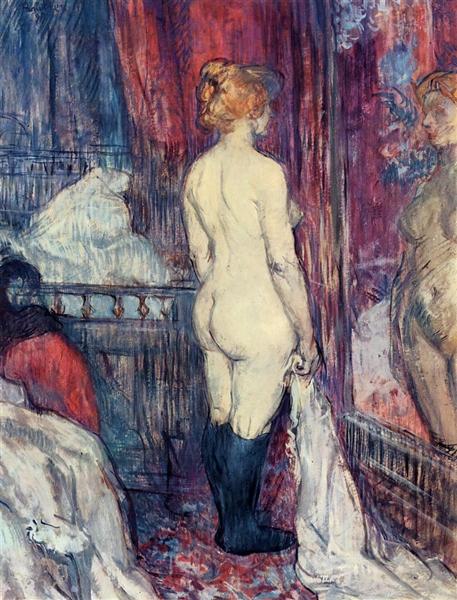
The composition is vertical. At the center stands a nude woman in black stockings with her back turned toward us; she loosely holds a sheet or towel in her right hand, while her left arm falls alongside her body. In the large mirror on the right, the figure appears from the front; face and torso emerge between red-purple curtains as though opening onto another world. In the left background, a bed, folds of white sheets, and the silhouette of a seated woman reinforce the everyday character of the scene. The brushstrokes flow like lines; vibrating layers of purple, navy blue, and red carry the heavy atmosphere of the room. The mirror frame, carpet patterns on the floor, and bed rail form rhythmic pauses that allow the eye to move across the surface. Anatomical modeling is minimal; volume is constructed through the energy of line and the encounter between warm and cool patches of color.
Three-Level Analysis through Panofsky’s Method
Pre-iconographical Level
An interior; a standing nude woman seen from behind; black stockings; a white sheet or towel in her hand; a frontal reflection in a large mirror; red-purple curtains; a bed and seated figure on the left; linear and rapid brushwork.
Iconographical Level
The subject is a typical variation on the brothel toilette scene. Through the mirror, a single figure appears twice; both back and face enter the painting simultaneously. The black stockings recall an erotic code within Lautrec’s iconography, while the towel and bed carry the functional reality of the scene. The theatrical red of the curtains frames the space like a stage.
Iconological Level
Lautrec treats nudity not as a ready-made presentation of desire but as the detached reality of a moment between periods of work. The mirror opens not only two sides of the body but also multiple layers of looking: the woman looks at herself, while we look at her and at her reflection. The painting thus makes the sexual economy of the modern city visible without turning it into spectacle; it captures a threshold at which privacy becomes public. The restlessness of the rapid brushwork and the acceptance conveyed by the figure’s upright posture express the dual condition of the brothel world—habit and fatigue.
Representation – Gaze – Void
Representation
Volume emerges through linear calligraphy rather than classical shading. The mirror creates an iconographic “double valence”; by dividing a single figure into two images, it stretches the boundaries of representation.
Gaze
Because the model faces the mirror, there is no direct eye contact with the viewer; yet in the reflection, the half-profile of the face seems almost aware of us. This softens voyeurism and transforms the scene into a “captured routine.”
Void
The room is kept compressed; the void opens primarily in the narrow vertical spaces between the curtains and in the bright plane of the mirror. The mirror functions both as a source of light and as visual breathing space.
Style – Type – Symbol
Style
Post-Impressionist linear painting; rapid layers of watery and opaque paint overlapping one another; framing and flatness derived from Japanese prints; an interior psychology influenced by Degas. Colors are used not in saturated masses but in semi-transparent vibrations.
Type
The type is the “brothel toilette”; the scene represents a moment of preparation and transition. Instead of the reclining odalisque, there is a standing body preparing to return to work.
Symbol
The black stockings carry signs of sexuality while also suggesting the body’s conditioning for work. The white sheet is the neutral fabric of transience and routine. The mirror evokes the fracture of self-regard and the erasure of the boundary between public and private. The red curtains cover and reveal the scene as the theatrical surface of desire.
Explicit Identification of the Art Movement
The work belongs within Post-Impressionism, at the intersection of Lautrec’s distinctive linear expression and his subjects drawn from modern life. The atmospheric light of the Impressionists gives way here to decorative flatness combined with sociological observation. The graphic economy of poster design can be sensed as it enters the painted canvas.
Conclusion
Nude Standing before a Mirror – Mirror, Gaze, and the Silence of the Burgundy Room constructs the multiplicity of the modern gaze within a single room: the woman, ourselves, and the mirror. Lautrec records the naked yet undistorted reality of brothel routine through rapid line and vibrating color. What appears is less a spectacle of desire than the weight of everyday life and a moment of professional preparation. As the mirror multiplies the figure, it also establishes the ethical distance of the scene; the sharp emphasis of the black stockings makes the working condition of this world explicit.
