




Introduction to the Artist
Henri Matisse (1869–1954) was one of the most formative figures of twentieth-century painting in establishing color as an autonomous means of thought. With Fauvism, color ceased to function as a local tone imitating nature and became an energy capable of constructing emotion, rhythm, and space. Throughout Matisse’s long career, the figure remained central, although its treatment changed from period to period: the exuberance of color in the early years, formal simplification in the 1910s, decorative arrangements expanding the relationship between figure and space in the 1930s, and, in the 1940s—especially after his illness—a reduction of line and color toward a simplicity capable of saying almost “the most with the least.” Painted in 1944, Girl with White Robe on Red Background carries the fundamental tendency of this late period: the body is not an event but a posture; space is not an interior décor but a stage composed of fields of color. Here Matisse makes visible one of the simplest distinctions of modern painting: the reciprocal dialogue between line and color.
Introduction to the Work and Composition
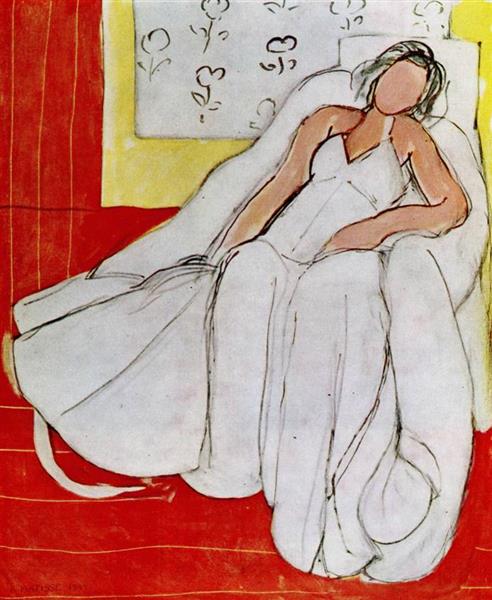
A red ground occupies most of the composition. This red field behaves like a continuous background, its texture indicated in places by thin horizontal lines. Within it appears a white armchair or broad sofa, whose contours are rapidly established through black lines, with its volume suggested almost entirely through the curvature of those lines. A young woman wrapped in a white robe or covering sits in the chair. Her body sinks into the seat, while her head tilts toward her right shoulder. The face lacks detail; the head is left as an oval patch, and the hair is gathered through a few dark lines.
The woman’s torso and arms, rendered in pale flesh tones, create a slight contrast with the white of the chair. Her right arm rests across her torso, while the left remains along the edge of the chair, reinforcing the state of repose. Her legs descend from beneath the robe like two long white masses; rather than clearly defining knees and feet, the line is allowed to flow. Behind her, in the upper central area, is a large pale gray rectangular field containing irregular black scribbles resembling flowers, suggesting a panel or surface on the wall. At the upper right, a yellow block of color intersects with the red ground, while on the left another boundary strip combines yellow and white. The entire scene is constructed through only a few basic colors and rapidly drawn lines; there is no excess, and rhythm arises from posture and surfaces rather than detail.
Three-Level Analysis through Panofsky’s Method
Pre-iconographical Level
A young woman sits in a white chair against a red background. She is wrapped in a white robe or covering, her head tilted to one side, her arms relaxed, and her body resting comfortably. Behind her is a pale gray rectangular surface marked with black signs, while a yellow field appears on the right. The lines are simple, rapid, and sketch-like.
Iconographical Level
The title identifies the figure as a “girl with a white robe”; the theme is one of everyday rest within an interior. In Matisse, however, the ordinary scene becomes a formal arrangement rather than a psychological narrative. The white robe almost merges the figure with the chair, while the red background removes the interior from the appearance of a realistic room and transforms it into a unified field of color. The gray panel and the marks upon it connect the scene to a particular “room,” yet the nature of that room remains undefined.
Iconological Level
In late Matisse, scenes of this kind become modern icons of bodily existence and serenity. The year 1944 belongs to the artist’s post-illness period, a phase in which physical movement diminished while visual concentration increased. The absence or simplification of the figure’s facial features suggests not an individual portrait but a universal state of rest. The dominance of the red background functions almost like a curtain separating the inner world from the external one; within this color, the body is simultaneously sheltered and made visible. The painting transforms a small moment of everyday life into a fundamental question of modern painting: how does a body exist within space, and how can color accompany that existence?
Representation – Gaze – Void
Representation
Matisse shifts the burden of representation from “event” to “pose.” No story is narrated; who the girl is, what she thinks, and exactly where she is remain undisclosed. What is represented is the weight of the resting body and the flow of the robe established through line. The red ground becomes less a realistic wall or carpet than a chromatic field against which the figure’s presence is measured.
Gaze
The figure’s gaze is closed or withdrawn because the face lacks detailed features. This withdrawal creates an inward state that avoids eye contact with the viewer. The spectator witnesses the girl’s moment of rest from outside but without intervention. The structure of gaze quietly reduces the distribution of power: because the figure does not look at us, we do not “capture” her through reciprocal vision; gaze becomes not a field of confrontation but a condition of distance adapted to the serenity of the scene.
Void
Void is felt most strongly in the breadth of the red field and in the simple boundaries surrounding the chair. Space is not a room filled with objects but an openness created between fields of color. The omission of detail from the figure’s face produces a second layer of void: personal identity recedes, while the universal posture of the body comes forward. Void therefore becomes not absence but a space of stillness.
Style – Type – Symbol
Style
The work carries Matisse’s late economy of line. The contours are at times trembling and at others rapidly gathered together; volume is constructed not through light and shadow but through the curvature of line. Colors are applied as flat surfaces; small interventions of yellow and gray are added to the sharp contrast between red and white. The style represents the late transformation of Fauvist chromatic boldness into a simplified pictorial structure.
Type
The girl in the white robe is a variation of the “resting woman” type frequently encountered in Matisse’s iconography. Rather than individual character, she embodies the calm bodily type of the modern interior: neither dramatic nor erotic, simply a state of being and remaining still.
Symbol
The white robe symbolizes protection and withdrawal, wrapping the everyday vulnerability of the body like a covering. The red ground symbolizes an intense interior space separated from the noise of the external world, surrounding the figure almost like an emotional climate. The gray panel and the marks behind her remain like shadows of thought or everyday memory, recalling the “traces of the world” against the figure’s silence.
Explicit Identification of the Art Movement
Girl with White Robe on Red Background can be read as a late modernist and expressive figurative painting that combines the chromatic freedom inherited from Matisse’s Fauvist roots with the simplifying line of his late period. Color is connected not to natural reality but to the construction of emotion and space, while form undergoes deliberate reduction.
Conclusion
The painting constructs a resting body through only a few lines and fields of color, expressing one of the simplest statements of modern painting. Representation leaves narrative outside and concentrates on the weight of the pose; gaze, through the figure’s inward withdrawal, establishes a quiet distance from the viewer; void opens a space of serenity through the breadth of the red surface and the indeterminacy of the face. Matisse paints here not the portrait of a particular girl but the pure rhythm of resting and existing. The encounter between white and red becomes less a conflict than a balance in which the body quietly finds its place within color.
