




Introduction to the Artist
Henri Matisse (1869–1954) was one of the leading figures of twentieth-century painting to treat color not merely as “paint” but as a force capable of constructing composition. He carried the bold and liberated palette of his Fauvist beginnings toward increasingly simplified forms and flatter, more decorative surfaces. Matisse’s aim was less to “copy the image” than to establish its inner order: figure, space, and object are reconstructed through contour, patch, and rhythm. For this reason, the reduction of detail in his painting is not impoverishment but an intensification of visual thought.
Introduction to the Work and Composition
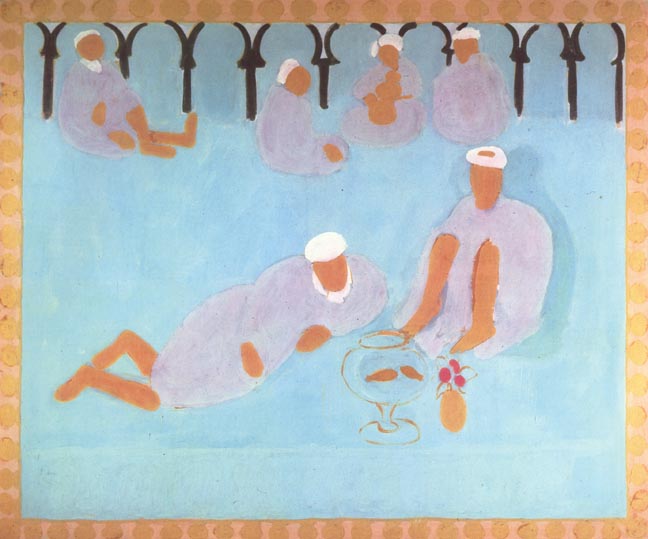
Moroccan Café consists of six figures placed across a broad pale blue ground. The figures, dressed in loose garments in lavender-violet tones, sit or recline; their faces are almost entirely erased. Along the upper band, a sequence of nearly black arch-like forms establishes the idea of space, while a warm-toned, speckled border runs around the painting like a frame. Beside the large figure in the lower section appears a transparent glass vessel resembling a bowl, together with a small red patch, perhaps a flower or ornament. The composition does not narrate an event; through postures, intervals, and fields of color, it constructs a tranquil state of collective presence.
Three-Level Analysis through Panofsky’s Method
Pre-iconographical Level
Several human figures sit or recline on a pale blue ground; dark arch-shaped forms appear above; below is a glass vessel containing fish and a small red detail; the faces contain no clearly defined expressions.
Iconographical Level
The title connects the scene to a “café.” Read together with the title, the white caps or head coverings and the collective arrangement of seated figures evoke the rhythm of an everyday gathering.
Iconological Level
Matisse proposes here less a “depiction of place” than a particular regime of seeing: the figures cease to function as individuals and become rhythm; space is no longer a room constructed through depth but an order distributed across the surface. The “café” becomes less a social scene than a form of suspended time and silent coexistence.
Representation – Gaze – Void
Representation
While depicting a social space, the painting deliberately reduces detail. Garments close into unified patches; bodies are read through masses rather than contour; the erasure of faces withdraws individual narrative. Representation therefore communicates not “who they are” but the condition of “being there”: the weight of sitting, the stillness of waiting, a proximity shared without speech.
Gaze
Because the figures’ eyes are not clearly defined, the painting establishes no direct exchange of gaze with the viewer. The viewer is positioned not as an interlocutor invited into the scene but as a witness observing its order from a distance. This choice calms the gaze and softens a possessive or curious mode of looking: what is seen is less a collection of “bodies” than a “choreography of postures.”
Void
The broad blue field is the most powerful element of the work. The intervals between the figures create not spatial depth but silent distance. The row of arches above functions like a boundary line, while the empty space around the glass vessel in the lower section establishes the center of the scene. Void here does not represent what is missing but the breath that determines the tempo of the painting.
Style – Type – Symbol
Style
The painting is constructed through flat fields of color, minimal modeling, and soft tonal contrasts. The harmony between pale blue and lavender-violet lightens the figures; the row of black arches provides rhythm; the border turns the painting into a decorative object while also enclosing the world of the scene.
Type
The “café gathering” type remains far removed from individual portraiture; the figures become an anonymous collective posture of everyday life. Sitting, reclining, and waiting bodies carry the type of the “timeless interior/exterior gathering” frequently encountered in modern painting: there is a crowd, but no dramatic interaction.
Symbol
The row of arches constructs space through signs rather than architecture, producing a sense of “place” through rhythm. The small red patch functions as an accent within the large field of color, creating a point of attention and vitality. The erasure of faces becomes a symbolic gesture of withdrawal that brings the pictorial order rather than personal identity to the foreground.
Explicit Identification of the Art Movement
The work carries the character of a period in Matisse’s art that preserves the chromatic boldness of Fauvism while moving toward a simpler, more decorative, and more surface-oriented order.
Conclusion
Moroccan Café is a painting that constructs the rhythm of space rather than narrating space itself. The anonymity of the figures prevents the gaze from becoming aggressive; void enlarges the silence of the scene; color becomes the principal architect of the composition. Matisse proposes not an image of a café but a flat, calm, and concentrated visual equivalent of being together.
