




Introduction to the Artist
Henri Matisse (1869–1954) was one of the central figures in the transformation of color from a “descriptive tool” into a primary force capable of constructing composition in modern painting. With Fauvism, he liberated color; yet this freedom was not arbitrary but grounded in deliberate simplification and the search for rhythm. In Matisse’s mature work, figure, space, and object are constructed less through the illusion of volume than through the organization of the plane—through patches of color, contour, repetition, and interval. This approach connects the viewer not to a “story” but to the tempo of seeing and the inner music of the painting.
Introduction to the Work and Composition
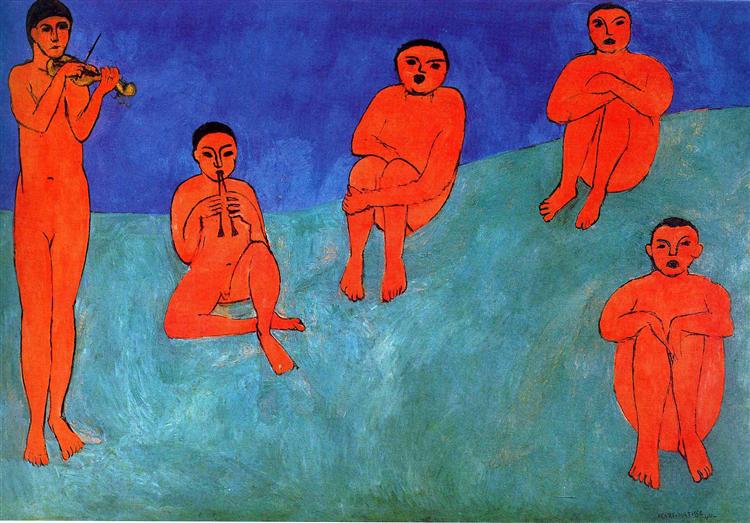
The painting contains five nude figures. The ground is divided into two large fields of color: above, a broad dark blue sky; below, a green slope that rises almost like a wave. The figures’ flesh is painted in an almost uniform warm red-orange tone. On the left, a standing figure plays the violin; beside him, a seated figure plays a wind instrument. At the center and on the right, three figures sit quietly with their legs drawn toward their bodies. Their faces are simple and mask-like; directions of gaze are clear, yet psychological detail has been removed. The composition does not deepen through perspective; everything remains close to the surface. Music here is not a “scene” but the order itself: the figures function like signs placed at rhythmic intervals across fields of color.
Three-Level Analysis through Panofsky’s Method
Pre-iconographical Level
Five nude figures appear against a blue sky and green ground; two figures play musical instruments, while three sit. The colors are flat and powerful, and detail is minimal.
Iconographical Level
The instruments and seated figures evoke the acts of making music and listening or accompanying. Rather than an everyday concert scene, the work resembles a representation of music itself: posture and continuity are emphasized more strongly than movement.
Iconological Level
The work treats music not as narrative but as a principle of order. The breadth of the color fields and the schematic treatment of the figures transform music from something heard into a visible rhythm. There is an idea of community, yet this community is formed not through dramatic interaction but through coexistence on the same plane and participation in the same tempo.
Representation – Gaze – Void
Representation
Matisse constructs the body not through anatomical realism but through a single warm patch of color. This mode of representation removes nudity from the status of “subject” and turns it into a unit of composition. The distinction between musicians and listening or seated figures is indicated minimally through gesture; rather than adding narrative, the painting leaves behind the skeleton of a fundamental condition: production—the figures who play—and duration—the figures who listen and wait.
Gaze
Because the faces are simplified, the figures’ gazes do not create a psychological encounter. The viewer is not positioned as an interlocutor invited into the scene but as a witness observing its order from outside. This distance removes looking from the logic of “possessing the body”; the gaze circulates among fields of color and intervals instead of remaining fixed upon the figures.
Void
The primary volume of the painting is constructed through void: the breadth of the blue sky and the open areas of the green slope function like breathing space carrying the figures. The intervals between them generate the sense of rhythm; void here is not absence but the pauses and continuity of music.
Style – Type – Symbol
Style
Flat fields of color, a restricted palette, and pronounced contours reveal Matisse’s decorative yet disciplined modernism. Color replaces light and shadow; the composition stands through the organization of the surface rather than perspective.
Type
The figures are not individuals but types within a “musical ensemble”: the playing body, the listening body, the waiting body. These types carry the idea of a “timeless community” frequently encountered in modern painting; rhythm, rather than identity, comes to the foreground.
Symbol
The violin and wind instrument are concrete symbols as sources of sound, yet the principal symbolic weight is concentrated in the contrast among colors. The red bodies vibrate like sound against the blue-green field; music is symbolized not primarily through objects but through relationships of color.
Explicit Identification of the Art Movement
The work belongs to a phase in which the chromatic freedom of Fauvism is brought into a mature order while also carrying an early modernist Expressionist intensity.
Conclusion
Music reconstructs an audible art within visual order: it strips bodies of narrative, draws the gaze away from psychology and toward rhythm, and transforms void into the breathing space of the painting. Music here is not a staged event but a tempo of existence constructed through color, interval, and repetition.
