




Introduction to the Artist
Henri Matisse (1869–1954) was one of the artists who most radically defended the autonomous power of color in twentieth-century modern painting. Although he is known as a founding figure of Fauvism, his works from the late 1890s still retain strong connections with the Impressionist and Post-Impressionist legacy. Cézanne’s structural approach to form, the intense colors of Van Gogh and Gauguin, and the decorative conception of surface associated with the Nabis left deep traces on Matisse. Nude in the Studio stands precisely at this transitional threshold: it has not yet reached the flattened, decorative, and calm compositions characteristic of his later work; the brushstrokes are forceful, the surface unsettled, and the colors vibrate with intensity.
Henri-Émile-Benoît Matisse
Source: WikiArt.
Introduction to the Work and Composition
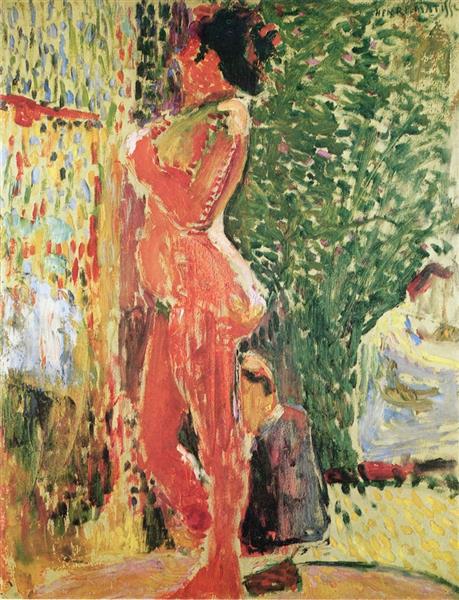
In the vertical composition, a standing nude figure occupies almost the entire left half of the canvas. The model faces the wall in profile or three-quarter profile; her torso opens slightly toward the viewer while her hips project backward. The skin is painted in warm reddish tones, interrupted here and there by yellow and orange patches. The contours of the body seem to be constructed not through precise lines but through the rhythm of brushstrokes.
Along the left edge appears a curtain or wall covering composed of multicolored vertical marks flowing downward; red, yellow, blue, and green drops descend almost like rain. On the right is a surface formed through dense green brushstrokes, perhaps a plant, curtain, or screen. In front of this green field, another seated figure—probably clothed—is faintly visible; the slightly bowed head, whitish clothing, and surrounding yellow marks suggest a second presence within the studio. The floor vibrates in yellow, green, and brown tones; there is no clear perspective, and space dissolves into the density of color.
Panofsky’s Three-Level Analysis
In the vertical painting, a nude female figure painted in red-pink tones stands on the left, facing the wall. Around her is a vibrating background composed of short yellow, blue, green, and red brushstrokes; along the left edge are vertical marks resembling drops of color, while on the right a dense green field contains a faint seated figure in white. The floor is painted in yellow and green tones, and the entire surface is covered with thick, animated paint.
Source: WikiArt.
At the pre-iconographic level, we see a studio or interior containing a standing nude female figure, an indistinct seated second figure in the background, and color fields resembling walls or curtains.
At the iconographic level, the nude model evokes the traditional studio pose of academic painting. The upright position of the body differs from the classical type of the reclining odalisque and instead emphasizes the standing nude as a working model; this creates a less exhibitionistic and more explicitly studio-based impression. The seated figure in the background may be the painter or another model; this ambiguity codes the scene as a “moment in the studio.” The drops of color and vibrating brushstrokes also recall the Impressionist technique of fragmenting light.
At the iconological level, Nude in the Studio can be read as an experimental field in which Matisse is both attempting to break with the academic tradition of the nude and discovering the structural role of color. Although the body is still modeled according to a relatively classical understanding of volume, it appears almost on the verge of dissolution; the brushstrokes blend the figure into the background. This carries the modern pictorial tendency toward painting not merely “what is seen” but the experience of seeing itself. At the same time, the nude is no longer a sculptural emblem of ideal beauty; it appears as a trembling, reddish, and somewhat fragile body within the working tension of the studio.
Representation – Gaze – Void
Representation: Nude in the Studio foregrounds a vulnerable body caught within a working moment rather than an idealized mythological nudity. The model is coded neither as a goddess nor as an exotic odalisque; she is in the studio, turned toward the wall, carrying the possible fatigue of prolonged posing. The reddish skin tone conveys both warmth and a certain sense of “burning,” as though light and color were passing across the body and dissolving it in places. At the level of representation, the nude carries within the body the tension between the modern painter’s working material and the subject’s own existence.
Gaze: Although the model’s face is not clearly visible, her direction is toward the wall; no direct eye contact is established with the viewer. This disrupts the classical voyeuristic tradition. As spectators, we appear less as an intrusive eye invited into the scene than as witnesses to the painter’s gaze circulating within the studio. The indistinct seated figure on the right creates another possible point of looking within the scene; whether this figure watches the model or is absorbed elsewhere remains uncertain. The gaze multiplies and loses its single center; within the framework of the Visual Dialectic, gaze becomes not a unilateral structure of power but a mobile circulation within the studio.
Void: The interior is almost entirely filled with color and brushstrokes; there is no empty, neutral space in the classical sense. Yet immediately around the figure, especially near the head and back, the colors seem to thin enough to create a small interval of breathing space. This visual void corresponds to the silence and concentration of the studio. There is also a narrative void: the identity of the model, the relationships within the studio, the duration of the pose, and its emotional condition are not explicitly given. The viewer must occupy this gap through their own experience.
Style – Type – Symbol
Style: The work stands between Impressionism and the path toward Fauvism. The colors are bright and direct, while the brushstrokes are thick and rapid. Drawing and contour disappear in places between patches of color; the body seems almost to be made from the same material as the background. Vertical drips, dotted marks, and vibrating surfaces give the painting an almost musical rhythm.
Type: The woman here differs from the “calm odalisque” type Matisse would later develop. She is not an ornament of the bourgeois interior but a young model working and posing within the studio. The indistinct face, emphasis on bodily form, and the figure’s orientation toward the wall move her away from individual portraiture and toward the type of the “studio model.” This type marks the transformation of the female body in modern painting from mythological elevation into an element of everyday artistic labor.
Symbol: The red nude may be read not only as warm flesh but as a flame symbolizing the intense energy and transformation taking place within the studio. The vertical drops of color along the left edge suggest both a curtain and paint overflowing from the canvas; it is as though the model were about to merge with the pictorial surface itself. The green field may evoke nature or the outside world, yet within the studio it becomes an “artificial nature” constructed through paint. The entire décor thus becomes a symbolic extension of the act of painting.
Explicit Identification of the Art Movement
Although Nude in the Studio stands close to Impressionism in chronological terms, its use of color is more inward and corporeal than the optical observation characteristic of classical Impressionism. The thick paint on the surface, fragmented brushstrokes, and dissolution of light into patches are clear signs of Post-Impressionist influence. At the same time, as a precursor to Fauvism, the work begins to liberate color from local tone and transform it into a structural force.
Conclusion
Nude in the Studio is an early but concentrated indication of the role Matisse would later play in the history of painting. At the level of representation, it replaces idealized nudity with the tired, fragile, yet energetic body of the studio. Gaze becomes less a source of voyeuristic pleasure than a plural circulation that witnesses the process of painting; void, however densely the surface is filled with color and marks, remains present in the unanswered questions surrounding the model’s identity and the relationships within the studio.
Style, type, and symbol transform the painting from a simple nude into a work in which modern painting begins to confront its own material.
