




Brief Introduction to the Artist
Henri Matisse (1869–1954), one of the most influential figures of modern art, is known for the distinctive relationships he established between color and form. Beginning his artistic career as a founding figure of the Fauvist movement, Matisse gradually developed a language that emphasized direct and simplified forms, the pictorial surface, and decorative rhythm. The female figure, interior space, windows, and nature became indispensable themes within his pictorial universe.
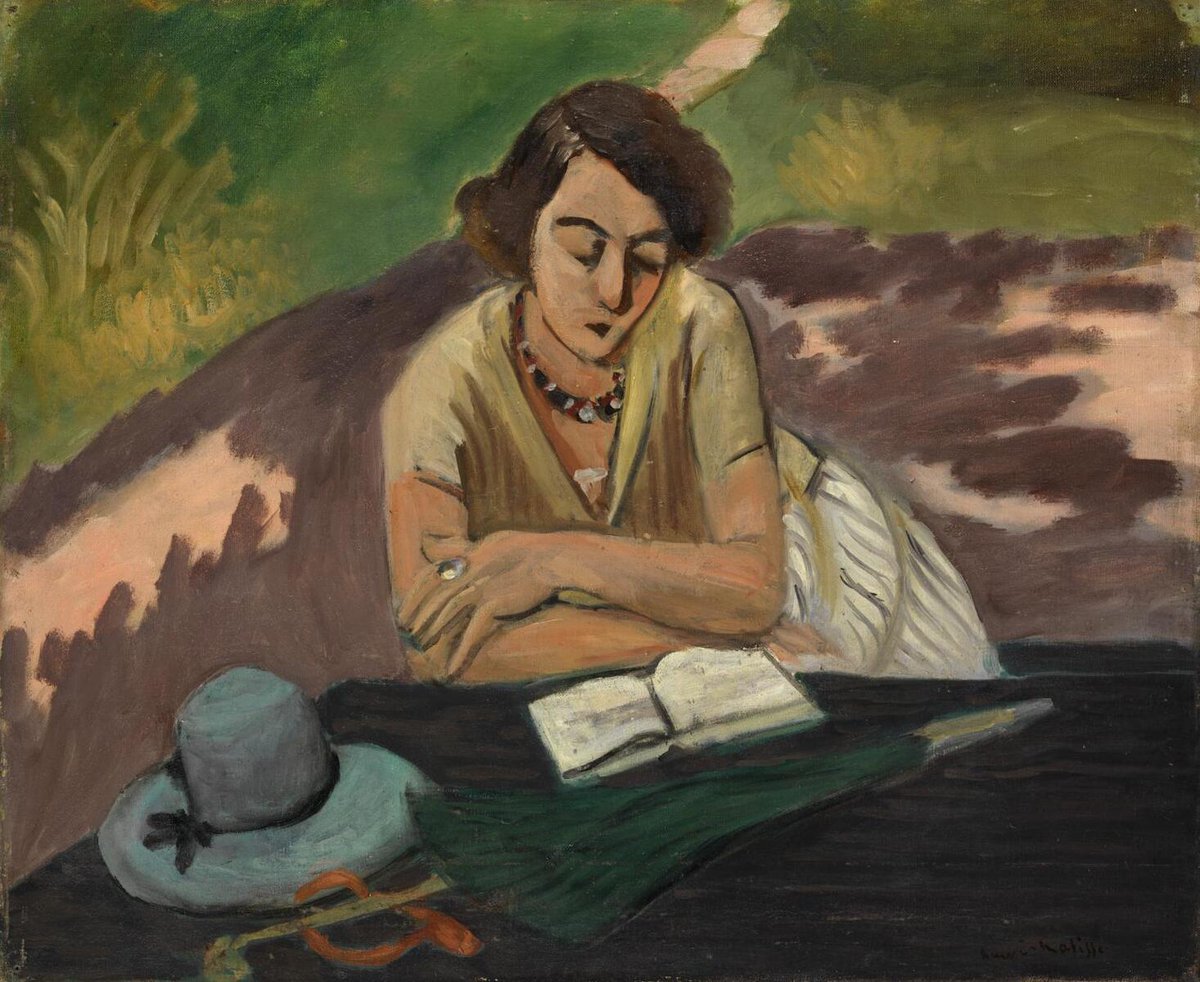
Painted in 1921, Reading Woman with Parasol belongs to a period in which Matisse turned toward the representation of figures in outdoor settings and simplified the poetic relationships he constructed through color and void.
Introduction to the Work and Composition Analysis
At the center of the painting, a woman reads a book in the shade. In front of her is a table holding an open book, a blue hat, a green parasol, and a pair of glasses with orange-colored arms. Her head is slightly lowered, and her eyes are focused on the text. The light falling across her shoulder softens the tones of her flesh and clothing. The greenery in the background and the violet-brown ground divide the composition into two areas.
The woman’s body language is calm; she appears not merely engaged in an activity but also as an expression of inner tranquility. The hat and parasol function as two objects associated with activity and the external world despite her bodily stillness. In contrast to the inward and self-contained nature of reading, these objects signify a state of preparedness for the outside environment.
The colors are neither brilliant nor muted; pastel transitions create an emotional softness. The figure is alone, yet this solitude appears not melancholic but rather the result of intellectual concentration.
Three-Level Analysis through Panofsky’s Method
Pre-iconographical Level
A woman sits at a table. In front of her are an open book, a hat, glasses, and a closed parasol. She lowers her head and concentrates on the book. Nature and a pale ground appear in the background.
Iconographical Level
The woman is represented not merely as a reader but as a thinking being. The hat and parasol represent the external world, while the book represents the inner world. The lowered position of her head signifies not only the act of reading but also inwardness and contemplation.
The scene presents the woman not merely as an object of beauty or desire but as a figure capable of thinking independently, spending time alone, and concentrating. This approach to the representation of the modern woman reveals the more egalitarian relationship Matisse establishes with the figure.
Iconological Level
In this work, Matisse opens a visual space for the intellectual solitude of the modern woman. Reading becomes more than an intellectual activity; it becomes a space of mental freedom. The figure’s solitude is not sociological but carries a liberating bodily quality. The woman is not alone here; she is in the company of herself.
The scene can also be read as a moment of pause against the speed of modern life: the hat has been removed, the parasol is closed, and we are not under direct sunlight—we are in the shade. This shade becomes a visual symbol of tranquility.
Explicit Identification of the Art Movement
The work is one of Matisse’s later works that retains Fauvist influences. Through the clarity of its color fields, the simplicity of contour, and the decorative restraint of its figurative language, it belongs to Matisse’s distinctive modernist vocabulary.
Representation, the Female Figure, and Silence
Reading Woman with Parasol presents the woman neither as a figure being looked at nor as one arranged for display. The woman neither looks outward nor submits herself to being looked at; she thinks. Silence spreads across the entire surface not merely as a visual condition but as a sensory state.
Space is not constructed around the woman; rather, the woman’s mental presence gives direction to the space. The objects on the table deepen this silence through detail. Reading becomes not simply an action but a mode of existence.
Conclusion: Consciousness in the Shade
Henri Matisse’s Reading Woman with Parasol visualizes the modern woman’s quiet right to think. There is neither dramatic narrative nor demonstrative gesture. There is only a moment of inner concentration constructed through color, form, and tranquility.
Rather than drawing a boundary between figure and nature, Matisse brings them together within the same softness. The woman absorbed in reading becomes one of modernity’s simplest and most inward-looking visual metaphors.
