




Introduction to the Artist
Henri Matisse (1869–1954) was one of the principal founders of Fauvism, the movement that carried out the color revolution of the twentieth century. The paintings he exhibited in 1905 at the Salon d’Automne in Paris, together with the group labeled the fauves—the “wild beasts”—overturned academic tonal values and established color as an independent, autonomous force. Beginning with Cézanne’s method of constructing form through color and the Impressionists’ fragmentation of light, Matisse simplified line and developed a spatial language in which the placement of color patches directly affects emotion. The threshold of 1905–06 reveals not only Matisse’s chromatic boldness but also his modern pastoral vision: painting should produce harmony and happiness.
Introduction to the Work and Composition Analysis
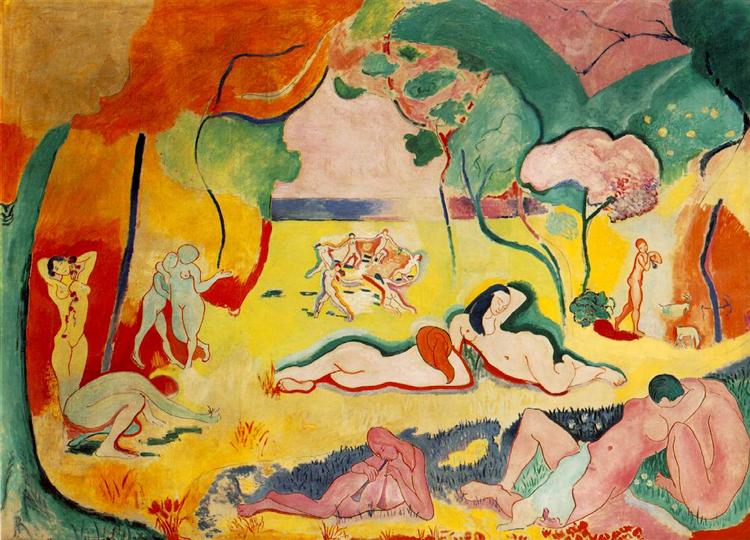
The Joy of Life (Le Bonheur de Vivre) presents an Arcadian scene spread beneath a broad grove of trees. On the left, a tree with an orange-red trunk frames the composition, balanced on the right by another tree rendered in pink-violet tones. A brilliant yellow meadow occupies the center, while at the horizon the sea and sky separate into violet-green bands. The figures are enclosed by linear contours, and their flesh is organized through the same non-naturalistic palette as the surrounding landscape.
In the foreground, a pink-toned couple curves around one another; on the left, a seated figure plays the flute; at the center, two reclining figures rest; and on the right, a small figure carrying wine appears almost like a Dionysian detail. In the far distance, directly at the center, figures join hands in a circular dance, anticipating the theme of Dance, which Matisse would develop into an independent masterpiece a few years later.
Space does not deepen through classical perspective; fields of color construct the ground. The flatness of the yellow meadow is balanced by the arabesque curves of the tree trunks and the rhythm of the figures’ contours. Matisse creates an arrangement stripped of unnecessary detail and centered on the joy of the figures: emotional topography replaces naturalistic landscape.
Three-Level Analysis through Panofsky’s Method
Pre-iconographical Level
Nude figures occupy a wooded clearing: some recline, one plays music, a couple embraces, a small figure on the right carries something, and dancers hold hands in the distance. Bright fields of orange, yellow, pink, and green dominate the scene.
Iconographical Level
The scene is a modern pastoral or Arcadia. Nudity evokes the classical ideal; dance and music suggest Dionysian exhilaration; the open landscape represents liberated nature. The circular dance signifies unity, rhythm, and the cycle of life, while the reclining figures embody relaxation and tranquility. The trees function not merely as sources of shade but as an arabesque frame surrounding the scene.
Iconological Level
Matisse proposes a utopian design for happiness against the tensions of modern life. Happiness arises not from realistic narrative but from the harmony of color and line. The bodies do not conflict with nature; they adapt themselves to the chromatic plane. At the beginning of the twentieth century, on the threshold of prewar unease, the pastoral ideal becomes an artistic ethic: painting should offer the soul the comfort of an armchair, carrying balance and joy rather than violence and drama.
Representation
The figures are not psychological portraits but representations of states of existence: reclining bodies embody tranquility; the musician represents inner rhythm; the embracing couple carries erotic intimacy; and the circle of dancers expresses collective exhilaration. The body lies between the classical ideal and a childlike simplicity, producing rhythm rather than individual subjecthood. Tree trunks, curving arms, and contours flow as though participating in the same dance; harmony rather than individuality comes to the foreground.
Gaze
None of the figures establishes eye contact with the viewer; each remains absorbed in its own state. This absence of gaze does not exclude the viewer but instead invites them into the rhythm of the scene. The circular dance in the distance draws the visual center into an internal movement, while the arabesques of the trees carry the eye back toward the foreground. Gaze therefore does not pursue narrative; it yields to the flow of color and line.
Void
The broad open area of the yellow meadow is divided by clusters of figures and the arabesques of the trees. The deliberate compression of perspective transforms void into a musical plane: colors are allowed to breathe, and the figures do not crowd one another. In the distance, the bands of sea and sky become a silent curtain behind this openness.
Type – Style – Symbol
Type
A modern pastoral or Arcadian scene; a figurative landscape.
Style
A Fauvist palette of pure and saturated color, thick contours, and broad placed patches rather than detailed modeling. Cézanne’s tradition of the Bathers, Gauguin’s bold use of the flat plane, and the decorative rhythm of Islamic and Eastern carpet patterns are brought together in a new synthesis by Matisse.
Symbol
The circular dance symbolizes the cycle of life, collective exhilaration, and rhythm; reclining figures signify relaxation and peace; the musician carries inner harmony; and the embracing couple represents eros. The curving trees surround the scene like a protective canopy of nature. The yellow field can be read as sunlight poured inward, the orange-red trunks as vital warmth, and the violet-green bands as the coolness of distance.
Explicit Identification of the Art Movement
The work belongs to Fauvism. Through the autonomy of pure color, the decisive role of contour, and the flattening of perspective, it crystallizes the principles and boldness of Fauvism while simultaneously becoming a monumental expression of Matisse’s ethics of happiness.
Conclusion
The Joy of Life is a manifesto of the ethical-aesthetic proposition Matisse brought to modernism: painting exists not to dramatize life but to construct it. Colors do not copy reality; they create a new reality, while line does not imprison the figure but transforms it into music. The pastoral ceases to be merely a historical theme and becomes the free and peaceful desire of the modern individual. For this reason, the painting remains not only an emblem of its own period but also a symbol of the continuing search for hope and balance.
